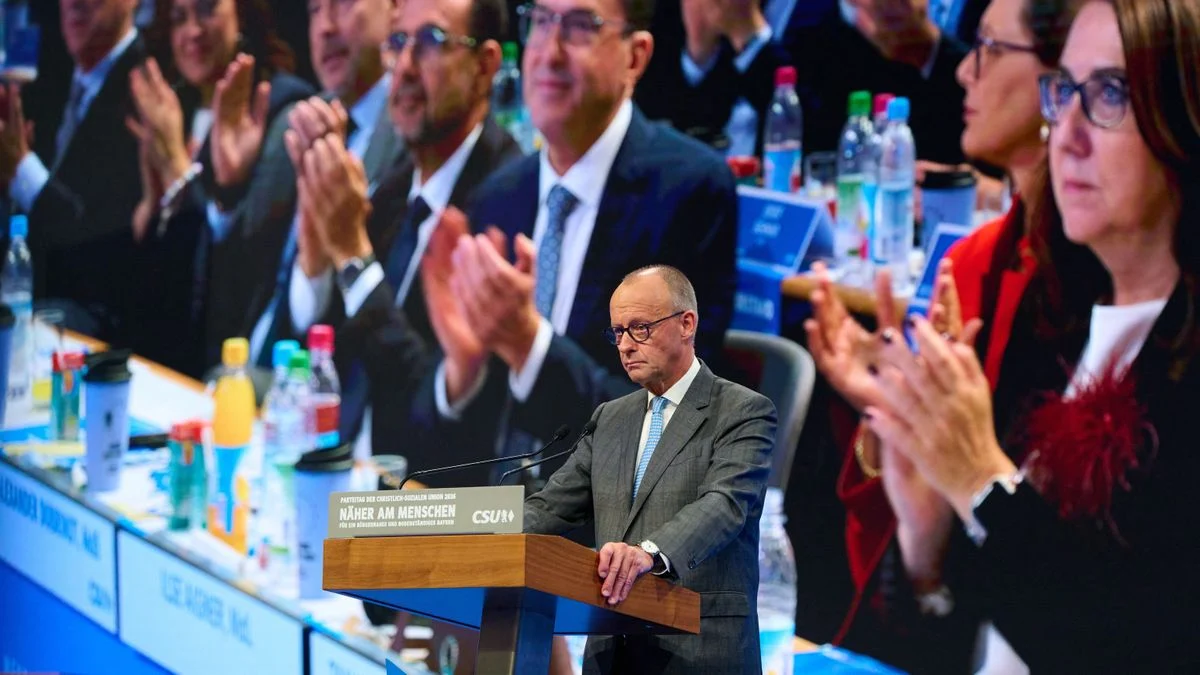
Munich, Germany – October 24, 2026 – Amidst the fervent atmosphere of the Christian Social Union (CSU) party congress, a palpable undercurrent of anticipation and strategic maneuvering defined the air. While the official agenda focused on pressing national issues, all eyes were on an unspoken question: who would be the next Federal President? Specifically, would Bavarian State Parliament President Ilse Aigner emerge as the Union’s favored candidate? The spotlight intensified on Chancellor Friedrich Merz, whose every gesture and silence was meticulously scrutinized for clues regarding this pivotal decision. His hour-long address, delivered against a backdrop of musical exhortations for resilience, conspicuously omitted any direct mention of the presidential race, yet a singular moment of profound symbolism spoke volumes, igniting a fresh wave of speculation and internal party friction.
Main Facts: A Silent Chancellor, A Resounding Signal
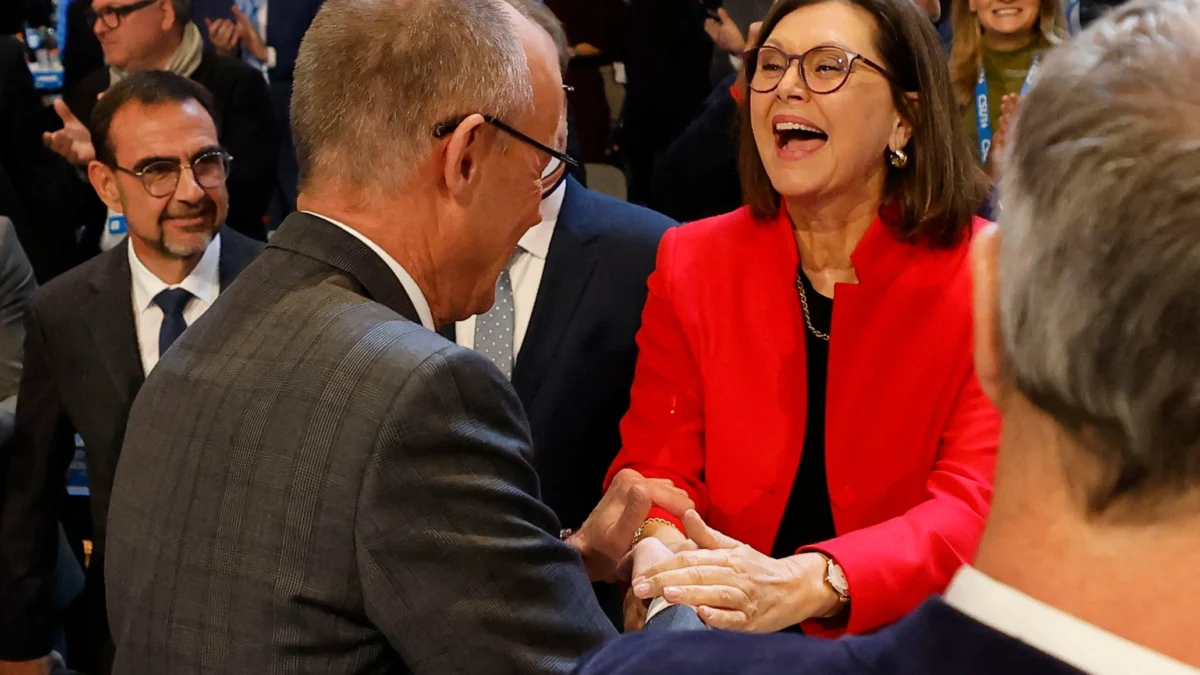
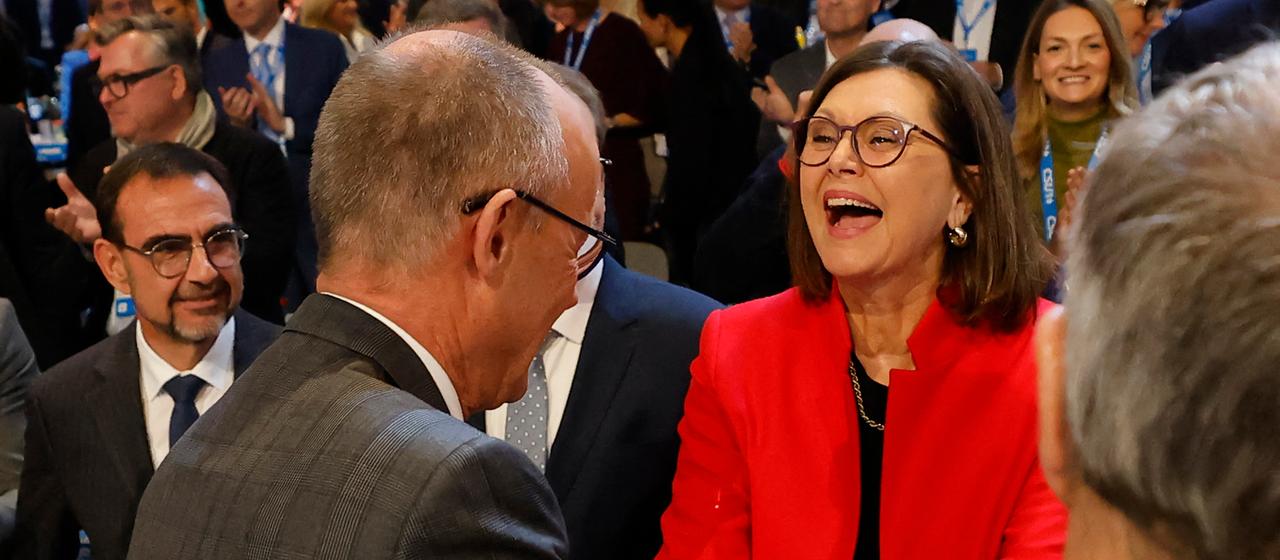
The core of the political drama unfolded around the potential candidacy of Ilse Aigner, a seasoned CSU politician. While the CSU leadership, spearheaded by Markus Söder, is overtly championing Aigner for the nation’s highest ceremonial office, Chancellor Friedrich Merz maintained a diplomatic silence on the "P-Frage" (Presidential Question) during his keynote speech at the CSU’s gathering. This silence, however, was punctuated by a highly symbolic pre-speech interaction. Merz, upon arriving on stage, embraced Aigner warmly and then, notably, singled her out for a direct greeting immediately after acknowledging CSU Chairman Markus Söder. This gesture triggered a spontaneous standing ovation from the delegates, an unequivocal demonstration of their fervent support for Aigner. The moment, interpreted by many as an implicit endorsement from the Chancellor, nonetheless highlighted the deep-seated divisions within the Union regarding the selection of a candidate for the Federal Presidency.
Chronology: The Unfolding Drama at the Parteitag
The CSU Party Congress, a crucial forum for the sister party of the Christian Democratic Union (CDU), commenced with a mix of political camaraderie and strategic undercurrents. As Chancellor Merz, leader of the CDU, prepared to address the delegates, the atmosphere was charged with expectation.
His arrival was met with polite applause, a standard reception for a visiting party leader, particularly a Chancellor. The musical choice for his entrance, "Eye of the Tiger" by Survivor, was far from coincidental. It served as a clear, if subtle, message from the CSU: an anthem for perseverance and fighting spirit, urging the Chancellor not to lose sight of key objectives and to "finally pull through" on reforms. It was a musical call to action, reminding Merz of the need for faster policy implementation and for the Union to assert itself more decisively within the governing coalition.
Merz’s speech, extending for a full hour, meticulously covered a broad spectrum of national issues. He touched upon foreign policy challenges, the state of the German economy, the burgeoning startup scene, and the critical fight against political extremism. Towards the conclusion of his address, he even offered a near-promise to reduce the electricity tax for all citizens, "if at all possible." His rhetoric was comprehensive, touching on the priorities of his government and the challenges facing Germany.
Yet, despite the exhaustive scope of his address, one significant topic remained entirely unbroached: the potential candidacy of Bavarian State Parliament President Ilse Aigner for the Federal Presidency. Not a single word was uttered regarding the ongoing speculation, the burgeoning calls from within the CSU, or any other potential candidates. The Chancellor, it seemed, deliberately chose to silence the "P-Frage."
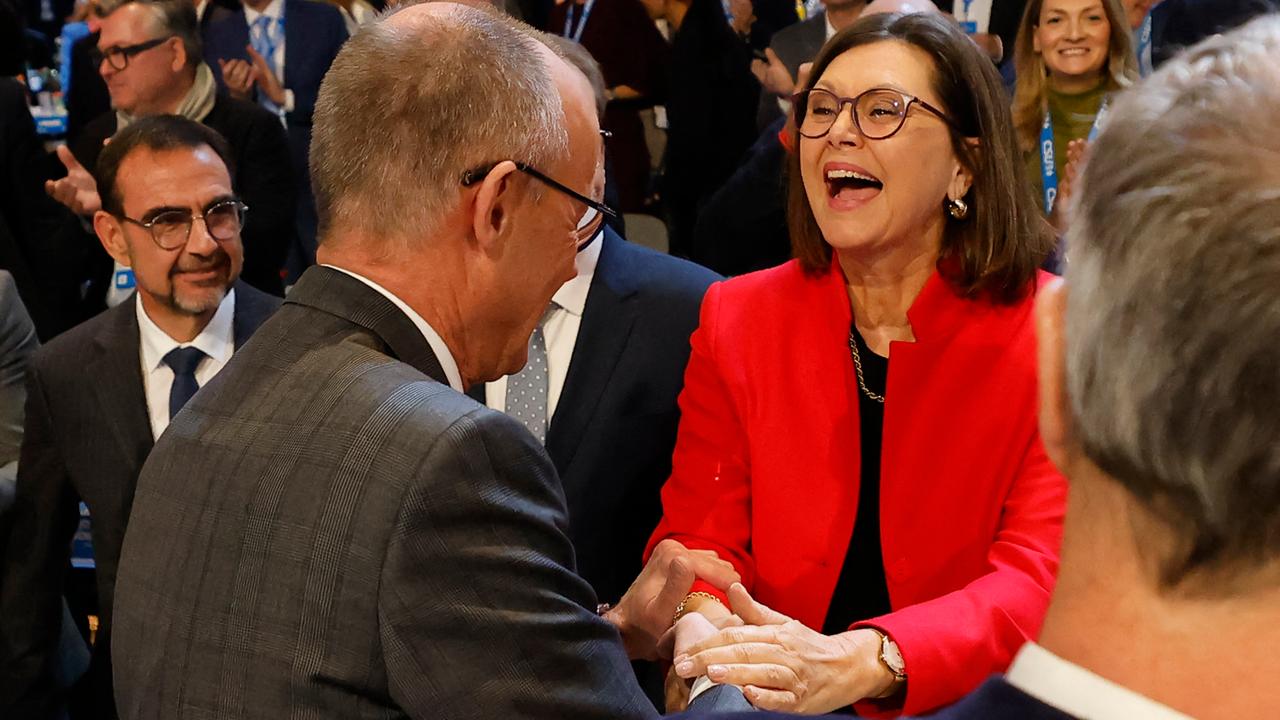
The most telling moment, however, transpired just before Merz ascended the podium. Merz and Aigner share a known rapport, extending to personal connections, with the Merz family’s holiday home situated in Aigner’s electoral district by Lake Tegernsee. As Merz stepped onto the stage, he paused to embrace Aigner. Then, taking his place at the speaker’s lectern, his first official greeting was directed at CSU Chairman Markus Söder, followed immediately by an equally prominent acknowledgment of Aigner. The hall erupted. A wave of fervent applause swept through the delegates, many rising to their feet in a spontaneous standing ovation. Aigner herself rose, waving to the cheering crowd, her expression betraying a sense of profound recognition. It was a signal, clear and unambiguous, that resonated deeply with the CSU delegates – a moment that felt less like a simple greeting and more like an honoring.
Despite this powerful visual affirmation, Merz’s speech itself remained devoid of any further mention of Aigner or the presidential question. He did not utter her name in the context of the presidency, nor did he name any other potential candidates. The Chancellor’s silence on this specific issue was absolute, a calculated omission in a speech otherwise rich with policy detail and political pronouncements. This stark contrast between the symbolic gesture and the subsequent verbal omission underscored the delicate tightrope Merz was walking.
Supporting Data: Internal Pressures and Strategic Plays
Behind the scenes, the political calculations were intense. Sources close to the Chancellor revealed the immense pressure Merz was reportedly under. "Merz is not in a position, after the lost elections and the still-stalled reforms, to step before his CDU and say: I’m gifting the Federal President’s post to the CSU," one CSU insider reportedly commented, highlighting Merz’s vulnerable standing. The CDU, as the larger sister party, feels it has the "right of access" (Zugriffsrecht) to the highest office. This sentiment is particularly strong among CDU women, who are reportedly making their influence felt, arguing emphatically that the next Federal President should be a woman from their own ranks. The internal whispers even suggested a preference for a CDU man over a CSU woman, underscoring the fierce protection of party prerogatives.
Markus Söder, however, remained resolute in his advocacy for Aigner. In an interview for the "Bericht vom Parteitag" (Report from the Party Congress), Söder forcefully articulated the CSU’s perspective: "Never in 75 years has the CSU provided either the Federal Chancellor or the Federal President. One can certainly argue that it’s a bit our turn now." This historical argument forms a cornerstone of the CSU’s current push, aiming to break a long-standing pattern of CDU dominance in these top federal roles.
Söder’s conviction in Aigner’s suitability is not merely political; it appears to be deeply personal. He emphasized her qualifications, stating, "It’s not about horse-trading for posts. We have an offer, a personality who is completely undisputed in her democratic, personal, and character-based suitability for the office." He further challenged any counter-arguments by noting, "I haven’t heard any other names yet." This aggressive stance positions Aigner as a uniquely qualified and consensus-building figure, while simultaneously highlighting the perceived lack of viable alternatives from the CDU.
The current Federal President, Frank-Walter Steinmeier (SPD), is serving his second term, which concludes in early 2027. The election of his successor by the Federal Convention, a body comprising members of the Bundestag and an equal number of delegates elected by the state parliaments, typically occurs a few months before the incumbent’s term expires. This upcoming election is proving to be a critical test of unity and power within Germany’s conservative bloc.
Official Responses: Söder’s Assertions vs. Merz’s Calculated Omission
The official responses to the "Presidential Question" were starkly contrasting. Chancellor Merz’s response was, in essence, a non-response. His deliberate silence during his extensive speech, following a moment of highly charged symbolism, can be interpreted as a strategic attempt to appease both factions without committing. He acknowledged Aigner personally, recognizing her standing, but refrained from any political endorsement, thereby avoiding an immediate backlash from within his own CDU. This calculated omission allows him to defer the difficult decision and the internal political fallout that would inevitably follow a premature declaration. It reflects a leader grappling with the complexities of maintaining party unity while facing external and internal pressures.
Markus Söder, on the other hand, was vociferous and unambiguous. His "official response" was a full-throated endorsement of Ilse Aigner. His arguments were multi-faceted:
- Historical Inequity: The CSU has never held either the Chancellorship or the Presidency, making it "their turn." This appeals to a sense of fairness and proportional representation within the Union.
- Aigner’s Undeniable Qualifications: Söder stressed her impeccable democratic credentials, personal integrity, and character, portraying her as a universally acceptable candidate. This is a direct challenge to any potential CDU objections based on suitability.
- Lack of Alternatives: By stating he hadn’t "heard any other names," Söder implicitly dismissed any nascent CDU candidacies, putting the onus on them to present a viable, equally strong alternative.
These explicit statements from Söder, delivered publicly and forcefully, serve to galvanize CSU support for Aigner and to apply direct pressure on Chancellor Merz and the CDU to accept their proposal. Söder is not merely suggesting; he is actively campaigning for Aigner, making it a test of his own influence within the Union.
Implications: A Power Struggle and a "Zerreißprobe" for the Union
The CSU party congress, despite the rhetorical emphasis on the unity between the sister parties, exposed a deeper reality: when it comes to the highest offices of the state, self-interest often trumps proclaimed solidarity. The current situation is clearly "mehr Schein als Sein" (more appearance than reality) for the Union, revealing a fundamental power struggle beneath the veneer of cooperation.
For Chancellor Merz, the growing discontent over his silence and the CDU’s failure to propose alternative candidates represents a significant "machtpolitische Zerreißprobe" (power-political acid test). His leadership is being challenged, not just by external political opponents but by the intricate and often fractious dynamics within his own conservative alliance. Navigating this presidential question without alienating a significant part of either the CDU or the CSU will require immense political dexterity. A misstep could further weaken his standing, particularly after recent electoral setbacks and ongoing struggles to push through reforms.
Markus Söder, however, finds himself in a strategically advantageous position. His advocacy for Aigner is a win-win scenario within the Union:
- If Aigner becomes President: Söder solidifies the CSU’s influence at the federal level, securing a prestigious national office for Bavaria. Crucially, it would also strategically remove a potential rival from the Bavarian political landscape, as Aigner, a popular and experienced politician, might otherwise be a future challenger for leadership positions within Bavaria.
- If Aigner does not become President: This outcome could paradoxically clear a path for Söder himself to potentially follow Merz as a future Chancellor candidate. The argument is that two CSU figures at the absolute apex of German politics – a CSU Chancellor and a CSU President – would be deemed "definitively too much Bavarian influence" from the perspective of the larger CDU. If Aigner is out of the presidential race, it implicitly strengthens Söder’s long-term aspirations for the Chancellery, as it would avoid the "Bavarian overload" argument that might hinder his own federal ambitions.
Söder, ever the pragmatist, understands that the Union parties cannot unilaterally decide the next Federal President. The election requires a majority in the Federal Convention, which means cooperation with coalition partners, primarily the SPD, is essential. He stressed the importance of a timely, joint decision: "The best would be, of course, still now in November." This urgency underscores the high stakes and the need for internal Union consensus before engaging in broader coalition negotiations.
The outcome of this "Presidential Question" will have far-reaching implications. It will test the resilience of the CDU-CSU alliance, potentially reshaping the internal power balance and influencing future electoral strategies. For Merz, it is a critical leadership challenge that could either consolidate his authority or expose his vulnerabilities. For Söder, it is a masterclass in strategic politics, positioning himself for gains regardless of the immediate outcome. And for Ilse Aigner, a respected figure at the heart of this intricate political game, her future role on the national stage hangs in the balance, awaiting the resolution of a deeply internal, yet nationally significant, power struggle. The "P-Frage" is not merely about a person; it is about power, influence, and the future direction of Germany’s conservative political landscape.