The promise of artificial intelligence has long been shrouded in the language of science fiction: autonomous machines, sentient decision-making, and the total replacement of human cognitive labor. Yet, for the German Mittelstand—the backbone of Europe’s largest economy—the reality of the "AI revolution" is proving to be far more pragmatic. Rather than chasing the futuristic dream of general-purpose digital coworkers, companies are discovering that the true value of "Agentic AI" lies in the unglamorous, repetitive, and essential business processes that keep an organization running.
The recent Telekom AI Agent Study 2026 provides a grounded look at how companies with 50 to 2,500 employees are actually implementing these technologies. By analyzing 13 specific use cases among 123 AI-savvy decision-makers, the study reveals a shift in perspective: the most successful AI implementations are not those that attempt to solve complex, open-ended problems, but those that master the mundane.
The Pragmatic Pivot: Main Facts and Strategic Scope
The core finding of the research is that the "sweet spot" for Agentic AI is not found in end-to-end automation of highly complex, unpredictable workflows, nor in simple, single-step tasks that can be handled by traditional software macros. Instead, the greatest return on investment (ROI) is found in processes that bridge two to four systems and involve two to four distinct work steps.
Agentic AI shines where human intervention is currently required to act as a "glue" between disconnected systems. Whether it is moving data from an email client to a CRM, cross-referencing a price list in an ERP, or validating an invoice against a delivery note, these tasks are the bread and butter of the modern office. By automating these "connective tissue" processes, companies can eliminate the manual friction that leads to errors, delays, and employee burnout.
Chronology of Adoption: From Experimentation to Integration
The trajectory of AI adoption in the German mid-market has followed a distinct path. In the initial phase, companies focused on "Generative AI" as a tool for content creation—writing emails, generating marketing copy, or summarizing meetings.

However, as of late 2025 and moving into 2026, the focus has shifted toward "Agentic" architectures. Unlike a chatbot that merely responds to prompts, an agent is designed to execute. The evolution can be mapped as follows:
- The Phase of Discovery (2023–2024): Companies experimented with Large Language Models (LLMs) to answer simple questions.
- The Phase of Tooling (2024–2025): Organizations began integrating AI into standalone tools, such as automated ticket summarization in IT support.
- The Phase of Orchestration (2026–Present): The current era, where companies are connecting multiple systems (CRM, ERP, Finance) via AI agents that can "reason" through a process, check data integrity, and trigger actions across different software environments.
This progression marks a transition from "AI as a feature" to "AI as an operational layer."
Supporting Data: The ROI of Efficiency
The study highlights eight priority use cases that define the current state of industrial AI adoption:
- Order and Invoice Processing
- Quotation Generation
- Email Service Automation
- Procurement and Purchasing
- Lead Research
- Voice-based Customer Service
- IT Support and Ticket Handling
- System Analysis and Monitoring
The economic argument for these use cases is rooted in three pillars: Efficiency, Performance, and Growth.
For instance, in the "Order-to-Cash" cycle—a classic example of a high-volume, low-creativity process—an AI agent can ingest a customer inquiry, structure the data, pull pricing from the ERP, draft a professional quote, and prepare it for human approval. By automating these steps, the "lead-to-quote" time is drastically reduced.

Data from the study suggests that the most successful companies are not those that spend the most on "smarter" models, but those that spend the most time auditing their own internal processes before automating them. A process that is fundamentally broken will only result in "automated chaos" if an AI agent is applied to it.
Official Perspectives: The Role of Infrastructure and Governance
While the agents themselves are the tools, the infrastructure supporting them is the foundation of success. The Telekom AI Agent Study 2026 emphasizes that Agentic AI is as much a governance challenge as it is a technical one.
According to experts at Telekom MMS, organizations must establish clear "guardrails" before deploying autonomous agents. This includes defining:
- Access Control: What data is the agent permitted to see?
- Execution Limits: What actions can the agent perform without a human in the loop?
- Transparency: How are the agent’s actions logged to ensure auditability and compliance?
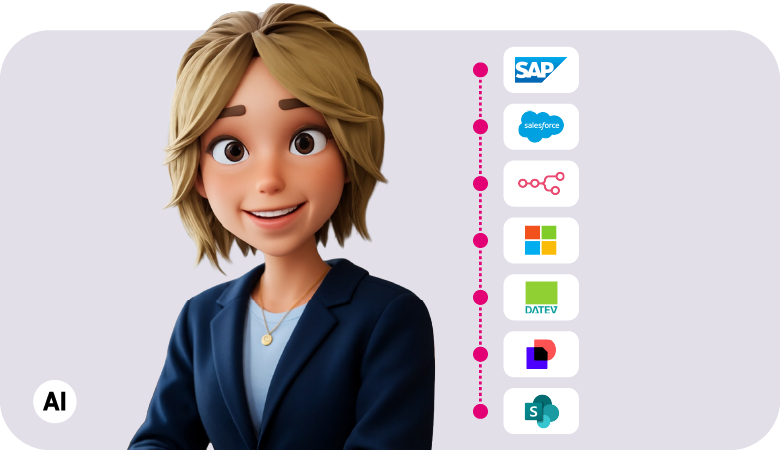
The T-AI Agent Platform is one such response to these requirements. By utilizing a low-code backbone like n8n, the platform allows companies to connect various data sources while maintaining strict control over permissions and costs. This ensures that the "Agentic" approach does not become a "black box" where decisions are made without oversight.
Implications for the Future of Work
The implications of this shift are profound for both management and employees. For management, the move toward Agentic AI necessitates a culture of transparency. If an agent is handling a procurement process, the criteria for "approval" must be codified, tested, and constantly monitored. This forces a level of process documentation that many mid-sized companies have historically lacked.
For employees, the shift is arguably positive. By offloading the "boring" tasks—the copy-pasting, the status checking, and the data reconciliation—knowledge workers are freed to focus on high-value activities: complex negotiation, creative problem solving, and building human relationships.
As noted by the cec Ingenieurgesellschaft case study, which successfully automated the processing of photo documentation in civil engineering projects, the goal is not to remove the human, but to remove the drudgery. The AI handles the "heavy lifting" of system integration, while the human focuses on the technical nuances that require professional judgment.
Conclusion: The "Boring" Advantage
As we look further into 2026 and beyond, the narrative surrounding AI is cooling down from the heat of speculative hype and warming up to the practical reality of process optimization.
The most significant competitive advantage for a company will not be the possession of the most advanced, human-like AI. Rather, it will be the ability to identify the "boring" bottlenecks in their own organization and apply targeted, well-governed, and reliable agents to resolve them.
The Telekom AI Agent Study 2026 serves as a clarion call for pragmatism. It suggests that the future of business isn’t about sci-fi-level intelligence, but about the relentless, methodical improvement of the workflows that already exist. For the Mittelstand, this is not just a technological upgrade; it is an operational imperative. In the world of business, the most revolutionary change is often found in the most mundane, reliable, and efficient execution of the daily grind.

By focusing on the "sweet spot" of system-bridging and process-chaining, companies can move past the hype and build a sustainable, AI-driven future—one invoice, one order, and one ticket at a time.