For decades, the history of computing has been defined by a fundamental, accepted limitation: heat. From the massive vacuum-tube mainframes of the mid-20th century to the sleek, high-performance smartphones in our pockets today, engineers have viewed the thermal byproduct of processing power as an unavoidable tax. We pay for computation with energy, and we pay for energy with heat.
However, Hannah Earley, the 31-year-old Co-founder and Chief Technology Officer (CTO) of the startup Vaire Computing, challenges this paradigm. She does not see heat as an inevitable byproduct; she sees it as a design flaw. Her company is betting on "Reversible Computing," an architectural shift that aims to recycle the energy typically lost during calculation. If successful, this approach could fundamentally reshape the efficiency of everything from massive hyperscale data centers to the handheld devices we use every day.
The Problem: Computing as a Destructive Process
To understand the magnitude of Earley’s vision, one must first understand how a standard silicon chip functions. When conventional processors perform calculations, they do so through a series of logical operations that essentially "delete" information.
Think of it like driving a car through a busy city. At every intersection, the driver slams on the brakes to stop, then accelerates again to reach the next light. Each time you hit the brakes, kinetic energy is dissipated as heat in the brake pads. In a computer, every time a bit of information is erased or overwritten to make room for new data, a small amount of energy is discarded into the environment as heat.
"The vehicle loses momentum," Earley explains. "It requires significantly more fuel to keep accelerating and decelerating compared to a vehicle that maintains a constant, efficient speed." This cycle of "compute, erase, heat, repeat" is the primary reason why modern data centers consume vast amounts of electricity, not just for the chips themselves, but for the massive cooling infrastructure required to prevent them from melting.
Reversible Computing: Breaking the Cycle
Reversible Computing aims to replace this stop-and-go model with a fluid, continuous flow. Instead of deleting the intermediate steps of a calculation, a reversible circuit preserves that information. By maintaining the state of the computation, the system can, in theory, run the process backward, effectively "recovering" the energy that would have otherwise been lost.
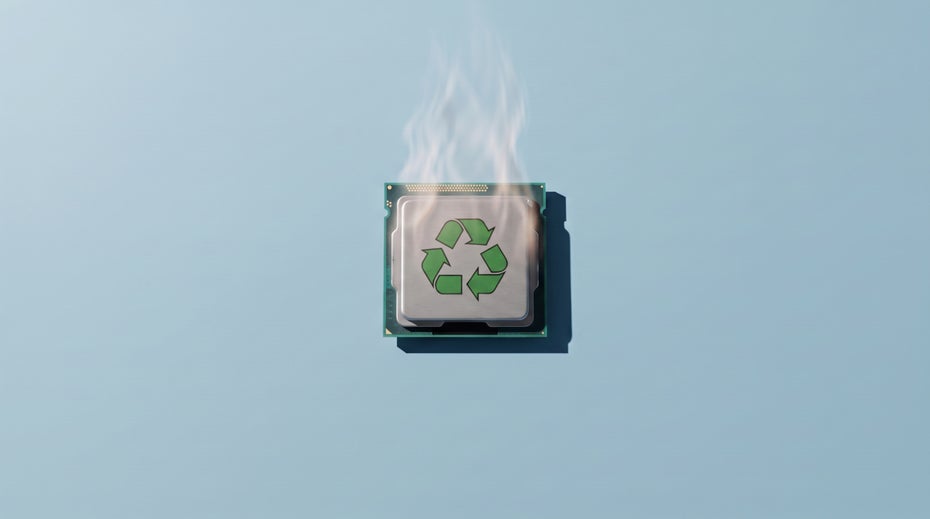
While the theoretical framework for reversible logic has existed for over 50 years, moving it from the whiteboard to the wafer has proved notoriously difficult. Previous attempts struggled to integrate these concepts with the realities of traditional CMOS (Complementary Metal-Oxide-Semiconductor) manufacturing.
This is where Vaire Computing has shifted the narrative. Rather than trying to force legacy architectures to be more efficient, Earley and her team have reimagined the fundamental hardware components. The centerpiece of their innovation is a patent-pending resonator—a microscopic component that stores recovered energy for later use.
"It’s essentially a souped-up pendulum," Earley laughs. It captures the energy fluctuations of the computation and swings them back into the circuit, allowing the system to reuse power that would have otherwise escaped as thermal waste.
A Chronology of Innovation: From Cambridge to Silicon
The journey toward this breakthrough began long before the company was founded. Earley’s fascination with the physics of computing started in childhood. By the age of nine, she was already navigating the complexities of web development, later mastering Perl and Java. Her curiosity pushed her down the abstraction stack until she reached the physical transistor level.
During her doctoral studies at the University of Cambridge, under the guidance of computational biology expert Gos Micklem, Earley’s path shifted from DNA computing to the physics of energy-efficient hardware. When Micklem provided her with the seminal 1999 doctoral thesis by Michael Frank—a pioneer in reversible computing—Earley was initially skeptical. After weeks of reflection, however, the realization struck her: the relationship between information, energy, and entropy was the key to the next century of computing.
Her doctoral work involved creating software capable of transforming standard programs into reversible formats. "I didn’t even put my name on some of her early papers," Micklem recalls. "It wasn’t because the work wasn’t good—it was because it was entirely her work. She had moved into a space where she was teaching me, not the other way around."

In 2021, after completing her studies, Earley met Rodolfo Rosini, a seasoned technology entrepreneur. The synergy was immediate. Together, they founded Vaire Computing and secured over $12 million in funding, bringing Michael Frank on board as their lead scientist to turn theoretical models into a commercial product.
The defining moment came in the winter of 2022. While working in a cold basement in Iowa, Earley spent days filling whiteboards with the schematics for a new type of logic gate. When the design finally clicked, it wasn’t a sudden explosion of triumph, but a quiet, profound relief. She realized that the physics was sound and that the path to a functional chip was no longer a theoretical pipe dream.
Supporting Data and Industry Skepticism
In 2025, Vaire Computing announced a major milestone: a test chip featuring a resonator that successfully recovered more energy than it consumed—even when accounting for the energy required to drive the component itself. For a field that had been stuck in the realm of academic papers for decades, this was a "heartbeat"—a tangible sign of life.
However, the road ahead remains steep. Igor Markov, a renowned researcher in Electronic Design Automation and a former professor at the University of Michigan, notes that while the results are promising, the transition to industry adoption is a different beast.
"Vaire clearly has something interesting in their hands," Markov notes. "But the industry is incredibly conservative. To move from a laboratory proof-of-concept to a production-grade processor, they will need a series of increasingly realistic and convincing demonstrators. They have to prove that this doesn’t just work in a vacuum, but in a world of complex, multi-layered, high-speed integrated circuits."
Implications: The Future of Computing
If Vaire succeeds, the implications for the global economy and the environment are staggering.
- The Data Center Crisis: Global energy consumption by data centers is a primary driver of carbon emissions. If a significant portion of that energy can be recycled through reversible logic, the cooling requirements—and the associated power grid strain—could be reduced by double-digit percentages.
- Mobile Longevity: For smartphones and laptops, the bottleneck for performance is often thermal throttling. If chips generate less heat, they can maintain higher clock speeds for longer periods, potentially revolutionizing what we expect from mobile devices.
- The End of Heat-Limited Performance: We have reached a point where we cannot simply add more transistors to a chip (Moore’s Law) because we cannot cool them efficiently. Reversible computing could bypass this "power wall," allowing for a new generation of high-density, high-performance computing that was previously physically impossible.
Conclusion: A New Blueprint
Hannah Earley’s vision is not merely to build a better chip; it is to challenge the foundational assumptions of the computing age. She represents a new breed of engineer who looks at the limitations of the past not as immutable laws of nature, but as engineering problems waiting for a creative solution.
"I want to look at every aspect of how we build computers," Earley says. "I want to take the entire process, strip it down, and rebuild it from the ground up with energy as the primary constraint."
While Vaire Computing still faces the monumental challenge of scaling their technology for mass production, the progress they have made in just a few short years has put the industry on notice. The era of "burning" information to create power may be coming to an end. In its place, we may soon see a new era of circular computing, where energy is not a fuel to be consumed, but a resource to be managed and recovered.
The "souped-up pendulum" in Earley’s laboratory might just be the device that swings the pendulum of computing history back toward a sustainable future.