On the floor of the Munich Trade Fair Center, specifically within the expansive confines of Hall C6, the atmosphere during this year’s Christian Social Union (CSU) party congress felt distinctly different. For over an hour, the party faithful sat in rapt attention, waiting for a signal—a moment of departure from the typical bombast associated with their leader, Markus Söder. When that moment finally arrived, it was delivered with a slight stumble, but the impact was seismic.
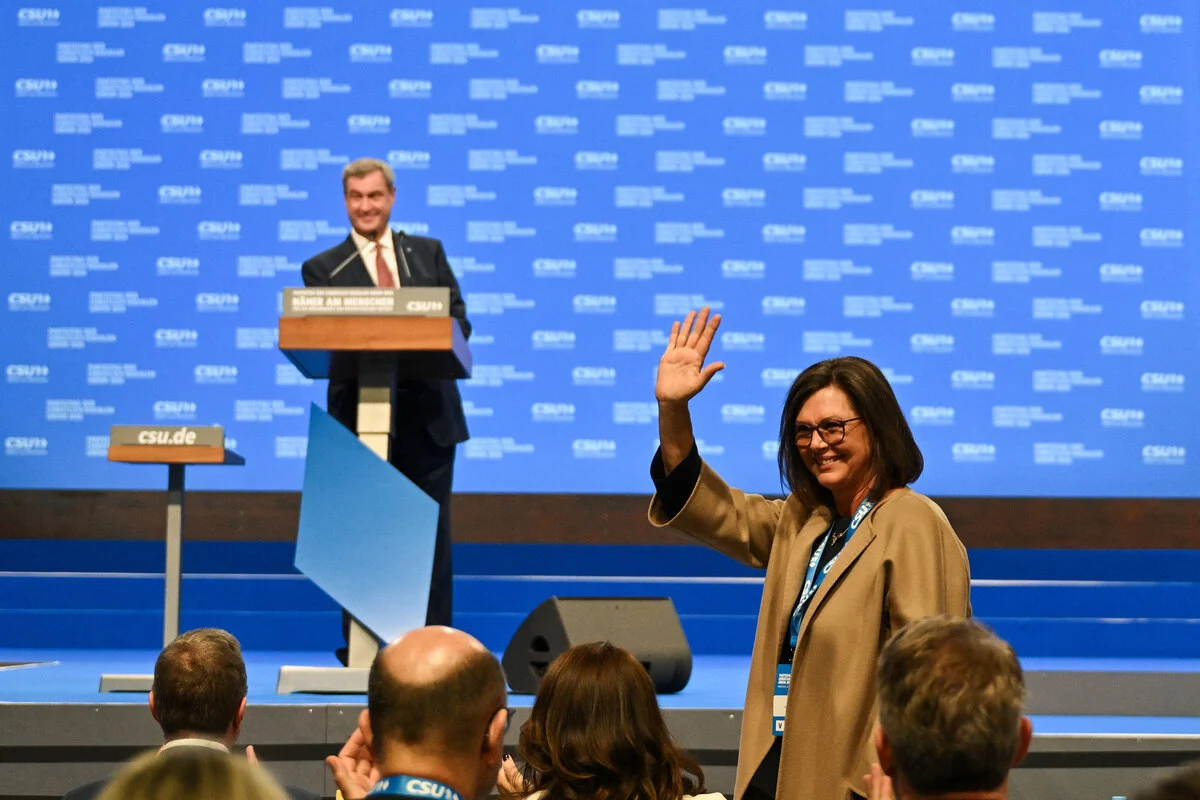
"The final decision will be made elsewhere," Söder told the delegates on a Friday afternoon, referring to the upcoming search for a candidate for the German Presidency. "But I would wish it from the bottom of my heart if Ilse Aigner were to become Federal President."
As the words left his lips, the tension in the room broke. The delegates, who had been offering polite, rhythmic applause throughout Söder’s otherwise combative speech, erupted. Ilse Aigner, the President of the Bavarian State Parliament, rose from her seat, acknowledging the crowd with a wave. Söder, sensing the shift in the room’s energy, leaned into the moment, telling his party members to "do it again tomorrow."

This endorsement marked the emotional crescendo of a performance that was as calculated as it was atypical for the Bavarian Minister-President.
The Evolution of a Political Style
To understand the significance of this speech, one must consider the historical context of Söder’s public persona. For years, the CSU leader has been the master of the "Bierzelt" (beer tent) aesthetic: sharp, aggressive, often polarizing, and always designed to place himself at the center of the frame.
This year, however, the script was rewritten. The digital screens behind the stage, which in previous years showcased slick, pop-star-style montages of Söder in action, were devoid of his image. Instead, they projected stark, sobering headlines of global instability—unrest in France and Italy, the shifting tectonic plates of geopolitics in Russia, China, and the U.S., and the fragmented state of coalition politics in Berlin. The final message on the screen was telling: "In times of such unrest, it is good to have a place of safety and stability—and that is Bavaria."

Söder did not speak of himself. He spoke of "we." He avoided the cheap jibes at political opponents that have become his trademark, instead positioning himself as a self-reflective team player. "No one is infallible, and I am certainly not," he admitted, acknowledging the criticism he faced following the party’s lackluster performance in recent municipal elections. The shift toward a more serious, almost humble demeanor suggests an acute awareness that the current political climate in Germany demands a steady hand rather than a sharp tongue.
Chronology of a Conservative Pivot
The congress unfolded as a display of defensive positioning. Following the opening remarks, the policy focus turned immediately to the perceived existential threats facing the political center.
- Morning Session (Setting the Stage): The tone was established not by a campaign film, but by the aforementioned global review, framing Bavaria as a bastion of order in a chaotic world.
- Mid-Day Address (The Critique of Berlin): Söder turned his focus to the German capital. He characterized the current federal government as being in the midst of a "storm." He warned of a "red front" and a "blue wave," framing the CSU as the only bulwark against radicalization on both ends of the political spectrum.
- The "Brandmauer" (Firewall) Debate: Söder launched a scathing critique of the Left Party and the AfD. He famously asked, "Where is the firewall against the left?" while simultaneously maintaining that the AfD, which he described as a party of "Kremlin stooges," could not be treated as a normal democratic partner.
- The Closing Act: The speech reached its climax with the endorsement of Ilse Aigner, signaling a desire for a more unifying, state-statesman-like figure to represent the conservative movement on a national level.
Supporting Data and Financial Wrangling
The economic undercurrent of the speech remained firmly rooted in the CSU’s long-standing grievances regarding the Länderfinanzausgleich (the state financial equalization scheme). Söder reiterated his stance that the system "hurts like hell," noting that Bavaria contributes four billion euros annually to the federal pot, with a significant portion ending up in Berlin.

Söder proposed a new strategy: a "radicalism clause" in the financial equalization system. The objective, he argued, is to ensure that federal states governed by extremist parties are not subsidized by the donor states. While the legal viability of such a clause is highly contentious, the political signal is clear: the CSU is looking for new mechanisms to punish political opponents while protecting the Bavarian treasury.
The economic data cited by Söder paints a picture of a state that sees itself as the "heart muscle of Germany." With the lowest unemployment rates and some of the most stable finances in the country, Söder argued that Bavaria is not just a region, but a "Space-Nation." He invoked the spirit of Franz Josef Strauss, even noting his own childhood affinity for Star Wars to bridge the gap between traditional conservatism and the high-tech future he envisions for the state.
Official Responses and Internal Dynamics
The reception among the delegates was overwhelmingly positive, though it remains to be seen how this "new Söder" will play on the national stage. By positioning himself as a team player, he has successfully mitigated some of the internal friction that followed the party’s recent polling dips.

However, the shadow of the upcoming federal elections looms large. The prospect of a "Black-Green" coalition, which is currently being discussed in various polls, remains a source of anxiety for the conservative base. By focusing on the "Number One" status of the Union (CDU/CSU), Söder is attempting to consolidate the conservative vote, warning that if the Union abandons its claim to leadership, it effectively signals its own end.
Regarding the AfD, Söder’s strategy remains a delicate balancing act. He explicitly warned against a legal ban on the party, arguing that such a move would only grant the AfD a "martyr status" that would ultimately benefit them at the polls. Instead, he argued for a democratic battle of ideas—a "tough" approach that acknowledges the threat without creating a political victim narrative.
Implications for the Future of the Union
The implications of this party congress are twofold. First, Söder is clearly attempting to pivot away from the hyper-personalized, populist style of his early tenure toward a more grounded, institutionalist approach. Whether this is a permanent evolution or a temporary tactical shift remains a point of debate among political analysts.

Second, the public support for Ilse Aigner is not merely a polite gesture. It reflects a strategic move to offer a candidate for national office who carries less of the "confrontational baggage" that Söder himself has accumulated over the years. By elevating Aigner, Söder is testing the waters for a more moderate, broadly palatable conservative figure who can appeal to the center while keeping the right-wing flank of the party at bay.
As the congress concluded on Saturday with the anticipated visit of CDU leader Friedrich Merz, the focus shifted toward the necessity of a unified front. The central challenge for the CSU remains the same: how to maintain its identity as a Bavarian party with distinct regional interests while leading a national conservative movement that is currently struggling to define its own "firewalls" in a volatile, post-election landscape.
Markus Söder’s speech was more than just a list of policy demands; it was a performance of transition. He is attempting to reinvent himself as the "statesman of stability" in a nation that feels increasingly precarious. Whether the electorate buys into this shift, or whether the "old Söder" inevitably re-emerges under the pressure of the next campaign cycle, will be one of the defining narratives of German politics in the coming year. For now, in the quiet aftermath of the Munich congress, the CSU has found its temporary peace—and a new potential face for the nation’s highest office.