


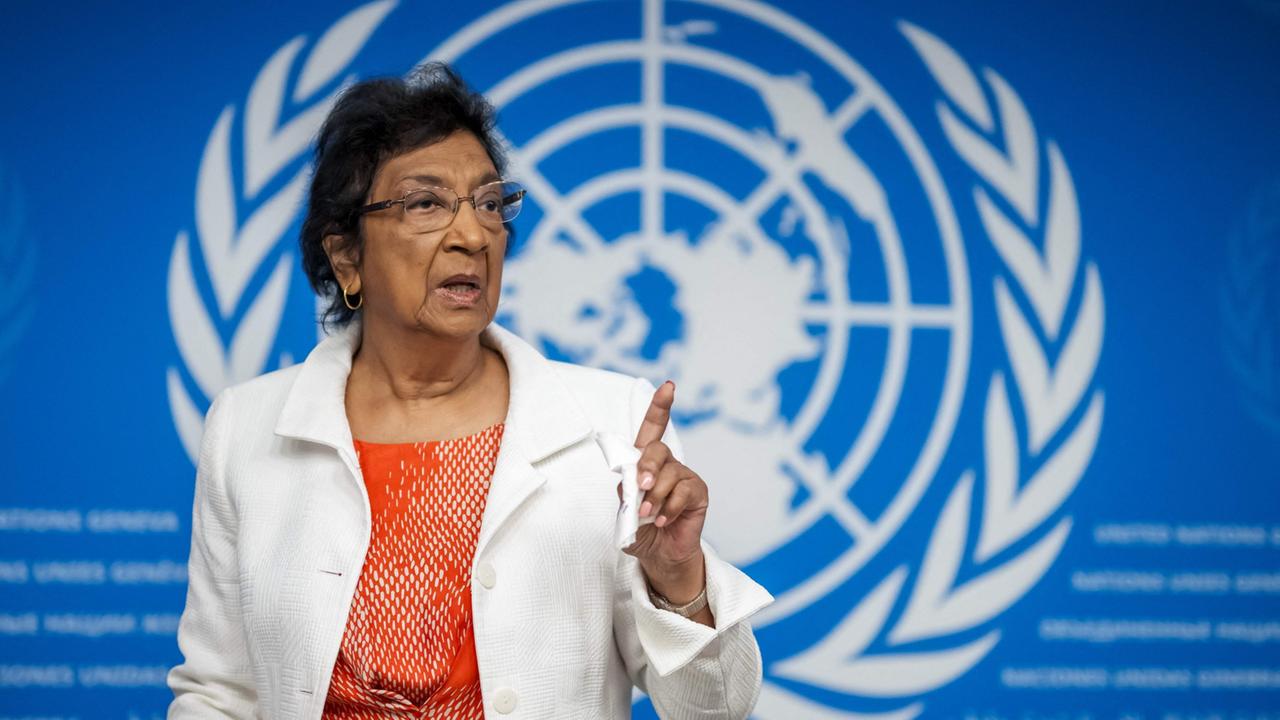
Oslo, Norway – October 9, 2026 – In a powerful statement against the encroaching tide of authoritarianism and the erosion of international norms, the Norwegian Nobel Committee today awarded the Nobel Peace Prize to Navanethem "Navi" Pillay, a distinguished South African jurist and human rights advocate. The decision, announced by Nobel Committee Chairman Jorgen Watne Frydnes, underscores Pillay’s lifelong dedication to upholding international law and advocating for the rights of the vulnerable, positioning her as a potent symbol of the multilateral order in an increasingly fractured world.
Frydnes’ address to the press left little room for ambiguity regarding the committee’s intent. "The Norwegian Nobel Committee has decided to award the Nobel Peace Prize for 2026 to Navanethem ‘Navi’ Pillay for her tireless efforts for peace and international law," he stated, echoing the official announcement. The award is not merely a recognition of an individual’s accomplishments, but a profound endorsement of the principles she has championed throughout her illustrious career: the supremacy of international law over the "law of the strongest" and the imperative of accountability for the gravest international crimes.
A Lifetime Dedicated to Justice: Pillay’s Unwavering Path
Navi Pillay’s journey is a testament to her unwavering commitment to justice and human rights on the global stage. Her extensive career has spanned virtually every critical institution dedicated to international law and accountability. From her early days as a judge at the International Criminal Tribunal for Rwanda (ICTR), where she played a pivotal role in prosecuting perpetrators of genocide, to her tenure as a judge at the International Criminal Court (ICC) in The Hague, Pillay has consistently been at the forefront of efforts to bring perpetrators of mass atrocities to justice.
Her role as the United Nations High Commissioner for Human Rights in Geneva further amplified her voice, allowing her to advocate for human rights protections on a global scale. More recently, she led the Independent International Commission of Inquiry of the United Nations for the Occupied Palestinian Territories, a testament to her continued dedication to investigating and documenting human rights abuses in some of the world’s most protracted conflicts. Currently, Pillay serves as a judge at the International Court of Justice (ICJ) in The Hague, presiding over a critical case in which Myanmar stands accused of genocide. This multifaceted experience positions her as a living embodiment of the international legal framework.
The Nobel Committee’s Message: A Stand Against Might Makes Right
The Nobel Committee’s selection of Pillay is a direct response to a growing global trend where powerful nations increasingly disregard international law and institutions. The past few years have witnessed a concerted effort by certain states to undermine the very foundations of the international legal order. This award serves as a powerful counter-narrative, asserting that adherence to law, rather than brute force, is the only viable path towards lasting peace.
The committee acknowledged the inherent limitations and complexities of international law, noting in its citation that while it has its weaknesses, it remains "the foundation for a more peaceful world." This nuanced perspective recognizes that the pursuit of justice is often arduous and imperfect, but crucially, it affirms the indispensable role of international legal mechanisms in preventing and responding to egregious human rights violations.
A Global Divide: The United States’ Escalating Campaign Against the ICC
The timing of Pillay’s award is particularly significant given the escalating tensions between the United States and international judicial bodies. Under the Trump administration, the U.S. has launched an unprecedented and aggressive campaign against the International Criminal Court (ICC). Despite not being a party to the Rome Statute that established the ICC, the U.S. has actively sought to undermine its jurisdiction and operations.
This campaign intensified following the ICC’s issuance of arrest warrants against senior Hamas officials and, controversially, against then-Israeli Prime Minister Benjamin Netanyahu and former Israeli Defense Minister Yoav Gallant. In response, the Trump administration declared its intention to dismantle the ICC "brick by brick." The U.S. has since imposed sanctions on thirteen ICC officials, including prosecutors and judges, effectively treating them as pariahs on the international stage. These sanctions have had a debilitating effect on the targeted individuals, restricting their access to basic services and financial transactions, a level of punitive action typically reserved for those accused of terrorism.
The U.S. Response to the Nobel Prize: Further Escalation
The U.S. government’s reaction to Pillay’s Nobel Peace Prize was swift and indicative of its continued antagonism towards international justice. Within hours of the announcement, the U.S. State Department unveiled new, sweeping sanctions targeting the entire ICC. These measures aim to prohibit any transactions with the court, sever its financial resources, and severely curtail its operational capacity. The U.S. Department of State declared its intent to "restrict the court’s ability to pursue its illegitimate investigations."
This aggressive stance by the United States signals a deepening chasm between a bloc of nations committed to multilateralism and those increasingly embracing unilateralism and a "might makes right" foreign policy. The sanctions against the ICC officials, and now the broader court, are seen by many as a direct attempt to shield certain actors from accountability for alleged war crimes and crimes against humanity.
A World Divided on International Law: The Stance of Major Powers
The challenges facing international organizations like the ICC are not confined to the United States. Several powerful nations, including China, India, Russia, and Israel, do not recognize the jurisdiction of the ICC. While the ICC’s mandate is to prosecute individuals for the most heinous international crimes – genocide, crimes against humanity, war crimes, and the crime of aggression – its effectiveness is significantly hampered by the non-membership of these key global players.
The absence of these states from the ICC’s jurisdiction means that their citizens accused of committing such crimes on the territory of member states cannot be automatically brought before the court. While the ICC can still issue arrest warrants, its ability to enforce them is severely limited without the cooperation of non-member states. This creates significant loopholes that allow impunity to persist, undermining the very purpose of international criminal justice.
The Alternative: A Bleaker Global Landscape
Despite the imperfections and the immense political pressures, European leaders have largely lauded Pillay’s award. Spanish Prime Minister Pedro Sánchez celebrated her work exuberantly, while European Commission President Ursula von der Leyen hailed Pillay on X (formerly Twitter) as a "defender of the rule of law against the law of the strongest." The European Union, while expressing regret over the U.S. sanctions, has reiterated its commitment to working closely with the ICC to ensure its effective functioning, though it has largely avoided direct confrontation with the Trump administration on this issue until now.
The Nobel Committee’s message is clear: while international law is not without its flaws – some critics question its efficacy in holding certain regimes accountable, such as that in Iran, and many lament the slow pace of investigations and tribunals – the alternative is a far more unstable and grim world. The committee emphasizes that "peace requires justice," and figures like Navi Pillay serve as a beacon of hope and inspiration for a more peaceful global order. Her Nobel Peace Prize is a powerful affirmation that even in the face of overwhelming challenges, the pursuit of justice and adherence to international law remain essential pillars for a sustainable and equitable future.


