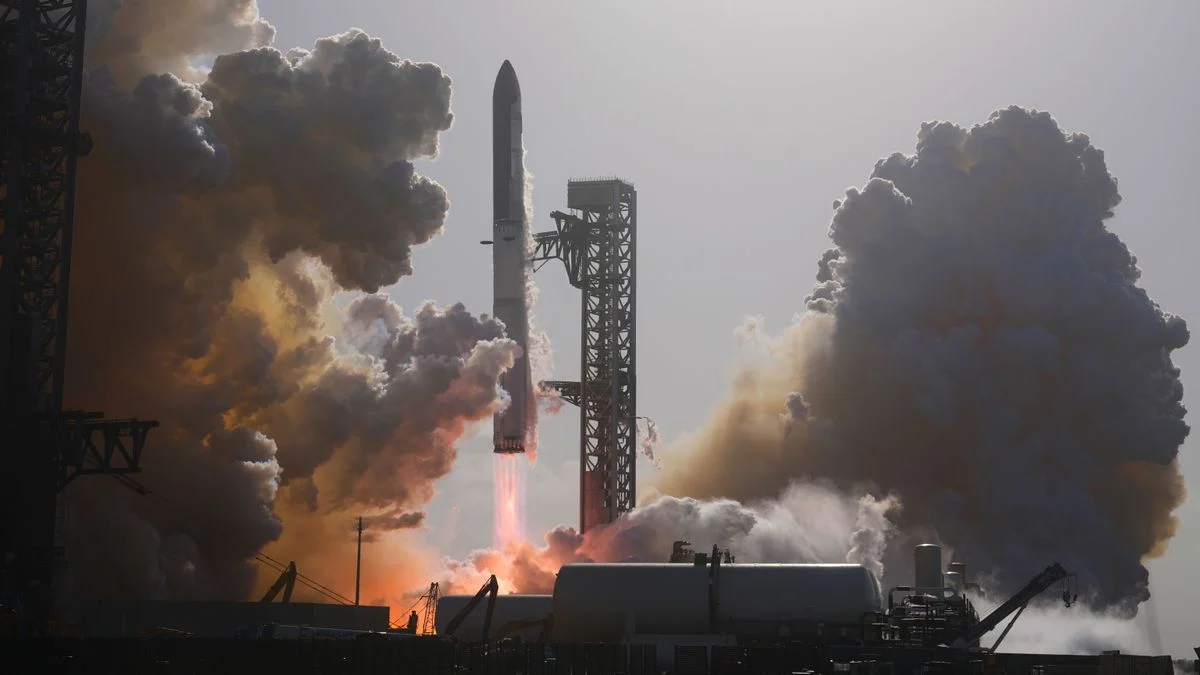
The gargantuan silhouette of the SpaceX "Starship" has once again etched itself into the history of modern aerospace engineering. In a recent test flight—the 13th in the ongoing development program—SpaceX demonstrated the maturing capabilities of the world’s most powerful rocket system. By successfully executing a controlled reentry and splashdown in the Indian Ocean, the aerospace giant is steadily moving from a phase of explosive experimentation to one of operational reliability.
Main Facts: A Controlled Triumph of Engineering
The mission objective was clear: to test the flight dynamics, thermal shielding, and re-entry precision of the "Version 3" Starship—a significantly refined iteration of the behemoth vehicle.
Following a successful liftoff, the lower stage—the 70-meter "Super Heavy" booster—completed its primary mission profile, performing a planned descent into the waters near the launch site. Roughly one hour later, the 50-meter upper stage, known as the Starship, successfully navigated the punishing heat of atmospheric reentry before executing a controlled splashdown in the Indian Ocean.
Beyond the hardware performance, the mission included a sophisticated simulation of satellite deployment. SpaceX utilized 20 functional Starlink internet satellites as test subjects. In a calculated move to verify deployment mechanisms and orbital insertion, the satellites were released into low Earth orbit before being commanded to de-orbit, intentionally burning up in the atmosphere. This procedure served a dual purpose: it validated the deployment hardware and provided critical data on orbital maneuvers without creating long-term space debris.
Chronology: From Abort to Ignition
The road to this successful test was fraught with the characteristic challenges of rapid, iterative development. The mission, initially slated to launch approximately one week prior to the actual event, faced a series of setbacks that underscored the complexity of the "Version 3" architecture.
- The Initial Scrub: The launch was scrubbed mere moments before liftoff when ground sensors detected that several of the Raptor engines failed to initiate their startup sequence. This forced a "hold" on the countdown, a standard safety procedure in the SpaceX launch protocol.
- Weather Constraints: Following the technical abort, the launch window was further delayed by unfavorable weather conditions in the Gulf Coast region. High-altitude winds and atmospheric instability necessitated a postponement to ensure the safety of the vehicle and ground infrastructure.
- The Successful Launch: Upon the final attempt, the countdown proceeded without incident. The "Version 3" Starship, which features extensive structural and performance optimizations over its predecessors, roared to life, marking the second time this specific iteration has been pushed to its limits.
Supporting Data: The Anatomy of a Titan
To understand the scale of the Starship program, one must look at the physical dimensions and the overarching mission architecture. Standing taller than the Statue of Liberty, the Starship system represents a paradigm shift in launch vehicle design.
The Two-Stage Architecture
The system consists of two primary components:
- Super Heavy (Booster): A 70-meter tall first stage powered by a cluster of Raptor engines, designed to provide the initial thrust required to break the grip of Earth’s gravity.
- Starship (Upper Stage): A 50-meter vehicle designed for long-duration space travel, orbital cargo delivery, and, eventually, human habitation.
The Philosophy of Reusability
The core differentiator of the Starship program is full and rapid reusability. Unlike traditional rockets that discard stages in the ocean, both the Super Heavy and the Starship are designed to return to Earth, landing upright and being prepared for flight again in a matter of days or weeks. This capability is the linchpin of SpaceX’s economic model, aiming to reduce the cost-per-kilogram of payload delivery to orbit by orders of magnitude compared to legacy systems like the Space Shuttle or the Saturn V.
Official Responses and Strategic Significance
While SpaceX remains characteristically focused on the technical data generated by the flight, the implications for global space policy are profound. The NASA Artemis program, which seeks to return humans to the lunar surface, is heavily reliant on the Starship platform.
"The progress we are seeing is consistent with the iterative development philosophy that has defined SpaceX from the beginning," said industry analysts observing the launch. "While the early tests—most notably the April 2023 flight that ended in a catastrophic explosion—provided the ‘learning by failing’ data, this latest success shows that the platform is moving toward the maturity required for human-rated missions."
SpaceX CEO Elon Musk has remained bullish, frequently stating that the primary goal is not just orbital delivery, but the establishment of a permanent human presence on Mars. The ability to launch, recover, and refuel Starships in orbit is the foundational technology required to make such a mission feasible.
Implications: The Long Road to Mars
The history of the Starship program is a timeline of rapid learning. The inaugural test in April 2023 resulted in a dramatic, uncontrolled explosion shortly after liftoff. While critics viewed this as a failure, the company framed it as a "rapid unscheduled disassembly" that provided more data in minutes than months of computer simulations could have.
Subsequent tests saw gradual improvements:
- Reaching Orbit: Later flights successfully achieved orbital velocity, proving the engines could handle the vacuum of space.
- Controlled Descent: The program eventually mastered the "belly-flop" maneuver, where the upper stage re-enters the atmosphere sideways to dissipate energy before flipping to a vertical orientation for landing.
- Targeting Reliability: The current phase is focused on repeatability. For Starship to become the "workhorse" of the solar system, it must prove that it can fly, land, and re-fly with minimal refurbishment.
The Vision for the Future
The implications of a successful, reliable Starship are transformative. For the scientific community, it means the ability to launch massive space telescopes and deep-space probes that were previously limited by the size of fairings on traditional rockets. For the commercial sector, it promises a massive increase in the number of satellites in orbit, potentially bridging the digital divide through global high-speed internet.
However, the most significant implication remains the human exploration of the Red Planet. Mars requires an immense amount of supplies, shielding, and life support systems—mass that only a vehicle of Starship’s scale can deliver.
As the program moves toward its 14th and 15th tests, the focus will likely shift from "can it survive the flight" to "how much cargo can it carry and how fast can we turn it around." The successful splashdown in the Indian Ocean is more than just a successful flight; it is a signal to the world that the era of heavy-lift, reusable, interplanetary transportation has officially arrived.
The Starship is no longer just a prototype—it is a promise. And if the current trajectory holds, the next decade of human history will be written not just on the pages of Earth-bound books, but in the dusty, rust-colored soil of a world millions of miles away.