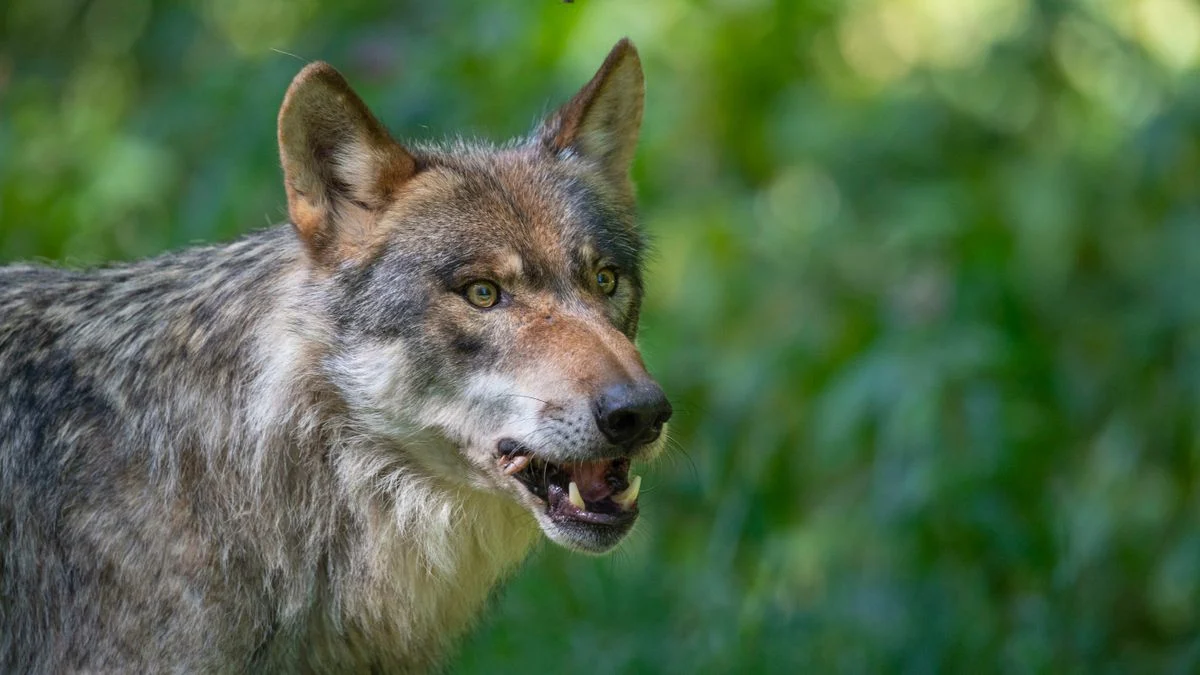
The tranquil village of Vasto, nestled along the Adriatic coast of Italy, was recently the site of a harrowing encounter that has reignited the fierce debate surrounding the coexistence of human populations and the expanding grey wolf (Canis lupus) population in Europe. For one local family, a routine evening in their home transformed into a scene of primal terror, as they watched through a reinforced glass window as a wolf stalked their property and engaged in a predatory confrontation just inches from where they stood.
This incident, which occurred under the cover of twilight, serves as a stark reminder of the shifting boundaries between rural human settlements and apex predators. As wolf populations across Italy and the wider European continent continue to rebound—largely due to strict conservation laws and the abandonment of marginal agricultural lands—the proximity of these animals to human infrastructure has become a focal point of public concern and political tension.
The Chronology of the Encounter
The events unfolded on a quiet Tuesday evening. A mother, who was in the main living area of the family home with her young child, noticed unusual behavior from the family pet. The domestic dog, usually calm, became frantic, barking toward the large patio window that overlooks the garden.
Upon investigating the noise, the mother was confronted by a sight that defies the typical, shy behavior of the European wolf. Standing on the terrace, bathed in the soft glow of the outdoor lights, was a large adult wolf. The animal did not flee upon being spotted; instead, it paced the perimeter of the terrace, appearing to test the thresholds of the house.
The mother and child retreated slightly but remained in sight of the glass, observing the predator’s movements. For several minutes, the animal explored the patio, sniffing at the door frame and the base of the windows. The experience was described by witnesses as deeply unsettling, characterized by the realization that the predator was not merely passing through but was actively investigating the residence as a potential source of food.
When the animal finally turned and retreated back into the dense brush surrounding the property, the family contacted local authorities. The incident has since been documented by regional forestry officials, who are tasked with monitoring the movement of predators in the Abruzzo region—an area known for its rich biodiversity and its long history of wolf conservation.
The Return of the Apex Predator: Supporting Data
To understand the severity of this encounter, one must look at the broader context of the wolf’s recovery in Italy. Once pushed to the brink of extinction in the mid-20th century, the Italian wolf population has made a dramatic comeback. Estimates from the Italian Institute for Environmental Protection and Research (ISPRA) suggest that there are now over 3,000 wolves inhabiting the Italian peninsula.
Factors Contributing to the Expansion
- Rural Depopulation: As younger generations migrate to urban centers for work, agricultural lands are being reclaimed by forest. This provides the ideal cover and habitat for wolf packs to thrive.
- Increased Prey Base: The proliferation of wild ungulates, particularly wild boar and roe deer, has provided a stable food source that allows wolf packs to sustain larger numbers.
- Legal Protections: Under the European Union’s Habitats Directive, the wolf is a strictly protected species. Hunting or culling is heavily restricted, allowing populations to expand into areas that have not seen predators for decades.
The incident in Vasto is not an isolated phenomenon. Data from the last three years show a significant uptick in "confidential" sightings—instances where wolves have been spotted within 50 meters of residential buildings. While attacks on humans remain statistically rare, the frequency of habituation—where wolves lose their fear of humans due to easy access to food scraps or lack of negative reinforcement—is rising at an alarming rate.
Official Responses and Expert Analysis
The local government in the Abruzzo region has responded with a mix of caution and calls for systemic management. Officials have emphasized that while the wolf is a vital component of the Italian ecosystem, public safety must remain the priority.
"We are dealing with a species that is highly intelligent and adaptable," noted Dr. Elena Rossi, a wildlife biologist specializing in large carnivore management. "When a wolf approaches a house, it is often a sign of ‘bold’ behavior. This is not normal, ancestral behavior for wolves, which are naturally elusive. This indicates that the animal may have had prior interactions with humans that were not sufficiently discouraged."
Local forestry police have begun conducting patrols in the area and have advised residents to secure waste containers, keep pets indoors after dark, and install motion-activated lighting. However, there is significant pushback from the local community, who argue that these measures are insufficient to deal with a predator that has demonstrated a lack of fear regarding human dwellings.
The Italian Ministry of the Environment has faced intense pressure to revise the National Wolf Management Plan. Proponents of a more active management strategy are calling for the controlled removal of "problematic individuals"—wolves that repeatedly show a lack of fear toward humans or livestock. Conversely, conservation groups argue that lethal control is a short-term fix that ignores the underlying ecological imbalances caused by human waste and habitat fragmentation.
The Broader Implications for Coexistence
The Vasto incident serves as a microcosm for the larger challenge facing the European Green Deal’s biodiversity goals. The EU aims to restore nature, but the "re-wilding" of the continent is colliding with the reality of modern human life.
The Psychological Impact
Beyond the physical risk, the psychological toll on rural populations cannot be overstated. For many living in areas with expanding predator populations, the simple act of walking to a car at night or letting children play in the yard has become fraught with anxiety. This erosion of the "safety bubble" associated with the home has led to a growing resentment toward urban environmentalists who dictate conservation policies from afar.
The Livestock Conflict
While the Vasto incident involved a residential property, the most frequent point of friction remains the livestock industry. Sheep and goat farmers across Italy are reporting higher rates of predation, even with the use of protective measures like guard dogs and electric fencing. The economic strain, combined with the emotional burden of losing livestock, has created a volatile political environment where local mayors are increasingly demanding the right to protect their citizens and livelihoods.
A Path Forward
Experts suggest that a successful coexistence model must include three pillars:
- Rapid Response Teams: Dedicated units that can haze or deter wolves that begin to habituate to human settlements.
- Compensation and Support: Streamlined systems to reimburse farmers for losses, paired with funding for advanced deterrent technologies.
- Public Education: Clear, evidence-based communication regarding how to handle wolf encounters, dispelling both the myths of the "bloodthirsty monster" and the dangerous assumption that wolves are "wild dogs" that can be befriended.
Conclusion
The image of the mother and child watching the wolf through their window is a powerful, haunting testament to the changing face of the European landscape. As we continue to push for a wilder, more biodiverse continent, we must also acknowledge that the boundaries we have drawn between the "wild" and the "domesticated" are becoming increasingly porous.
The wolf is no longer a creature of the distant mountains; it is a neighbor, albeit an uninvited and unpredictable one. Whether Europe can successfully navigate this delicate balance—protecting its most iconic predator while ensuring the security and peace of mind of its citizens—remains one of the most significant challenges of the decade. The encounter in Vasto is a warning, and for those who witnessed it, it was a life-altering moment that proved, once and for all, that the wild is much closer than we ever dared to imagine.