In the quiet corners of behavioral ecology, a paradigm shift is underway. For decades, the prevailing consensus regarding insect intelligence was dominated by the concept of “innate programming”—the idea that bees, wasps, and ants operate primarily through rigid, instinctual scripts, modified occasionally by simple trial-and-error learning. However, groundbreaking research recently published in the journal Science has shattered these assumptions.
A team led by behavioral ecologist Olli Loukola at the University of Oulu in Finland has demonstrated that bumblebees (Bombus terrestris) possess a level of problem-solving sophistication previously reserved for much larger-brained creatures. The study reveals that these insects do not merely react to their environment; they possess the cognitive flexibility to approach novel, complex challenges with foresight and deliberate, goal-oriented action.
The Experiment: A Masterclass in Design
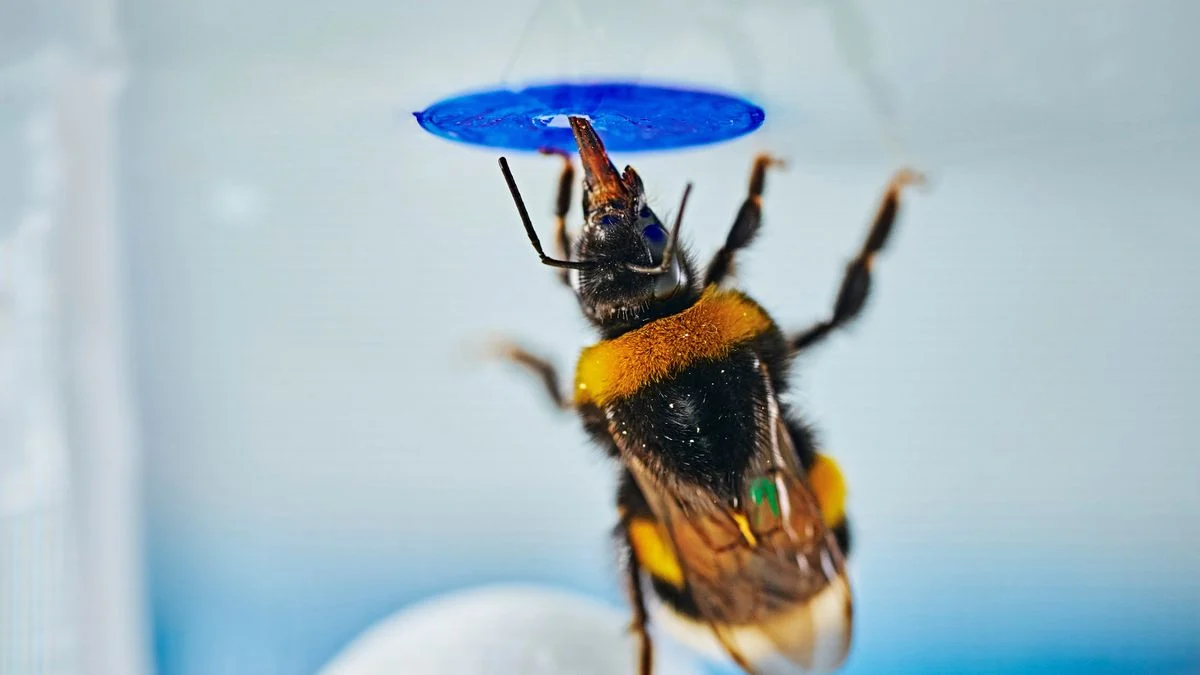
The experiment conducted by Loukola and his colleagues was deceptively simple in its physical setup but remarkably profound in its implications. The researchers placed bumblebees inside a circular, saucer-sized arena. Suspended from the ceiling was an artificial blue flower containing a reservoir of high-energy sugar solution. Crucially, the apparatus was engineered to be inaccessible via flight; the distance between the floor and the flower was too great for the bees to hover and land.
On the floor of this arena, the researchers placed a small polystyrene ball. The bees were essentially presented with a tool—an object that had no inherent value in terms of nectar—and a distant goal that was impossible to reach without modification of their environment.
The Methodology of Innovation
The genius of the study lay in the absence of traditional training. The researchers did not “teach” the bees how to use the ball, nor did they demonstrate the solution through a series of rewarded steps. Instead, the bees were given independent access to the ball and a separate, reachable blue flower, allowing them to familiarize themselves with the objects in isolation.
When the bees were subsequently placed in the arena with the elevated, unreachable flower and the floor-bound ball, the results were staggering. The majority of the subjects did not engage in aimless wandering or frantic buzzing. Instead, they moved the ball purposefully toward the position beneath the artificial flower, climbed atop the object, and used it as a makeshift platform to reach the reward.
Chronology of Discovery: From Observation to Proof
The journey to this discovery began with the team’s desire to challenge the limitations of insect cognition.
- Baseline Exploration: Initially, the bees were allowed to explore the arena with the ball and the target flower separately. This ensured that any successful behavior was not a result of accidental discovery but a synthesis of prior knowledge.
- The Novel Challenge: In the primary test phase, the bees were introduced to the “inaccessible flower” setup. The transition from exploration to goal-oriented manipulation occurred with remarkable speed.
- The Spatial Complexity Test: To ensure the bees weren’t just pushing the ball randomly, the researchers escalated the challenge. They partitioned the arena into two distinct sections. The target flower was placed in one section, while the ball remained in the other. Crucially, from the ball’s starting position, the flower was not visible.
- Goal-Oriented Execution: Despite the lack of a direct visual line of sight, 23 out of 30 bumblebees successfully navigated the ball to the correct location beneath the flower. This suggests that the bees were not merely tracking a visual cue but were working toward a mental representation of the goal.
Supporting Data: The Power of a Sesame-Seed Brain
To contextualize these findings, one must look at the biological hardware involved. A bumblebee’s brain is approximately the size of a sesame seed, containing roughly one million neurons. To put this in perspective, that is roughly one-hundred-thousandth of the volume of the human brain.
Historically, such diminutive neural architecture was thought to limit an organism to basic stimulus-response behaviors. Yet, the data from the University of Oulu study adds to a growing body of evidence suggesting that efficiency, rather than sheer size, defines intelligence in the insect world. Previous studies have already demonstrated that bumblebees can recognize human faces, count up to four or five, and engage in play behavior—a trait typically associated with mammals and birds.
The statistical significance of the current study—with a 76% success rate in the most difficult version of the experiment—provides a robust rebuttal to the “trial-and-error” theory. If the behavior were purely accidental, one would expect a significantly lower success rate and a much longer latency period for the bees to "stumble" upon the solution.
Official Responses and Scientific Context
The publication in Science has sent ripples through the entomological community. While some skeptics remain cautious about ascribing "consciousness" to insects, the consensus is shifting toward a recognition of "cognitive plasticity."
“This study forces us to redefine what we mean by ‘intelligence’ in the animal kingdom,” noted one independent expert in animal cognition. “When an animal can integrate disparate pieces of information—the location of a reward and the utility of an object—to solve a novel problem, we are looking at executive function.”
Dr. Loukola’s team emphasizes that their findings do not suggest that bees have a human-like understanding of physics. Rather, it indicates that bumblebees possess a flexible "cognitive map" that allows them to solve problems within their ecological context. The research underscores that evolution has selected for high-level problem-solving capabilities in species that operate in complex, resource-scarce environments.
Implications: The Future of Cognitive Research
The implications of this study extend far beyond the humble bumblebee.
Rethinking Neurobiology
If a brain with only one million neurons can perform complex, goal-oriented tasks, it invites a re-evaluation of how neural networks process information. Robotics researchers are already taking note; by studying the "algorithms" used by insects to navigate and solve spatial puzzles, scientists hope to develop more efficient, low-power AI systems that do not require the massive computational overhead of traditional deep-learning models.
Ecological Resilience
On an environmental level, this research highlights the vulnerability—and the brilliance—of pollinators. Bumblebees are essential to global biodiversity and food security. Understanding that they possess sophisticated learning mechanisms suggests that their survival strategies are more nuanced than previously realized. It also raises questions about how environmental stressors, such as pesticides or habitat loss, might impair these complex cognitive functions, potentially hindering the bees’ ability to adapt to a changing world.
A New Philosophy of Mind
Finally, the study serves as a humbling reminder of our anthropocentric bias. Humans have long looked to great apes, dolphins, and crows as the benchmarks of intelligence. By demonstrating that such cognitive agility exists at the scale of a bee, the research challenges us to expand our definition of sentient life. It suggests that intelligence is not a linear hierarchy but a diverse array of solutions to the universal challenge of existence.
Conclusion: A Small Creature with Large Capabilities
The work of Olli Loukola and his team at the University of Oulu is a milestone in the study of animal behavior. By proving that bumblebees can use tools to reach a goal without explicit training, they have pushed back the frontiers of what we believe possible for small-brained organisms.
As we move forward, the challenge will be to understand the neural mechanisms that allow these insects to perform such feats. Is it a specialized module in their brain, or an emergent property of their social structure? Whatever the answer, one thing is certain: the next time a bumblebee lands on a flower in your garden, you are not looking at a mindless automaton, but at a sophisticated, problem-solving individual that has successfully navigated the complexities of its environment through a remarkable display of cognitive grace.
The story of the bumblebee and the ball is more than just a scientific curiosity; it is a testament to the fact that intelligence, in its most efficient and elegant forms, is found in the most unexpected places. As research continues to unravel these mysteries, we are reminded that in nature, size is rarely a predictor of capacity, and the smallest creatures are often the ones teaching us the most about the nature of the mind itself.