

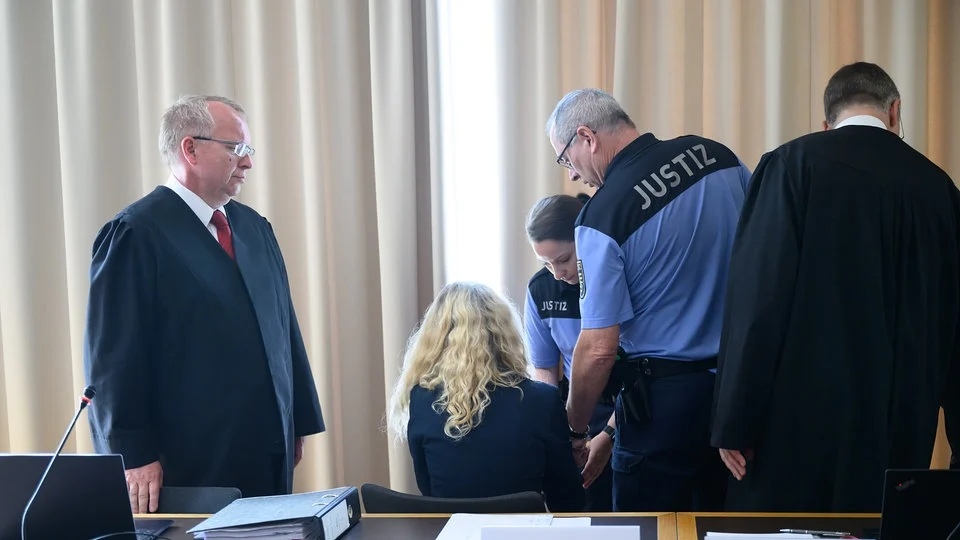
DRESDEN, Germany – The Dresden Regional Court has delivered a definitive and stern verdict in a case that has gripped the German public with its chilling blend of domestic betrayal, calculated greed, and brutal violence. In a high-profile trial that concluded this week, two defendants—a woman formerly married to a prominent lawyer and her accomplice, a one-time handyman—were sentenced to life imprisonment for the cold-blooded murder of a 76-year-old man.
The presiding judge’s ruling underscored the heinous nature of the crime, with the court taking the rare step of establishing a "particular gravity of guilt" (besondere Schwere der Schuld) for the primary defendant, Ramona B. This legal determination effectively ensures that she will remain behind bars well beyond the standard 15-year threshold typically required for a parole review, rendering her release highly improbable.
The Crime: A Calculated Execution
The events, which took place in the autumn of 2024, shattered the quietude of the rural landscape near Klipphausen. According to the prosecution’s evidence, which was meticulously corroborated by the court, Ramona B. orchestrated the murder of her 76-year-old husband under the guise of a tragic accident.
The victim, an elderly man known for his disciplined exercise routine, was out for a morning jog when his life was violently cut short. Investigators revealed that Ramona B. had meticulously tracked her husband’s movements, waiting for the opportune moment when he would be vulnerable on a secluded path. Using a heavy-duty off-road vehicle (SUV), she struck her husband from behind at high speed.
The court heard harrowing testimony regarding the sequence of events that followed. After the initial impact, which rendered the victim incapable of resistance, Ramona B. drove over the incapacitated man not once, but twice. The judge emphasized that the defendant acted with "treachery" (Heimtücke) and "greed" (Habgier), exploiting the victim’s absolute lack of suspicion or means of defense. The motive, as established by the court, was purely financial: Ramona B. sought to gain sole control of her husband’s substantial estate.
Chronology of the Investigation and Trial
The investigation into the death of the 76-year-old initially pointed toward a tragic hit-and-run incident. However, inconsistencies in the evidence quickly surfaced, leading police to suspect foul play.
- Autumn 2024: The victim is killed while jogging near Klipphausen. The crime is staged to look like a vehicular accident.
- Late 2024: Forensic analysis of the SUV used in the crime reveals traces that contradict the "accident" narrative. Investigators begin tracking the movements of the vehicle.
- Early 2025: Arrests are made. Ramona B. and the couple’s former handyman are taken into custody. During her time in pre-trial detention, further complications arise, including reports of a burglary at the suspect’s residence.
- 2026 Trial Proceedings: The Dresden Regional Court commences the trial. The proceedings draw significant media attention due to the social standing of the victim and the brutal methodology of the perpetrator.
- May 13, 2026: The court delivers its verdict, sentencing both defendants to life imprisonment.
The Accomplice: A Handyman’s Fatal Choice
While the conviction of Ramona B. was widely anticipated given the strength of the forensic evidence, the sentencing of her accomplice, the couple’s former handyman, sparked considerable legal debate.
The court found that the handyman was not a passive bystander, but an integral participant in the planning and execution of the crime. Despite the prosecution’s initial stance—which, in a surprising turn, requested an acquittal for the handyman, a request mirrored by the defense—the judges concluded that his involvement met the threshold for a co-perpetrator conviction.
The evidence demonstrated that the handyman had procured the vehicle specifically for the operation and, crucially, took the SUV to a Dresden-based repair shop immediately following the murder to cover up the damage sustained during the act. By facilitating the crime and actively concealing evidence, the court ruled that he had "approved of and assisted in" the murder, justifying the life sentence.
Supporting Data and Forensic Evidence
The conviction relied heavily on a synthesis of digital forensics and physical evidence. Investigators utilized GPS data from the defendant’s SUV, which proved the vehicle had been idling in the vicinity of the jogging path long before the victim arrived.
Furthermore, forensic medical examiners provided a grim reconstruction of the impact. The injuries sustained by the victim were inconsistent with a single, accidental collision; the crush injuries confirmed that the vehicle had traversed the victim while he was lying prone on the ground. These findings were instrumental in debunking the defense’s initial argument that the collision was an unavoidable accident caused by poor visibility or a sudden medical episode.
Official Responses and Judicial Stance
The sentencing has sent a clear signal from the German judiciary: the use of a vehicle as a weapon in a premeditated murder will be met with the harshest possible penalties.
"This was not an accident; this was an execution," the presiding judge stated during the final remarks. The judge further noted that the "particular gravity of guilt" finding was justified by the defendant’s cold calculation. The fact that the victim was a vulnerable individual—his own husband, whom she had vowed to support—added a layer of moral depravity that the court found impossible to ignore.
Legal experts observing the case noted the tension between the prosecution’s original request for the accomplice’s acquittal and the court’s ultimate decision. This divergence highlights the judicial independence of the Dresden court, which chose to look beyond the state’s recommendation to establish a broader scope of criminal liability.
Implications: A Case That Echoes Beyond Dresden
The trial has had profound implications for the local community and the legal landscape in Saxony. The revelation that the perpetrator was the victim’s wife, a woman who seemed to lead a life of privilege and stability, has left the public in a state of shock.
Broader Societal Impact
The case has ignited a national conversation regarding the prevalence of "domestic" murders and the difficulty of detecting premeditated violence within seemingly stable relationships. Furthermore, the trial exposed the vulnerability of elderly individuals to those closest to them, leading to calls for better awareness regarding financial elder abuse and physical safety in rural areas.
Legal Precedent
By classifying the accomplice as a full participant rather than a mere accessory, the court has set a significant precedent. It warns individuals that "logistical support"—such as providing a vehicle or cleaning up after a crime—is sufficient to warrant a murder conviction under German law, even if the individual did not personally strike the victim.
The Question of Finality
While the verdict is a major milestone, it is not yet legally binding. Both defense teams have signaled that they may appeal the decision, citing the severity of the sentencing and questioning the court’s interpretation of the accomplice’s intent. As of now, the defendants remain in custody, awaiting the next steps in what has become one of the most high-profile murder trials in recent Dresden history.
As the legal proceedings enter this potential appellate phase, the victim’s family continues to mourn a life stolen under the guise of a morning run. The case remains a stark reminder that even in the most quiet, seemingly secure corners of society, the darkest impulses of human nature can find a way to manifest, and that justice, while often slow, remains a cornerstone of the German legal system.
Reporting by MDR (kbe/aap). This topic was featured in the regional news segment of MDR SACHSEN on May 13, 2026, at 16:30.



















Leave a Reply