By Global News Desk
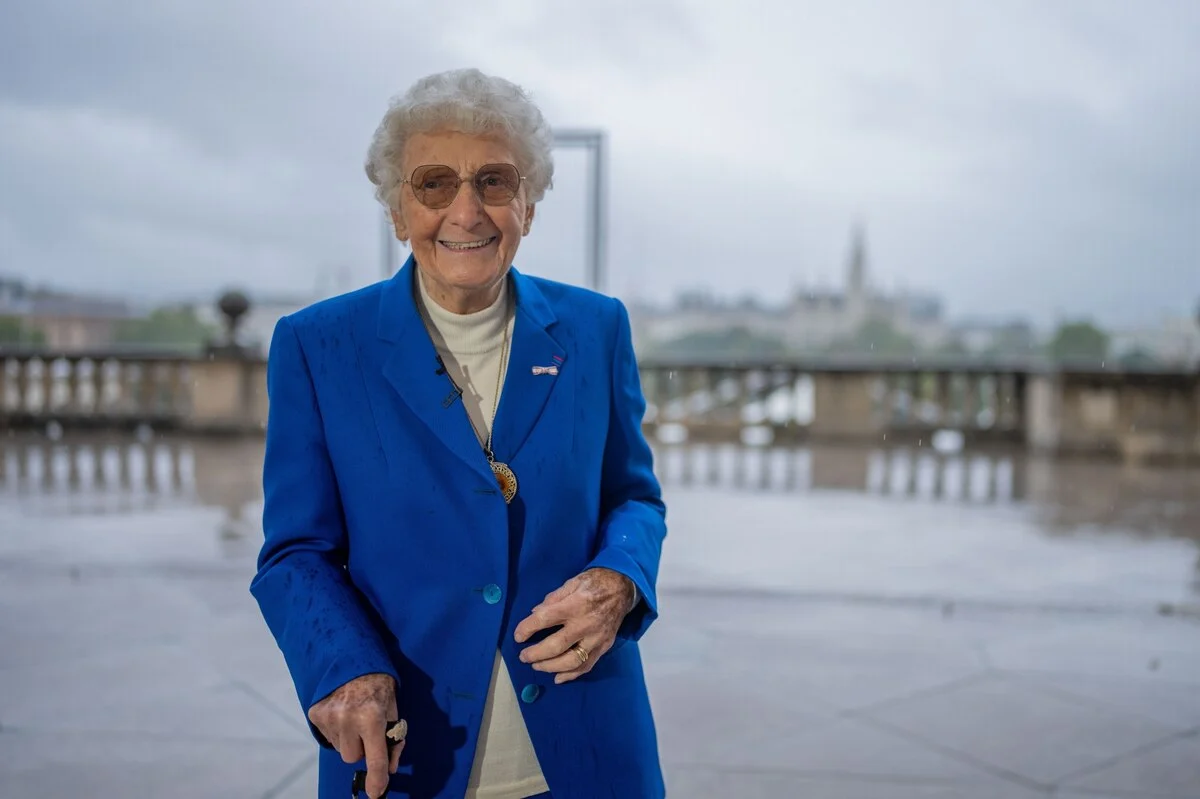
The passing of Melanie Berger-Volle at the age of 105 in Saint-Étienne, France, on October 21, marks the end of an era. Berger-Volle was not merely a survivor of the darkest chapter of the 20th century; she was an active, vocal, and relentless participant in the resistance against fascism. A Viennese-born Jew, a committed Trotskyist, and a woman who defined herself by her refusal to accept injustice, she lived a life that mirrored the turbulent history of Europe. Even in her final weeks, confined to a hospital bed, her spirit remained unbroken, as she famously organized a "strike" when hospital staff failed to provide adequate care, demanding the dignity she had spent over a century fighting to preserve.
The Genesis of a Rebel: Early Years in Vienna
Melanie Berger’s political awakening occurred long before most people have even begun to contemplate the structure of society. Raised in Vienna, a city characterized by its intellectual ferment and deep-seated political divisions, she was exposed to the harsh realities of class struggle and inequality at a young age.
By the age of 14, Berger was already active on the streets. While her peers were navigating the typical concerns of adolescence, she was pasting anti-fascist flyers onto the walls of buildings throughout Vienna. She was not driven by abstract theory, but by the tangible suffering of those around her. Her political trajectory led her to join the Revolutionary Communists, a Trotskyist splinter group that held a dual-pronged opposition: they were staunchly anti-Nazi, yet equally critical of the Stalinist regime in the Soviet Union. This early decision placed her in a perilous position, as she became a target of both far-right nationalists and authoritarian leftists.
Chronology of Persecution and Resistance
The annexation of Austria (Anschluss) in March 1938 acted as the catalyst for the most harrowing period of Berger-Volle’s life. Being both Jewish and a known leftist, her status in Vienna became untenable.
- May 1938: Fleeing the encroaching Nazi terror, Berger-Volle escaped Austria, heading first to Belgium and then to France.
- 1939–1940: Following the outbreak of World War II, the political landscape in France shifted. Resistance against the Nazis was increasingly criminalized by the Vichy authorities, turning former refugees into "undesirables."
- January 1942: Her clandestine work in a small resistance group was cut short when a police informant betrayed the cell. Berger-Volle was arrested.
- 1942–1943: Imprisoned in France, she endured brutal interrogation by special police units intent on extracting the identities of her comrades. According to archived police reports from Montauban, she remained steadfast, refusing to yield names despite physical abuse.
- October 15, 1943: Perhaps the most cinematic moment of her life. While suffering from acute jaundice in a Marseille hospital, her resistance group launched a daring, high-stakes extraction. Disguised as Gestapo officers, five of her comrades marched into the hospital ward, using authoritative German commands to "transfer" her for interrogation. It was a classic "Harakiri" operation—audacious, dangerous, and perfectly executed.
Following her escape, she went underground in Lyon, where she continued her service as a courier for the French Resistance, risking her life repeatedly to ensure the survival of the movement.
The Post-War Odyssee: A Life Between Borders
The end of the war did not bring an immediate sense of peace or security for Berger-Volle. The geopolitical reality of the post-war era presented new dangers. Her German-accented French made her a target of suspicion during the initial celebrations of the Liberation, and her Trotskyist politics made her a marked woman in the eyes of the Soviet-backed authorities who held power in parts of Eastern Europe.
Returning to her native Vienna became a high-risk endeavor, as Soviet forces were known to round up Trotskyists for deportation to Siberian labor camps. It was during these years that she met her husband, the journalist Lucien Volle. Together, they navigated the complexities of a divided Europe, eventually choosing to settle permanently in France in the early 1960s. This move was timely; it coincided with the resurgence of far-right movements in Austria, where former SS officers were beginning to find a foothold in the newly established FPÖ (Freedom Party of Austria).

The Legacy of Advocacy: "Just a Little Thing"
Berger-Volle was famous for her modesty. When asked about her wartime exploits, she would dismiss them as "just a little thing." This minimization belied a life of profound courage. In her later years, living in Saint-Étienne, she transformed her experiences into an educational mission. She became a fixture in local schools, speaking tirelessly to students about the dangers of authoritarianism and the necessity of individual responsibility.
Her story eventually gained wider recognition. In 2017, at the age of 93, she was finally honored by the Austrian government with the Golden Decoration of Merit. The recognition was long overdue, a reflection of how slow the political establishment was to reconcile with the stories of those who fought from the periphery.
Implications: The Moral Compass of a Century
The life of Melanie Berger-Volle offers a sobering reflection on the nature of courage. Her history serves as a rebuttal to the idea that resistance is the work of a lone hero. Throughout her life, she emphasized that her strength was derived from her connection to the group—the collective resistance of those who refused to be complicit.
The implications of her life extend to modern political discourse. Her refusal to be silenced, whether by the Gestapo in 1943 or by hospital staff in 2024, stands as an archetype of civic courage. She represents the "unyielding" citizen—someone who viewed the act of resistance as a permanent state of being, not a seasonal occupation.

As noted by scholars and observers, including those who highlighted her life in the Panter Preis ceremonies, Berger-Volle was not a victim who survived; she was a survivor who fought. Her legacy is one of "active memory." By documenting her life through interviews, biographies, and constant public speaking, she ensured that the mechanisms of fascist terror were not buried under the guise of historical "peace."
Conclusion: An Unforgettable Defiance
Melanie Berger-Volle’s death is not just the end of a long life, but the silencing of a living archive of resistance. She leaves behind a world that is fundamentally different from the one she entered in 1919, yet one that continues to grapple with the same echoes of nationalism and xenophobia that defined her youth.
Her final act—the hospital protest—was a poetic punctuation mark on a 105-year sentence of rebellion. It reminds us that defiance is not limited by age, health, or circumstance. As we reflect on her passing, the lesson she leaves behind is simple, yet demanding: that when one sees injustice, the only appropriate response is to stand up, even when one is expected to lie down.
In the words of those who knew her best, Melanie Berger-Volle did not just witness history; she bent it toward the light of resistance. Her life remains a testament to the idea that one person, armed with nothing more than an unyielding moral compass, can effectively hold the forces of darkness at bay. She will be remembered not for the length of her years, but for the depth of her courage.