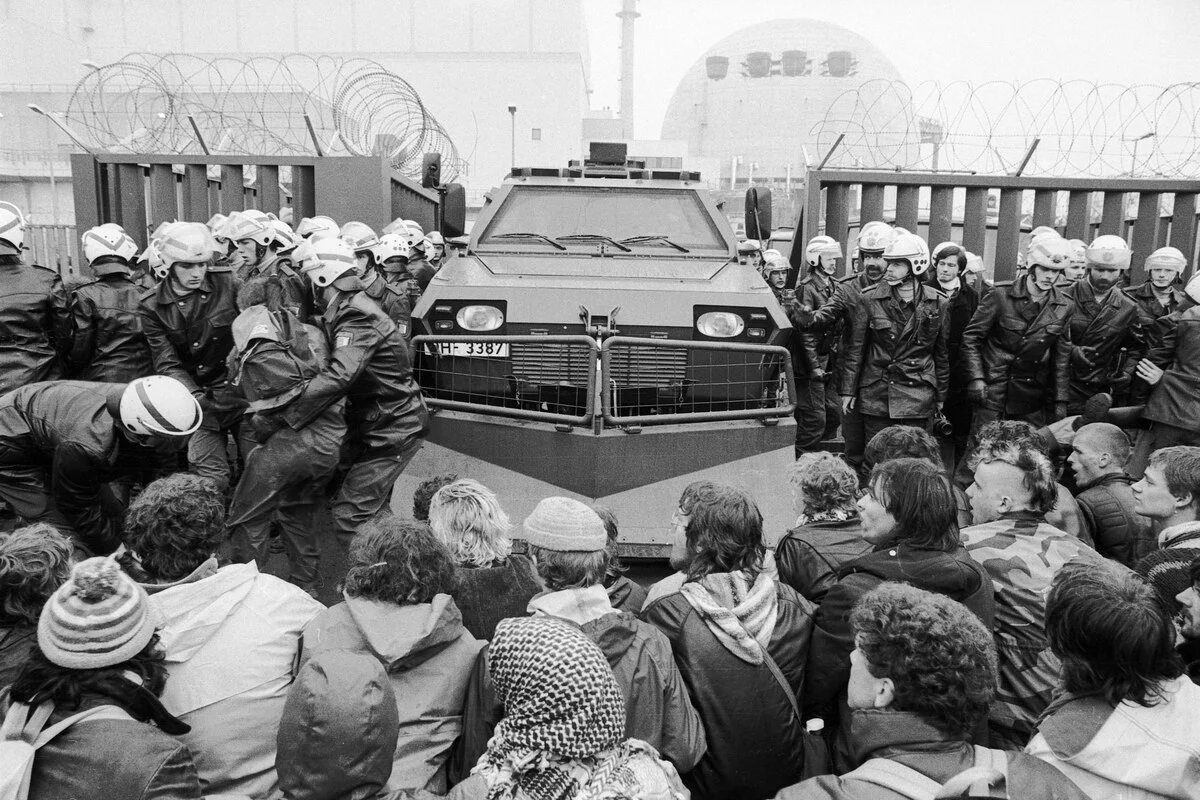
Fifty years have passed since the small municipality of Brokdorf, located in the tranquil Wilstermarsch region of Schleswig-Holstein, became the epicenter of the most significant civil protest movement in post-war German history. The Brokdorf nuclear power plant (AKW) was not merely a construction site; it was a symbol, a battlefield, and the crucible in which the modern German environmental movement and the Green Party were forged. Today, as the site undergoes its final decommissioning, the landscape remains a testament to a decades-long struggle between state authority and citizen resistance.
The Genesis of a Conflict: From Site to Fortress
The roots of the Brokdorf conflict lie in the autumn of 1976. In a move widely perceived as a "night-and-fog" operation, the state authorities attempted to initiate construction of the nuclear facility. On October 30, 1976, roughly 6,000 protesters gathered to oppose the project, with hundreds occupying the site. By dawn, the atmosphere had shifted from protest to confrontation; police forces utilized dogs, batons, and tear gas to clear the area.
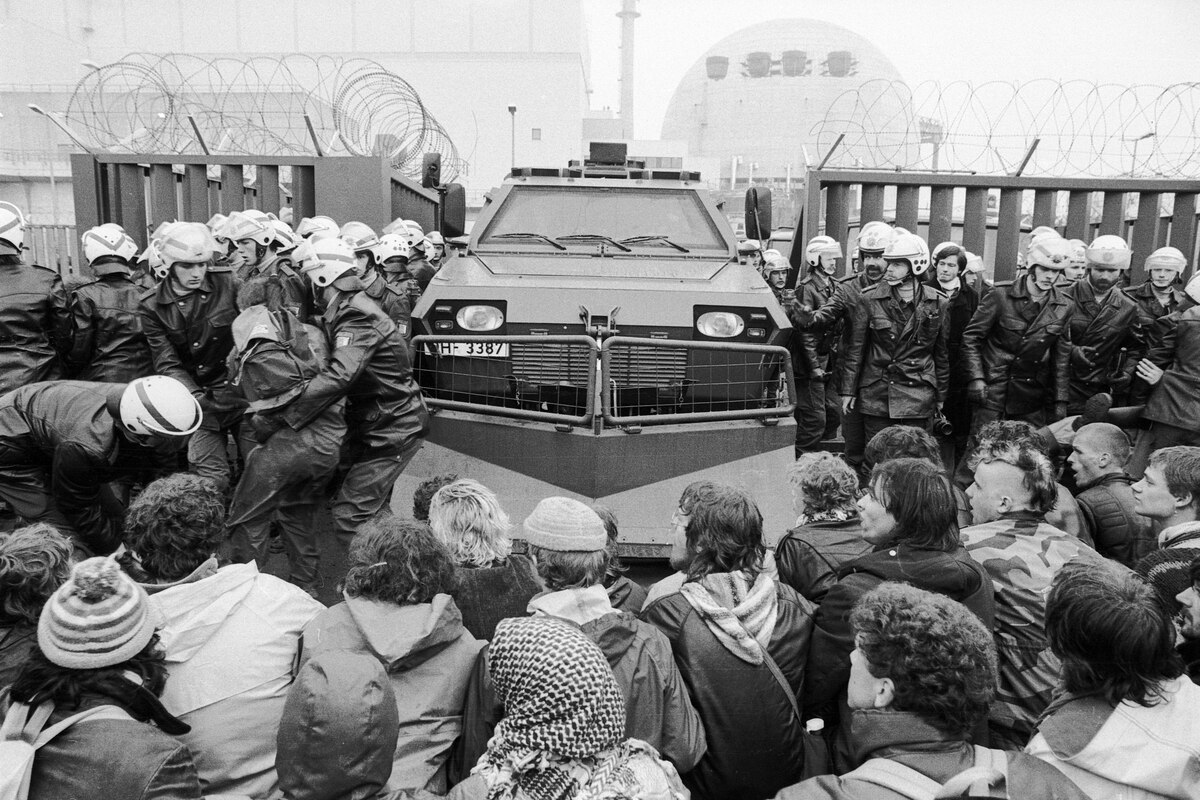
This event, historically dubbed "Brokdorf 1," marked a fundamental turning point. Unlike earlier, smaller protests—such as those in Wyhl, Baden-Württemberg, which focused on protecting local agricultural livelihoods—the Brokdorf protests quickly transcended regional interests. The conflict evolved into a broader rebellion against the "Atomstaat" (the atomic state) and the perceived ruthlessness of the capitalist system. For many students and urban activists, the fight against the nuclear reactor became synonymous with the fight for democracy and the rejection of a technocratic state.
Chronology of the Struggle
The intensity of the protests escalated rapidly throughout the late 1970s and 1980s:

- November 13, 1976 ("Brokdorf 2"): 30,000 protesters attempted to re-occupy the site. The state response was militarized; police and border guards defended the perimeter, using helicopters to drop tear gas canisters into the crowd. Hundreds were injured in the ensuing chaos.
- February 19, 1977: A massive demonstration of 50,000 people took place. Despite the rhetoric of militant groups like the Communist League of West Germany (KBW), who called for the "razing of the fortress," the movement remained largely non-violent, turning back after reaching the first police line.
- February 28, 1981: In a display of continued resolve, 100,000 people converged on the Wilstermarsch following the expiration of a four-year court-ordered construction freeze. The event was marked by hours of violent clashes with police.
- June 7, 1986: Occurring only weeks after the catastrophic meltdown at the Chernobyl nuclear plant, this protest was met with severe police suppression. The "Hamburg Convoy"—a column of over 10,000 protesters—was intercepted by authorities, who destroyed vehicles and inflicted significant damage, leaving the road near Kleve looking like a scrap heap.
- October 7, 1986: Despite the years of resistance, the Brokdorf nuclear power plant officially went into operation—the first in Europe to do so following the Chernobyl disaster.
The Brokdorf Decision: A Legacy for Democracy
While the protesters ultimately failed to prevent the plant from opening, their influence on the German legal system was profound. The years of litigation regarding demonstrations and assembly bans culminated in the landmark "Brokdorf-Beschluss" (Brokdorf Decision) by the Federal Constitutional Court in May 1985.
This ruling remains a cornerstone of German civil rights. The Court established clear definitions for "emergency" and "spontaneous" assemblies, emphasizing that bureaucracy and police restrictions should not stifle the fundamental right to protest. The justices famously noted that the ability of citizens to gather freely and without special authorization is an essential sign of a self-confident, mature democracy. This legal victory provided a shield for future generations of protesters, ensuring that the state could not arbitrarily silence dissent.

Supporting Data and The Human Element
The emotional and psychological toll of the conflict was immense. For individuals like the meteorologist Karsten Hinrichsen, the fight was not just political—it was personal. Having served as a scientific advisor to the legal groups that forced the initial four-year construction halt in 1976, Hinrichsen continued his activism for decades. Following the 2011 Fukushima disaster, he co-founded the "Brokdorf Akut" group, organizing vigils until the plant’s final shutdown on January 1, 2022.
In September 2025, in a final act of historical preservation, Hinrichsen donated his extensive collection of leaflets, meeting protocols, and internal documents to the "Archiv Deutsches Atomerbe" (German Atomic Heritage Archive) in Braunschweig, ensuring that the primary accounts of the struggle are preserved for historians.

Official Perspectives and Decommissioning
The plant, now permanently disconnected from the grid, has been under a rigorous decommissioning process for two years. For the operator, PreussenElektra, the focus has shifted from energy generation to waste management. The site now houses a specialized "Transport Preparation Hall," where spent fuel elements are packaged into Castor casks, awaiting the eventual establishment of a permanent geological repository for high-level radioactive waste.
The state government of Schleswig-Holstein continues to face friction regarding the disposal of lower-level radioactive materials. The administration has struggled to find local landfills willing to accept "freemeasured" (declassified) construction rubble from the demolition. This has led to contentious assignments of waste to sites like the one in Harrislee, near the Danish border, proving that the conflict in Brokdorf has merely transitioned from the reactor’s operation to its environmental legacy.

Implications for the Future
As the physical structures of the Brokdorf plant—the iconic light-gray reactor dome and the 150-meter ventilation stack—begin their slow disappearance, the site is being repurposed. Plans are underway to install one of Europe’s largest battery storage systems for wind energy on the 12-hectare site. This facility is intended to stabilize the grid during periods of low wind production, effectively using the footprint of the old "nuclear fortress" to support the transition to renewable energy.
The legacy of Brokdorf is multifaceted. It represents both a failure of the movement to stop the nuclear age in its tracks and a triumphant success in shaping the legal protections of the German citizenry. It stands as a reminder that the energy transition in Germany was not merely a technological or economic shift; it was a hard-fought cultural transformation, driven by thousands of individuals who walked the Elbe dikes to challenge the status quo.

Fifty years later, the silence at the plant is profound, but the voices of those who occupied its gates echo in the way Germany approaches protest, environmental policy, and the limits of state power today. The "fortress" is falling, but the movement that defined it remains a permanent fixture of the national consciousness.