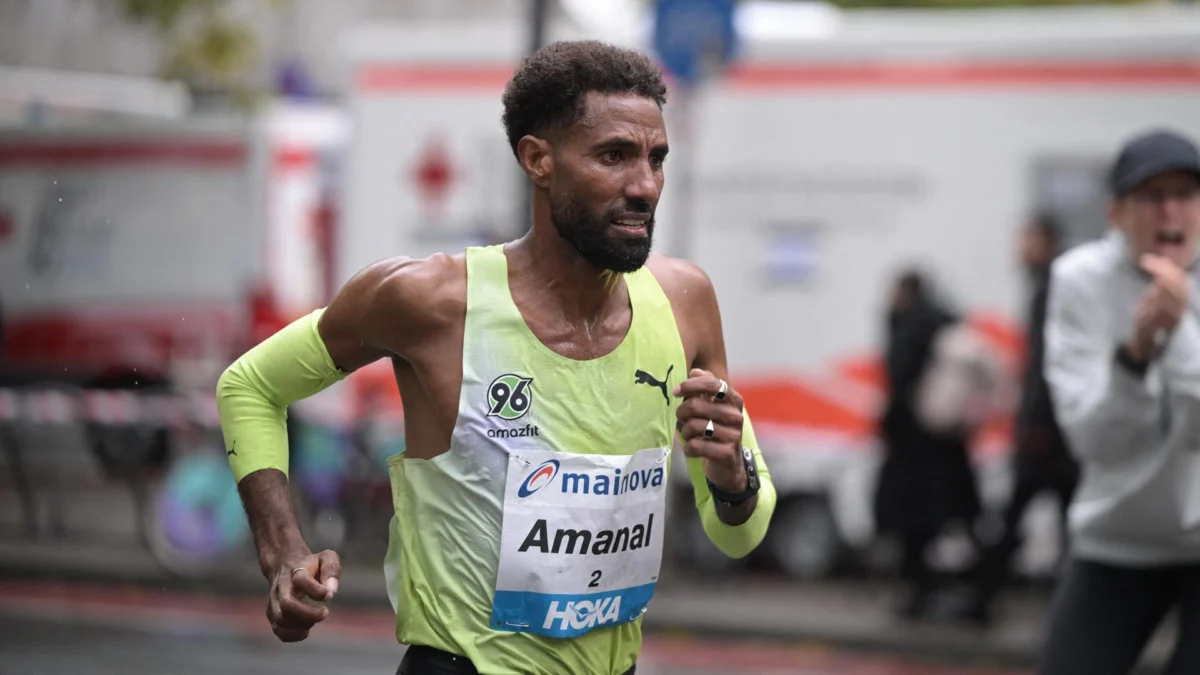
The 2026 Frankfurt Marathon will be remembered as a race of sharp contrasts—defined by the sheer grit of elite endurance, a bizarre obstacle on the course, and the birth of a new German long-distance sensation. In a display of tactical brilliance and physical resilience, Ethiopian runner Jirata Dinki clinched the title, denying local hero Amanal Petros a dream victory in a race that saw both triumph and frustration unfold on the rain-slicked streets of Frankfurt.
The Main Facts: A Battle for the Podium
The men’s elite race culminated in a high-stakes tactical battle. Jirata Dinki claimed the top step of the podium, crossing the finish line in a formidable 2:05:26. German star and European record contender Amanal Petros, representing Hannover 96, secured a hard-fought second place with a time of 2:05:46. The final spot on the podium went to Kenya’s Benard Biwott, who finished in 2:06:23.
The depth of the field was further illustrated by the performances of other German hopefuls. Richard Ringer displayed his consistency by finishing in a respectable fifth place with a time of 2:07:07, while Samuel Fitwi rounded out a strong showing for the home nation by finishing seventh in 2:08:57.
On the women’s side, the day belonged to Ethiopia’s Zeineba Yimer, who dominated with a winning time of 2:19:45. However, the true headline was the sensational marathon debut of Germany’s Blanka Dörfel. The 24-year-old, already a recognized talent over 10,000 meters, shattered expectations by claiming second place in 2:20:46—the second-fastest marathon time ever recorded by a German woman.

Chronology of the Race: From Rain-Sodden Starts to High-Stakes Chaos
The morning in Frankfurt began under testing conditions. Heavy rainfall greeted the field, leaving the streets scattered with deep puddles that forced the elite pack to navigate not only their rivals but also the precarious grip of the asphalt.
As the race settled into a rhythm, Petros—who had openly targeted the European record of 2:03:36—established himself firmly within the lead pack. By the 30-kilometer mark, the race began to break open. Petros initiated a bold tactical surge, testing the resolve of his competitors. Only Biwott and Dinki managed to stay in contact.
The "Delivery Incident"
The race took a surreal turn in the final kilometers. As Petros was locked in a fierce battle for the lead, he found his path obstructed by an unexpected obstacle: an app-based food delivery rider who had wandered onto the course. In a moment of high-tension drama, the delivery driver positioned himself directly on the runners’ line. Petros, clearly frustrated and fighting for the win, was forced to gesture wildly and make physical contact with the driver to clear his path. The incident, while brief, served as a vivid reminder of the challenges of staging world-class marathons in bustling urban centers.
Despite this distraction, the final sprint towards the iconic Frankfurt Festhalle was pure athletics. Petros managed to shake off Biwott, but he had no answer for Dinki’s late-race acceleration. The Ethiopian athlete surged ahead, distancing himself from the German to claim the win.

Supporting Data and Historical Context
The performances on Sunday provide significant data points for the future of German distance running.
- Amanal Petros: While he missed the win, his time of 2:05:46 cements his status as a world-class marathoner. His consistency at the 2:05-2:06 level suggests he is closing the gap on the East African elite.
- Blanka Dörfel’s Ascent: Dörfel’s 2:20:46 is a historical milestone. Only the legendary Irina Mikitenko, who clocked 2:19:19 in Berlin in 2008, remains ahead of her in the German all-time rankings. For a debutant, such a performance is rare and indicates an immense ceiling for the 24-year-old.
- Weather Impact: The early rain and the presence of deep puddles throughout the course undoubtedly hampered attempts to break the European record. The athletes were essentially forced to run an "obstacle course" of water, which impacts stride length and energy conservation over 42.195 kilometers.
Official Responses and Reflections
In the immediate aftermath, the mood was one of tempered satisfaction. Amanal Petros, speaking at the finish line, was reflective about his performance. "I have given everything that I had," he noted, his voice carrying the exhaustion of a sub-2:06 effort. "The race was incredibly tactical, and at the end, I simply lacked the final percentage of power to stay with Dinki."
Blanka Dörfel, conversely, appeared buoyed by her own surprise. "The last five kilometers were incredibly hard. It felt like running through a cold footbath," she laughed, referencing the water-logged streets. "I have never run this distance before, so I ran entirely by feeling. I believe that with better conditions and more experience, I can go significantly faster next time."
The contrast between the two athletes was palpable: Petros, a seasoned professional adjusting to the disappointment of a narrow loss, and Dörfel, a burgeoning talent realizing that she is potentially the future of German female marathon running.

The Implications: What Does This Mean for the Future?
The 2026 Frankfurt Marathon leaves us with three distinct conclusions.
1. The Professionalization of "The Incident"
The collision between Petros and the delivery driver will likely trigger a review of course security protocols. As cities become increasingly dense and the gig economy sees more couriers on the streets, organizers must find more robust ways to secure the race route, particularly in the final, deciding kilometers where seconds determine the winner.
2. A New Standard for German Women
Blanka Dörfel’s performance acts as a catalyst. For years, the German women’s marathon scene has been searching for a successor to the generation of Mikitenko and her peers. By running a 2:20 on her debut, Dörfel has signaled that she is not just a track specialist, but a genuine marathon threat on the world stage. Her approach—running by "feeling"—suggests a natural talent that, if paired with more traditional training cycles, could see her threaten the national record in the coming years.
3. Germany as a Marathon Hub
Despite the rain and the logistical hiccups, the Frankfurt Marathon proved once again that it is a premier venue for world-class times. The ability of the field to produce sub-2:06 times in the men’s race and a sub-2:20 performance in the women’s race confirms that the course remains one of the fastest in Europe.

As the dust settles on Frankfurt, the narrative has shifted from disappointment over a missed victory to excitement over the future. Petros remains a leader of the pack, but the emergence of Dörfel provides a fresh, compelling chapter for German athletics. The marathon world will undoubtedly keep a close eye on these two as they prepare for the next season, with the goal of turning these near-misses and stunning debuts into podium-topping finishes on the international circuit.