The global construction industry is at a crossroads. As cities expand and infrastructure demands rise, the world remains tethered to a material that is as essential as it is ecologically devastating: concrete. Every year, humanity consumes approximately 30 billion tons of this versatile, durable, and ubiquitous building material. Yet, the price of our modern skylines and bridges is paid in carbon emissions. Cement—the fundamental binder in concrete—is responsible for a staggering portion of global CO2 output, owing to both the chemical processes involved in its creation and the extreme heat required for its production.
However, a quiet revolution is emerging from a laboratory at the Bauhaus-Universität in Weimar, Germany. A start-up named Oliment GmbH is betting on an unlikely hero: olivine, a green-tinted mineral abundant in the Earth’s crust. What began as a skeptical inquiry by a researcher has evolved into a breakthrough that could pave the way for a climate-neutral future in construction.
The Genesis of an Accidental Discovery
The story of Oliment is rooted in scientific rigor and, perhaps ironically, healthy skepticism. Researcher Frank Bellmann did not initially set out to invent a green alternative to cement. His original intent was to conduct a series of experiments to prove that the application of magnesium silicates in cement production was not feasible.
In science, however, the most profound discoveries are often found in the results that defy expectations. To his own surprise, Bellmann observed that the material did indeed work. This discovery, incubated within the academic walls of Weimar, suggests that the heavy reliance on traditional, carbon-intensive cement might finally have a viable expiration date.
For years, the team behind Oliment chose to operate in the shadows. "Bisher sind wir mit Absicht tief geflogen, damit wir erst mal in Ruhe arbeiten konnten" (Until now, we have intentionally flown under the radar so we could work in peace), explains Alexander Butt, the company’s commercial managing director. By keeping a low profile, the team was able to focus on technical validation, moving away from the "stealth mode" only once they were certain they had a solution to one of the industry’s most intractable problems.
Cement: The Hidden Carbon Giant
To understand why Oliment is considered a "leapfrog" innovation, one must look at the mechanics of current cement production. Traditional Portland cement is manufactured by heating limestone, clay, and other minerals in massive kilns at temperatures reaching 1,450 degrees Celsius.
This process is doubly damaging to the climate. First, the chemical reaction required to transform limestone into clinker releases CO2 that was previously trapped in the rock. Second, the massive amount of energy required to sustain those temperatures is almost exclusively derived from fossil fuels. Because of this, the cement industry accounts for roughly 7-8% of global CO2 emissions—a figure that is increasingly untenable in a world aiming for net-zero goals.
The Olivine Advantage
Mineralogists have toyed with the idea of using magnesium silicates since the 1980s and 90s, but the industry remained stagnant for decades. The primary challenge was that olivine, unlike limestone, does not naturally behave like a binder when mixed with water. It lacks the "hydraulic activity" required to turn into a hardened, rock-like substance.
"In its original form, olivine does not react with water and does not develop compressive strength," explains Dr. Daniel Wagner, a mineralogist at Oliment. While limestone also requires processing, it had the advantage of established chemical pathways. Because researchers couldn’t find a corresponding process for magnesium silicates, most abandoned the path.
Frank Bellmann, however, discovered a critical missing link. He found that magnesium silicate could be activated at significantly lower temperatures—around 800 degrees Celsius—in a rotary kiln. This is roughly half the energy required for traditional cement. Moreover, because the required temperature is lower, the process can potentially be electrified, allowing for the total removal of fossil fuels from the production cycle. Crucially, olivine contains zero carbon in its natural state, fundamentally changing the emissions math of the resulting concrete.
Chronology of Development
The transition from a university lab to an industrial pilot plant was not a given. The project’s acceleration is largely attributed to the tenacity of Günter Bellmann, Frank’s father. An experienced engineer who had worked on large-scale infrastructure projects in the former East Germany, including the construction of the Leipzig-Grünau district, he recognized the potential of his son’s research.
When the Bundesagentur für Sprunginnovationen (SPRIND)—the German Federal Agency for Disruptive Innovation—established its offices in Leipzig in 2019, the elder Bellmann saw an opportunity. Through a persistent effort to get his pitch deck into the hands of the right decision-makers, he secured the initial funding necessary to move the project from academic theory to a startup entity.
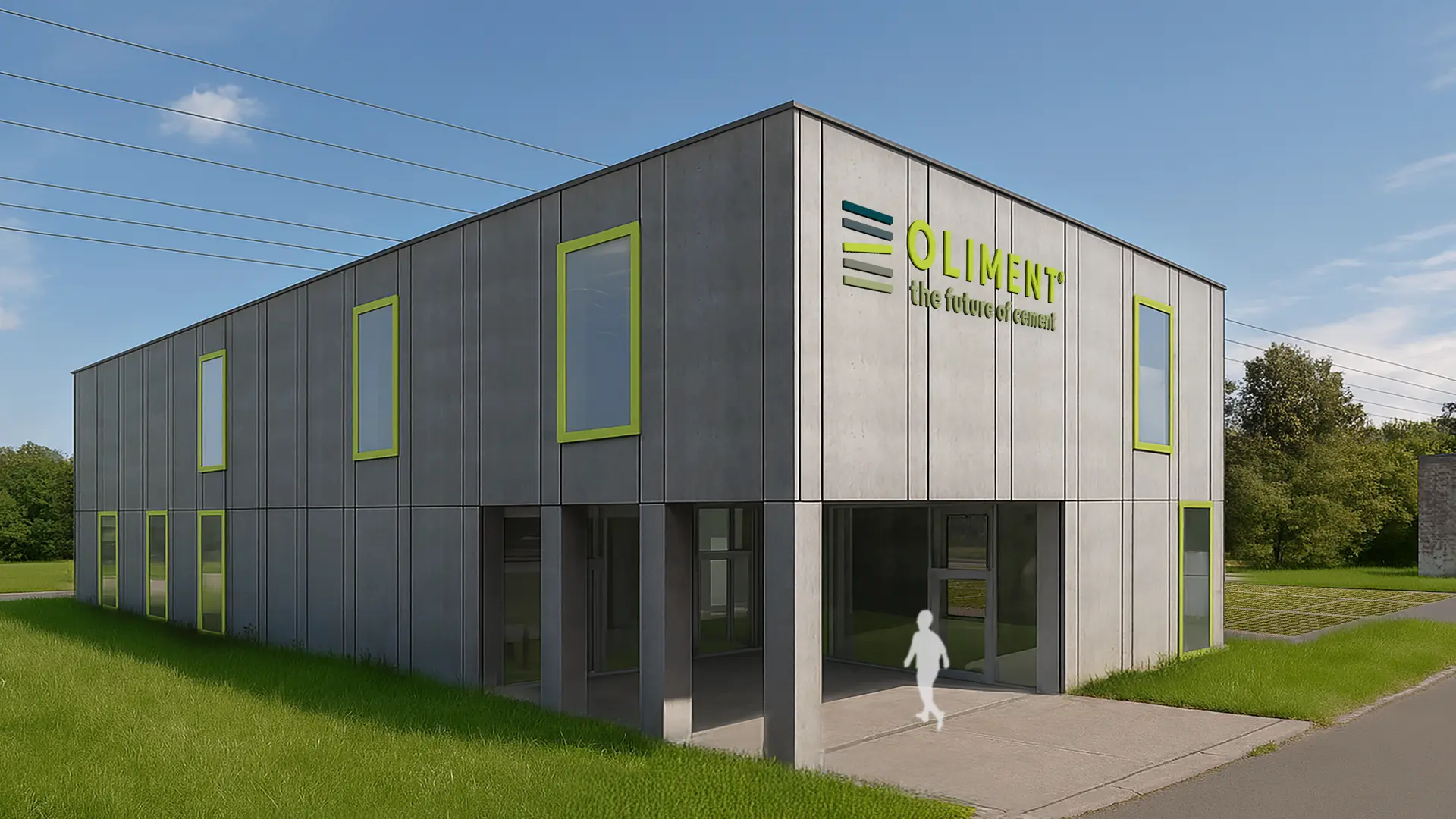
Following this seed funding, the team reached a major milestone in June of this year: the laying of the foundation for an office building in Espenhain, near Leipzig. This building is not just a workspace; it is the first real-world test for Oliment’s binder. The company has also established a "Technikum"—a pilot production facility capable of producing one ton of the new binder per day.
Hurdles on the Path to Scalability
Despite the promising results, the road to replacing a commodity as entrenched as concrete is paved with significant obstacles. The primary hurdle is regulatory.
"This means that completely new approvals are required," says Olav Carlsen, the SPRIND partner manager responsible for the Oliment project. Because concrete is used in structures meant to last for decades, such as bridges, high-rises, and tunnels, the building codes are incredibly strict. Authorities require ironclad proof that a building made with Oliment will not lose its structural integrity over 50 or 100 years.
To provide this proof, Oliment must conduct extensive, expensive, and time-consuming "weathering" tests. These simulations subject the material to accelerated environmental stress to mimic the passage of decades. Furthermore, the company must build a "first-of-a-kind" industrial plant to prove that the process can scale from one ton a day to the thousands of tons required by major construction firms.
Official Perspectives and Market Implications
The support from SPRIND is a testament to the strategic importance of this project. SPRIND typically backs "deep tech" projects in biotechnology or artificial intelligence, where research cycles span decades. In this landscape, Oliment is an anomaly. However, the agency views it as a "high-risk, high-reward" endeavor essential to the transition of the construction sector.
"The demand for a CO2-reduced starting material is enormous," notes Carlsen. The economic pressure on the construction industry is mounting. As carbon certificates become more expensive and public procurement guidelines tighten regarding the "embodied carbon" of building materials, developers are desperate for low-carbon alternatives that perform like traditional concrete.
If Oliment succeeds in navigating the regulatory landscape, the impact could be global. Traditional cement plants produce between 3,000 and 10,000 tons of cement per day. For Oliment to succeed, it must eventually partner with major industrial players capable of building full-scale plants that can match this output.
Conclusion: A Shift in Foundations
The success of Oliment would represent more than just a win for the climate; it would represent a fundamental shift in how we conceive of industrial progress. For decades, the industry has relied on a "burn and build" model that effectively treats the atmosphere as a dumping ground for carbon.
By utilizing a common, carbon-free mineral and an energy-efficient production process, Oliment offers a blueprint for a circular, low-carbon future. The journey from a skeptical lab test in Weimar to a building site in Espenhain has been long, and the path to global adoption remains fraught with technical and regulatory challenges. Yet, as the world searches for ways to build our future without destroying our climate, the humble olivine stone may prove to be the most vital building block of the 21st century.