Prague, Czech Republic – October 26, 2026 – A contentious legislative maneuver in the Czech Republic has ignited widespread public outcry and protests, as the lower house of parliament, the Chamber of Deputies, has fast-tracked a controversial bill to abolish public broadcasting fees. The swift passage of the bill in its first reading has sent shockwaves through civil society, raising grave concerns about the independence and future of Czech public media. Tens of thousands of citizens have taken to the streets in Prague and other cities, voicing their opposition to a move that critics fear could compromise the integrity of journalistic reporting and usher in an era of political influence over the airwaves.
The Core of the Controversy: Abolishing Fees, Shifting Funding
At the heart of the legislative storm is the government’s proposal to eliminate the mandatory fees that currently fund the Czech Republic’s public service broadcasters, Česká televize (Czech Television) and Český rozhlas (Czech Radio). Instead, the government intends to finance these institutions directly from the state budget. While proponents argue this will streamline funding and ensure greater financial stability, opponents contend it represents a direct threat to the editorial independence that public service media are meant to uphold.
The proposed shift would result in a significant budgetary cut for public broadcasting, estimated to be over 15 percent. This reduction in funding, coupled with the direct allocation from the state budget, has fueled fears that politicians could exert undue influence over content, potentially compromising the impartiality and critical reporting that have long been hallmarks of Czech public media.
A Rapid Legislative Push and Escalating Protests
The government’s intention to alter the funding model for public broadcasters was first announced in the summer. However, the speed at which the legislation was introduced and advanced through parliament took many by surprise. In an unusual late-night session on Friday, October 23rd, the ruling coalition submitted the bill, pushing for a vote in the Chamber of Deputies just hours later. The vote concluded shortly before 4:30 AM on Saturday, October 24th, marking a rapid and, for many, a concerning pace of legislative action.
This abrupt parliamentary maneuver triggered immediate and spontaneous protests. A demonstration convened on Friday evening outside the Parliament building, and throughout the weekend, citizens across several Czech cities took to the streets to express their dissent.
On Sunday afternoon, the Altstädter Ring (Old Town Square) in Prague became the epicenter of a massive demonstration. Despite intermittent weather, tens of thousands of people, answering the call of the initiative "A Million Moments for Democracy," gathered to voice their concerns. The sheer scale of the turnout underscored the depth of public anxiety surrounding the government’s actions.
Voices of Dissent: Fear for Independence and Historical Parallels
The messages displayed on placards at the Prague demonstration clearly articulated the protesters’ grievances. Phrases like "Hands off the media" and "Today money, tomorrow content" were prominently featured, reflecting a deep-seated fear that direct state funding would inevitably lead to political interference in journalistic output.
Sara, an 18-year-old high school graduate attending the protest with a friend, articulated this sentiment forcefully. "We are here because we believe that the media should be independent and should not be threatened by what a politician thinks," she stated. "And we find the way the government is handling this important law to be inappropriate."
For many, the proposed changes evoked uncomfortable historical parallels. Lenka Bartakova, who brought her child to the demonstration, expressed her deep-seated apprehension. "I experienced this under communism, so I absolutely do not want to see something like that return," she said, her child’s stroller decorated with plush toys of familiar television characters. "They say it’s only about the fees and that they won’t have any influence on the content – but they will. As soon as politicians have their hands on it, no one knows what will happen afterwards." This sentiment, drawing a direct line to the era of state-controlled media under communist rule, highlights the gravity with which many Czech citizens perceive the current legislative push.
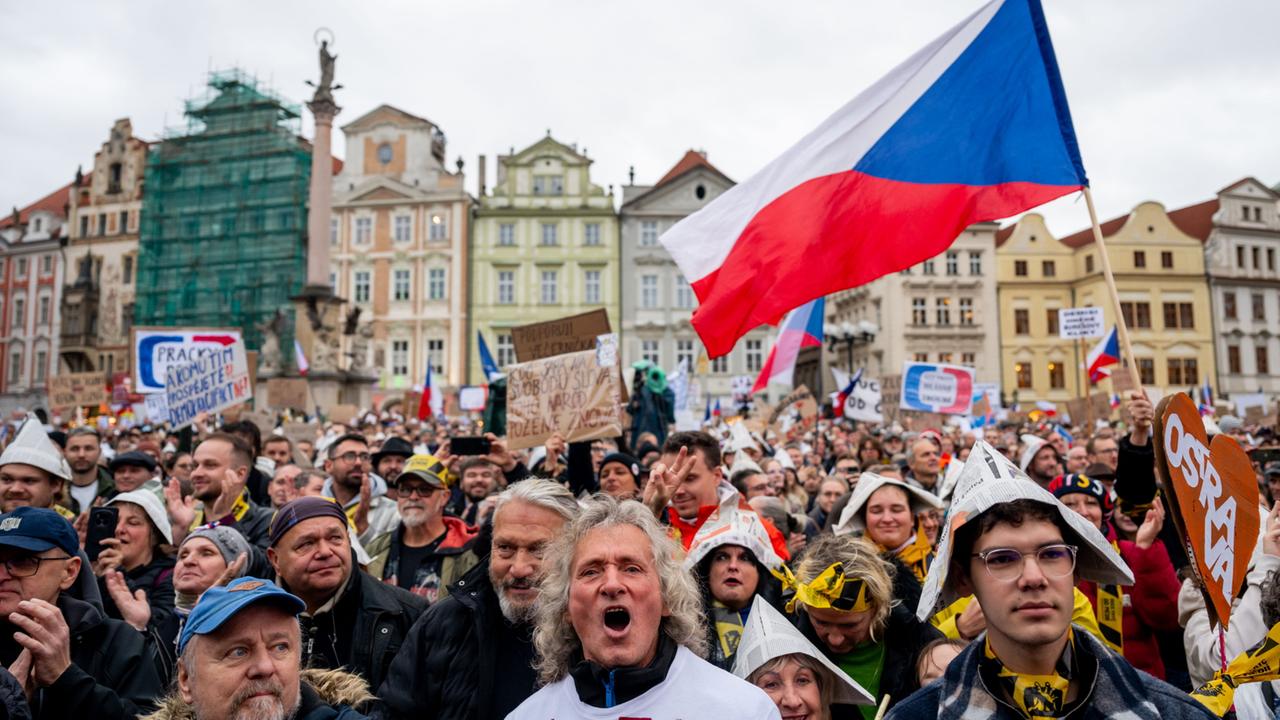
Another demonstrator, Zdenek Skala, also voiced his displeasure with the parliamentary proceedings. "We believe that such a change should be debated thoroughly and publicly," he argued. "But that is not happening – and obviously, this debate is intentionally being prevented." The use of symbolic imagery, such as hats made of newspaper – a nod to the Czech children’s television character "Večerníček" – and images of a weeping mole, further underscored the emotional and cultural significance of public broadcasting for many Czechs.
Official Responses: Government Defiance, Presidential Concern
The government, however, remains largely defiant in its stance. Prime Minister Andrej Babiš has repeatedly asserted that the intention is not to interfere with journalistic content. He stated on the social media platform X that the proposed change would make the financing of public broadcasting "more stable and predictable."
Conversely, liberal President Petr Pavel has expressed significant concern, not necessarily about the substance of the proposed change, but about the method by which it was introduced and passed. He too took to X to criticize the parliamentary process, stating that it undermines "faith in the good intentions of the initiators." This public disagreement between the President and the Prime Minister highlights the deep divisions within the Czech political landscape regarding the future of public media.
Political Maneuvering: A Strategy for Electoral Gain?
Political scientists suggest that the government’s swift legislative action may be driven by more than just a desire to reform public broadcasting. Vladimira Dvorakova, a political scientist, posits that the timing of the vote, following the opposition’s strong performance in the Senate elections in early October, could be a deliberate political calculation.
"It is an attempt to divert attention to something else and to wage a culture war instead of a debate," Dvorakova commented. "There is no other reason for it to have gone so quickly." This perspective suggests that the government might be seeking to rally its base and create a divisive issue that distracts from other political challenges, particularly in the wake of electoral setbacks. The rapid legislative process, in this view, is not about a genuine desire for public discourse but about circumventing it to achieve a political objective.
The Road Ahead: Continued Opposition and Uncertain Future
Despite the first reading’s approval, the bill’s journey is far from over. It must still undergo further readings and amendments in the Chamber of Deputies before potentially moving to the Senate and, ultimately, to the President for his signature. However, the intensity of public opposition and the President’s reservations cast a long shadow over its ultimate enactment.
The impact of this legislative push is already being felt. Employees of public service broadcasters have called for a strike on November 3rd, signaling their commitment to defending their institutions. Furthermore, another large-scale demonstration is already scheduled for mid-November, indicating that the protests are likely to continue and potentially escalate.
The debate over the future of public broadcasting in the Czech Republic is more than just a discussion about funding mechanisms; it is a fundamental argument about the role of independent media in a democratic society. As the legislative process unfolds, the resolve of the protesters, the stance of the President, and the political calculations of the government will all play crucial roles in determining whether Czech public media will remain a bulwark of independent journalism or become susceptible to political influence. The coming weeks and months will be critical in shaping the landscape of information and public discourse in the Czech Republic for years to come.