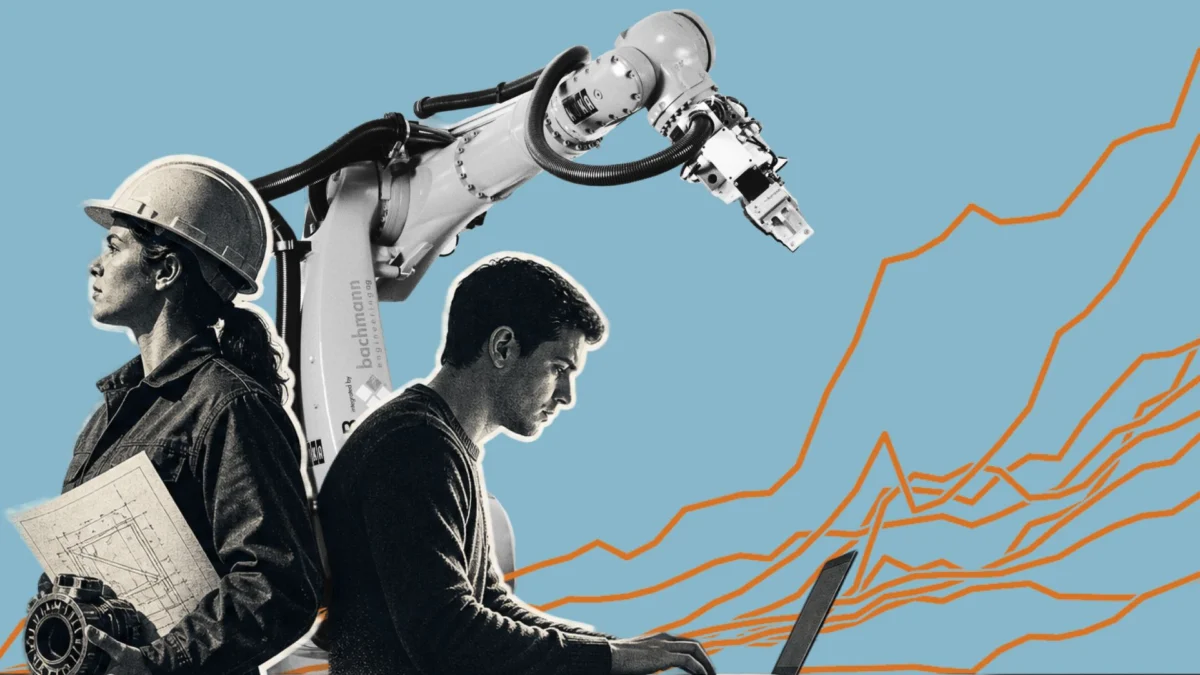
In the landscape of the modern German economy, a peculiar and defining paradox has emerged. While the broader job market is witnessing a significant cooling period—characterized by a contraction in total job postings—a specific, high-value segment of the workforce is finding itself in unprecedented demand. As companies scramble to integrate artificial intelligence into their operational frameworks to meet the ambitious benchmarks of the federal government’s AI strategy, a severe shortage of skilled human talent has come to the fore.
The current economic climate, as captured by data from the job portal Indeed, reflects a stark reality: since November 2022, the month preceding the global public release of the generative AI phenomenon ChatGPT, the total volume of job advertisements in Germany has plummeted by approximately 37 percent. This decline signals a period of corporate caution and economic stagnation. Yet, beneath this aggregate trend lies a counter-cyclical gold rush. The "AI Talent Gap" is no longer a theoretical concern for policymakers; it is an acute operational bottleneck for businesses attempting to transition from pilot projects to full-scale AI deployment.

The Chronology of a Skills Shift
To understand the current scarcity of expertise, one must look at the timeline of the "AI Acceleration" period.
- Late 2022 (The Inflection Point): The launch of ChatGPT in November 2022 acted as a catalyst. Before this date, AI was primarily the domain of highly specialized data scientists and research-heavy institutions. The democratization of generative tools forced corporate boards to pivot, realizing that AI was no longer a future-looking R&D project but an immediate competitive necessity.
- Early to Mid-2023 (The Pilot Phase): Throughout the following year, companies across Germany initiated thousands of small-scale experiments. While hiring for general roles slowed down due to inflationary pressures and energy costs, the demand for "AI literacy" began to appear in job descriptions for non-technical roles, such as marketing, legal, and human resources.
- 2024 (The Implementation Crisis): We have now entered a phase where companies are struggling to move beyond the "prototype" stage. The lack of qualified personnel to integrate, oversee, and ethically manage these systems has become a primary barrier to growth. The decline in the overall job market, while daunting for the general workforce, has ironically highlighted that the only roles currently "safe" or "in growth" are those that involve the practical application of machine learning and data-driven systems.
Decoding the Data: Where the Opportunities Lie
The analysis of current employment data—conducted in collaboration with technology-analysis firm Interface—reveals that the demand is not exclusively focused on the "builders" of AI. While there is a perpetual hunt for AI researchers and machine learning engineers, there is a massive, untapped demand for "applied users."

The Three Tiers of Demand:
- The Architects (High Complexity): These are the software engineers, data architects, and machine learning specialists responsible for building proprietary models and fine-tuning LLMs (Large Language Models). These roles command the highest salaries and are the most difficult to fill.
- The Implementers (Operational Focus): This segment represents the bridge between R&D and business. They are professionals who understand how to integrate APIs into existing business workflows, manage data pipelines, and ensure compliance with the EU AI Act.
- The Translators (Strategic Focus): These are perhaps the most critical for mass adoption. They are not necessarily coders, but domain experts—lawyers who understand AI regulation, marketers who can prompt-engineer for brand consistency, and HR professionals who can manage the workforce transition.
The data suggests that the "AI Premium" in salary and job security is becoming a permanent fixture of the German labor market. Even in industries traditionally considered "analog," such as manufacturing and logistics, the ability to operate robotic systems enhanced by computer vision or to analyze supply chain data using predictive AI is becoming a core competency.
Official Stances: The German AI Strategy
The German federal government has identified this shortage as a strategic risk. The federal AI strategy emphasizes not only the development of German-made AI infrastructure but also the mass upskilling of the existing labor force.
Official reports from the Federal Ministry of Education and Research highlight that Germany risks falling behind international competitors if it fails to cultivate a "hybrid workforce." The government’s initiatives aim to bridge the gap between academic research and industrial application. However, critics from the private sector argue that these initiatives are moving too slowly to address the immediate hiring needs of firms that are struggling to remain competitive in the face of rapid technological disruption.
The government’s stance is clear: The transition to an AI-augmented economy is inevitable, and the state’s role is to ensure that the German vocational and university systems pivot toward data-literacy and digital ethics. Yet, the current reality remains that companies are sourcing talent globally rather than waiting for the local educational pipeline to catch up.

Implications for the Workforce
The implications of this shift are profound, creating a "bifurcated labor market." On one side, we see a contraction in roles that are easily automated or subject to administrative streamlining. On the other, we see a booming demand for roles that leverage AI to create value.
1. The Death of the "Generalist"
In the near future, the term "generalist" may become obsolete. Employees who possess deep domain knowledge in a specific sector (e.g., automotive engineering or pharmaceutical research) combined with a practical understanding of how to use AI tools will become the most valuable commodity in the German economy.

2. The Reskilling Mandate
For the current workforce, the message is clear: passive observation of the AI revolution is a career risk. Companies are increasingly prioritizing internal mobility, favoring employees who demonstrate an aptitude for learning new AI-integrated software over those with longer tenures but static skill sets.
3. The Ethical and Legal Dimension
As AI implementation matures, there is a surge in demand for roles focused on the governance of these systems. With the implementation of the EU AI Act, companies are looking for "AI Compliance Officers" and legal specialists who can navigate the complex intersection of intellectual property rights, data privacy, and algorithmic bias.

Conclusion: Navigating the New Normal
The cooling of the German job market, as evidenced by the decline in postings on platforms like Indeed, is a sobering indicator of the current economic environment. However, the surge in demand for AI-literate talent acts as a vital counterweight.
For the job seeker, the path forward is no longer about finding a role that is "AI-proof"—such a thing barely exists—but about becoming an "AI-augmented" professional. The companies that are currently weathering the economic downturn are those that have successfully integrated technology to boost productivity. They are the ones currently hiring.

The challenge for Germany is to turn this individual necessity into a systemic strength. Whether through private sector training, university-led upskilling, or federal policy, the imperative is the same: the future of the German economy depends on its ability to transition from a workforce that competes with AI to one that leads by directing it. The talent is there, but the bridge between traditional skill sets and the requirements of the future needs to be built—and crossed—with significant urgency.