In the high-stakes, hyper-competitive theater of the English Premier League, where managerial turnover is often measured in months and tactical evolution is the only currency that buys longevity, a young German tactician is making waves. Fabian Hürzeler, the former mastermind behind FC St. Pauli’s ascent to the Bundesliga, has arrived at Brighton and Hove Albion and, within a few short months, has fundamentally altered the tactical landscape of the English game.
Hürzeler’s approach is not built on the bluster of aggressive shouting or the rigid adherence to a single formation. Instead, it is a masterclass in spatial awareness, calculated intensity, and a modern interpretation of the classic "Tortoise and the Hare" fable. His Brighton side does not just play football; they anticipate it.
The Tactical Foundation: "I’m Already There"
The most striking observation for opponents—be they struggling bottom-table sides or established giants like Manchester United and Arsenal—is the eerie sensation that Brighton players have already occupied the space where the ball is about to arrive.
During a blistering series of fixtures in September, both Manchester United and Arsenal found themselves caught in a tactical web. As players attempted to pivot, pass, or find an outlet, they were consistently met by a Brighton player in blue. It was not a matter of numerical superiority; rather, it was a triumph of structure. Hürzeler’s system uses positioning and pressing to guide the opposition’s passing lanes, rendering their options predictable.
"The opponent shouldn’t even be allowed to exit Brighton’s attacking space," notes the Global Soccer Network (GSN), whose data analysis highlights the surgical precision of Hürzeler’s setup. By forcing the opposition into confined areas, Brighton effectively "fences in" their rivals, turning every turnover into a potential scoring opportunity.
Chronology of a Meteoric Rise
Hürzeler’s journey from the Millerntor-Stadion in Hamburg to the Amex Stadium has been swift, yet the tactical principles he brought with him are deeply rooted.
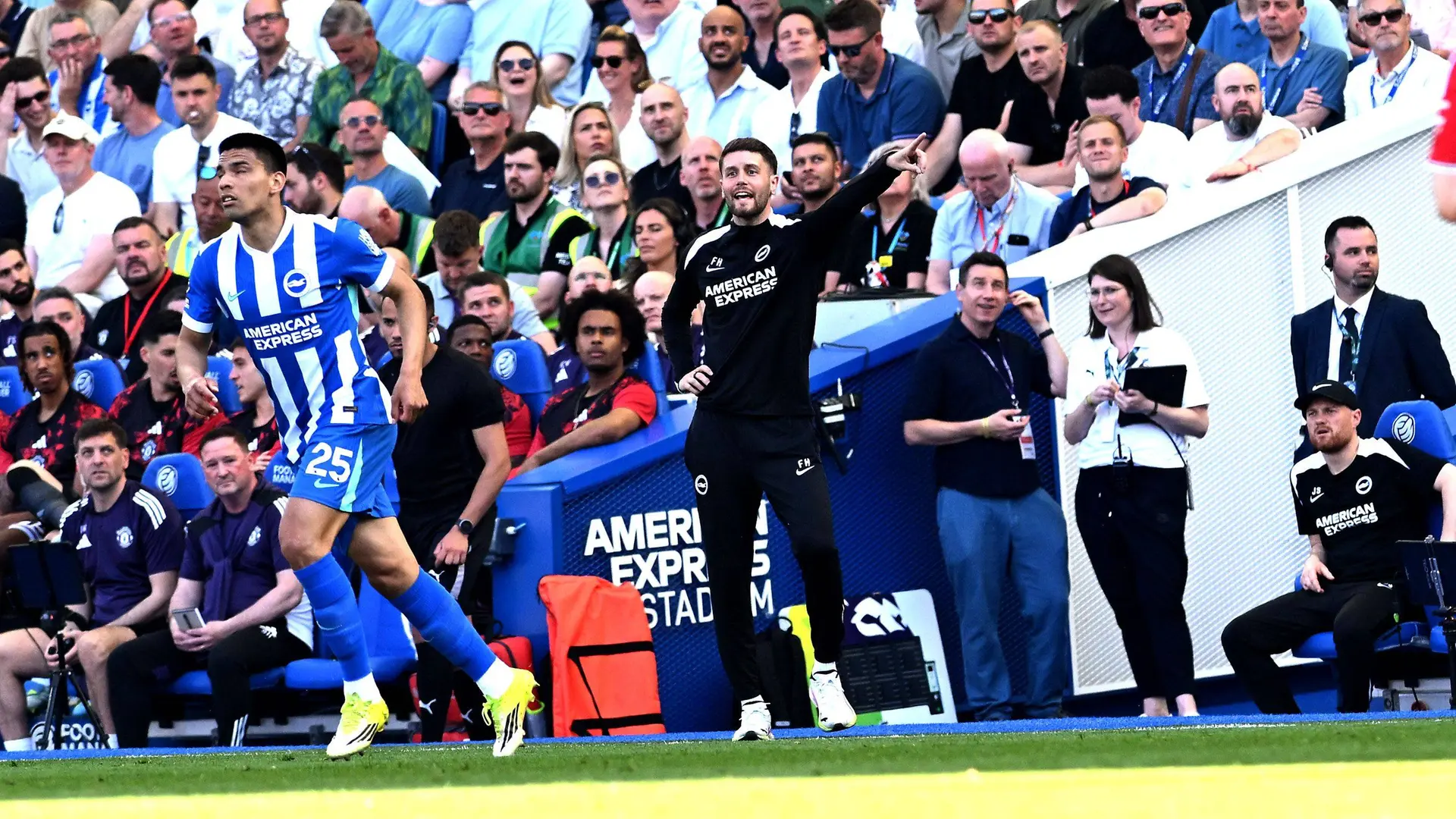
- The St. Pauli Blueprint: At FC St. Pauli, Hürzeler implemented a high-possession, dominant style that prioritized controlling the opponent’s options. He was adamant that his team should dictate the flow of the game rather than reacting to it.
- The Premier League Baptism: Upon arriving at Brighton, the transition was seamless. The squad, arguably more technically gifted than his previous charges, absorbed his philosophy with remarkable speed.
- The "Lektion" (Lesson) for the Elite: The turning point in public perception occurred during Brighton’s 3-2 comeback win against Manchester United at Old Trafford, capped by a goal from German international Pascal Groß. Shortly thereafter, Arsenal manager Mikel Arteta was left visibly shaken following a 3-0 defeat, admitting that his side had been given a "lesson" in tactical discipline.
- The Current Momentum: Following the recent international break, Brighton’s form has been relentless, with a 2-0 win over Sunderland and a 5-0 demolition of Crystal Palace. With high-profile tests against Liverpool and Manchester City on the horizon, the Premier League is watching with bated breath to see if Hürzeler’s "spatial wonder" can topple the established hierarchy.
Supporting Data: The Science of Dominance
The brilliance of Hürzeler’s system is best illustrated by the cold, hard data. While many managers demand endless running, Hürzeler demands "situational intensity."
39% of Ball Recoveries in the Final Third
Brighton leads the league in high-press effectiveness. Roughly 33 balls are won per match in the opponent’s half, with nearly seven of those occurring inside the penalty area—the best record in the Premier League. This ensures that Brighton’s attacks are rarely one-off events; they occur in waves, sustained by the immediate recovery of possession.
Tactical Efficiency Over Physical Output
GSN data reveals a startling statistic: Brighton ranks among the lowest in the league for total running and sprint volume. They are not outrunning their opponents; they are out-thinking them. By occupying the correct spaces, the team minimizes the need for frantic, recovery-based sprints.
"The team occupies spaces so well that they currently don’t have to run or dribble much to dominate the opponent," the GSN analysis states. This is a radical departure from the high-intensity, high-fatigue pressing models popularized by coaches like Jürgen Klopp or Ralf Rangnick.
Official Responses and Managerial Philosophy
Hürzeler’s philosophy is defined by flexibility. He famously stated during his time at St. Pauli that he prioritizes "spaces, not positions." He explained: "There are spaces that must be occupied by us, but who does it is ultimately irrelevant."
This dogma-free approach allows Brighton to be fluid. When a player drifts out of position, another instinctively rotates to fill the gap. It is a system that demands a high footballing IQ from every player on the pitch.
Reflecting on the Arsenal match, football legend Alan Shearer echoed the sentiment of many pundits: "Every time they [Brighton] did it, they got the ball. They do it as a team, not alone or in pairs." This collaborative pressing, applied at the exact moment of tactical vulnerability, has made Brighton one of the most difficult teams to play through in Europe.
Implications: The Evolution of the "Long Ball"
Perhaps the most fascinating aspect of Hürzeler’s evolution is his willingness to adapt. At St. Pauli, he was famously skeptical of the "long ball," viewing it as a manifestation of chance rather than skill. He feared that relying on long balls hindered player development.
However, at Brighton, he has integrated the long ball as a sophisticated tactical weapon. Data shows that Brighton boasts a 60% success rate on long balls—the second-best in the league. It is no longer a "panic button" but a calculated tool to bypass the opposition’s press. By mastering this, Hürzeler has removed the predictability from his own side, forcing opponents to guard against both short, intricate build-up play and dangerous, direct aerial balls.
The Road Ahead: A New Standard?
As Hürzeler prepares his team for the daunting tests against Liverpool and Manchester City, the implications of his success are profound. He is proving that the Premier League, often criticized for its reliance on individual brilliance and sheer physical speed, is still susceptible to the "German school" of tactical structure.
If Brighton continues to perform at this level, Hürzeler will not just be a manager of a "surprise package" team; he will be the architect of a new tactical trend. His ability to distill complex, space-oriented football into an effective, winning formula suggests that he is the vanguard of a new generation of managers.
For now, the Premier League is left to solve the riddle of the "Hase und Igel"—the Hare and the Hedgehog. As the season progresses, one thing is clear: when the ball arrives in the final third, a Brighton player is already there, and they are ready to dictate what happens next. The revolution at the Amex is not just about points; it is about the mastery of time and space, and Fabian Hürzeler is holding the compass.