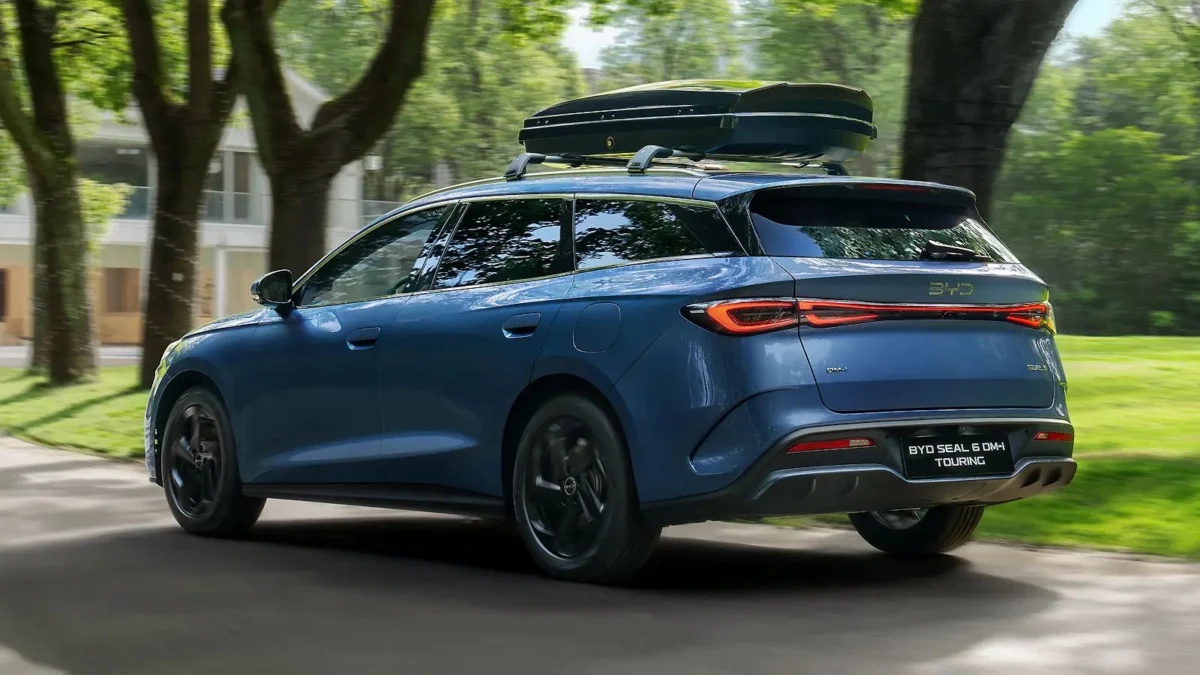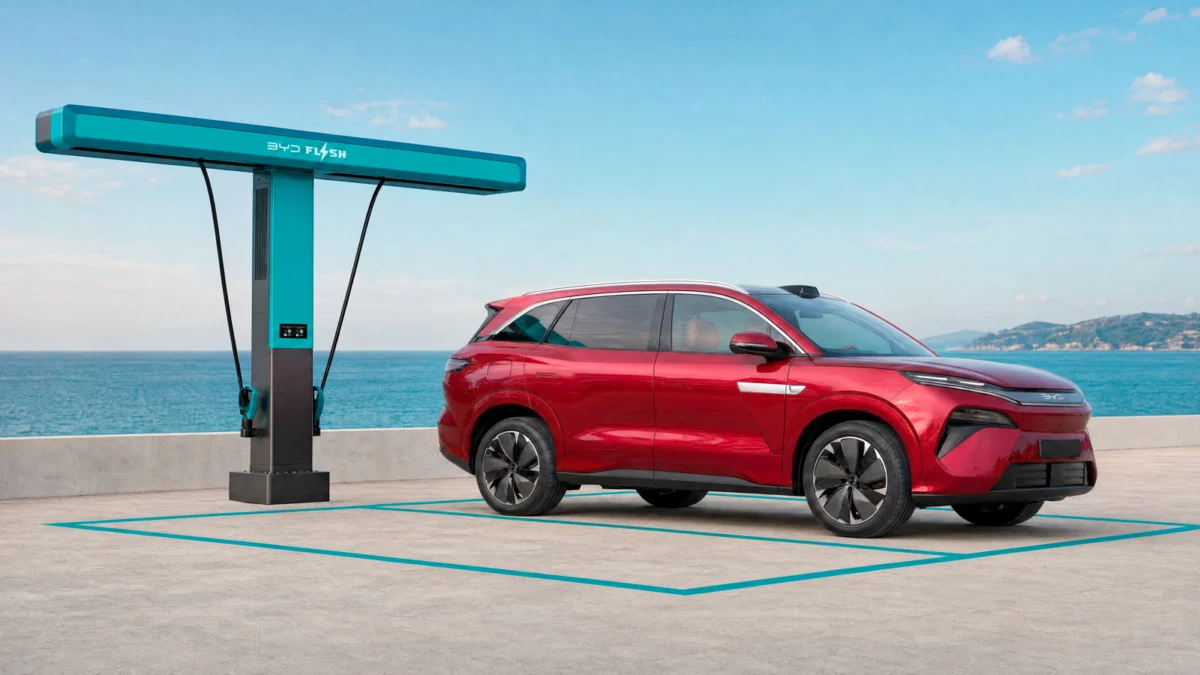
At the Paris Motor Show, Chinese automotive giant BYD made a bold statement regarding the future of electromobility. The introduction of the BYD Atto 8, a full-electric, seven-seater SUV, marks a strategic pivot for the brand. Positioned above the compact Atto 2, the popular Atto 3, the Sealion 5, and the Seal U, the Atto 8 is not merely a new model—it is a technology flagship designed to dismantle the long-standing stigma that BYD vehicles are "leisurely" chargers.
Equipped with the proprietary Blade Battery 2.0 and capable of leveraging BYD’s new "Flash Charging" technology, the Atto 8 aims to transform the European electric vehicle landscape. With a market entry scheduled for the first quarter of 2027, BYD is positioning itself to compete directly with premium electric haulers like the Kia EV9.
The Technical Core: Blade Battery 2.0 and Flash Charging
The cornerstone of the Atto 8’s performance is its massive 115-kWh battery pack. BYD has opted to stick with Lithium-Iron-Phosphate (LFP) chemistry, a move that surprised many industry analysts who expected a shift to more energy-dense chemistries. However, the "Blade Battery 2.0" represents a significant evolution. By refining the cathode structure, electrolyte composition, anode, and the Solid Electrolyte Interphase (SEI) layer, BYD claims to have achieved a 5% increase in energy density while simultaneously reducing internal resistance to facilitate rapid ion movement.
The most provocative aspect of this launch is the "Flash Charging" capability. BYD’s marketing slogan, "Ready in 5. Full in 9. +3 in the cold," encapsulates the promise:
- 10% to 70% in 5 minutes.
- 10% to 97% in 9 minutes.
- 20% to 97% in 12 minutes at temperatures as low as -30°C.
It is crucial to note that these figures are contingent upon the use of BYD’s proprietary Flash Charging infrastructure. While the company has not released a formal "maximum charging power" specification, back-of-the-envelope calculations suggest the vehicle must be capable of accepting sustained power inputs in the 600-kW to 800-kW range to achieve these times.
Chronology of Development and Market Entry
The roadmap for the Atto 8 is ambitious, reflecting the company’s aggressive expansion strategy in Europe.
- Q4 2024: Official unveiling at the Paris Motor Show, highlighting the shift toward high-performance, high-capacity charging.
- April 2026: Scheduled European debut for the Flash Charging infrastructure project.
- 12-Month Rollout (2026–2027): BYD intends to establish a network of 3,000 "Flash Charging" stations across Europe.
- Q1 2027: Expected commercial market launch of the Atto 8 in Europe.
This timeline leaves a gap of roughly one year between the deployment of the first chargers and the vehicle’s arrival at dealerships. During this interim period, the Atto 8 will function like any other premium EV, relying on existing public CCS2 charging infrastructure, albeit without the benefit of the extreme charging speeds promised by the Flash network.
Supporting Data and Performance Specifications
The Atto 8 enters the market in two distinct powertrain configurations, both utilizing the 115-kWh architecture:
1. Design RWD (Rear-Wheel Drive)
- Power: 340 kW (approx. 462 hp)
- Acceleration (0–100 km/h): 8.0 seconds
- Range (WLTP): Up to 653 kilometers
2. Excellence AWD (All-Wheel Drive)
- Power: 570 kW (approx. 775 hp)
- Acceleration (0–100 km/h): 4.6 seconds
- Range (WLTP): Up to 602 kilometers
Beyond the powertrain, the vehicle boasts substantial dimensions (5,040 x 1,996 x 1,760 mm), offering a cavernous interior. Practicality is enhanced by a 270-liter trunk that expands to 1,960 liters with seats folded, complemented by a 136-liter "frunk." The interior tech suite includes a massive 26-inch head-up display, a 15.6-inch infotainment screen, and full integration of Google services, including Maps and the Play Store.

Official Responses and Infrastructure Challenges
BYD’s commitment to building 3,000 stations is a capital-intensive undertaking. According to BYD country manager Bono Ge, the cost per installation ranges between £500,000 and £1 million (€590,000 to €1.2 million). To manage the massive power demand, these stations utilize battery-buffered storage (approximately 370–380 kWh per unit). This allows the stations to draw power from the grid at a manageable, steady rate while providing a high-output burst to the vehicle during the charging session.
Regarding the charging connector, while BYD has not officially confirmed the specifics, industry experts anticipate a reinforced CCS2 implementation. Reports indicate that this custom hardware is designed to handle a continuous current of 1,000 amperes, with a "boost mode" pushing up to 1,500 amperes at 1,000 volts.
Strategic Implications for the European Market
The Atto 8 is, in many ways, a product for "early adopters." The reliance on a proprietary network presents both an opportunity and a risk.
The Infrastructure Dilemma
The promise of a nine-minute charge is currently theoretical for the average European driver. Without a fully realized network of 3,000 stations, the Atto 8’s primary selling point is neutralized. Furthermore, while the stations will be open to other CCS2-compatible vehicles, those vehicles will be limited by their own internal battery management systems, meaning the "Flash" experience will be exclusive to BYD owners for the foreseeable future.
Competitive Positioning
By targeting the seven-seater SUV segment, BYD is challenging incumbents like the Kia EV9 and the Skoda Peaq. These vehicles have established themselves as benchmarks for family-oriented, long-range electric travel. BYD’s advantage lies in its vertical integration; because they manufacture the batteries, the charging stations, and the vehicles themselves, they have an unprecedented level of control over the charging ecosystem.
The "Deep Pockets" Factor
Critics of the strategy point to the high cost of installation and the uncertainty of site locations. However, as noted by industry analysts, BYD’s financial resilience—often described as having "deep pockets"—allows them to sustain losses on infrastructure deployment to gain long-term market share. Whether European consumers are willing to embrace a brand that requires a specific, proprietary charging network remains the critical question.
Conclusion: A Paradigm Shift?
The BYD Atto 8 is a watershed moment for the Chinese automaker. It signifies a transition from being a budget-conscious manufacturer to a leader in high-performance electric architecture. By tackling the two greatest pain points of electric vehicle ownership—charging speed and cold-weather performance—BYD is attempting to remove the final barriers to mass adoption.
However, the success of the Atto 8 will not be determined in the design studio or even on the test track. It will be determined by the speed at which BYD can roll out its 3,000-station network across the diverse regulatory and geographical landscape of Europe. Until those stations are operational and accessible, the Atto 8 remains a formidable machine waiting for its environment to catch up to its capabilities. For now, it serves as a clear warning to European manufacturers: the era of "leisurely" electric travel is coming to an end, and BYD is the one holding the stopwatch.