

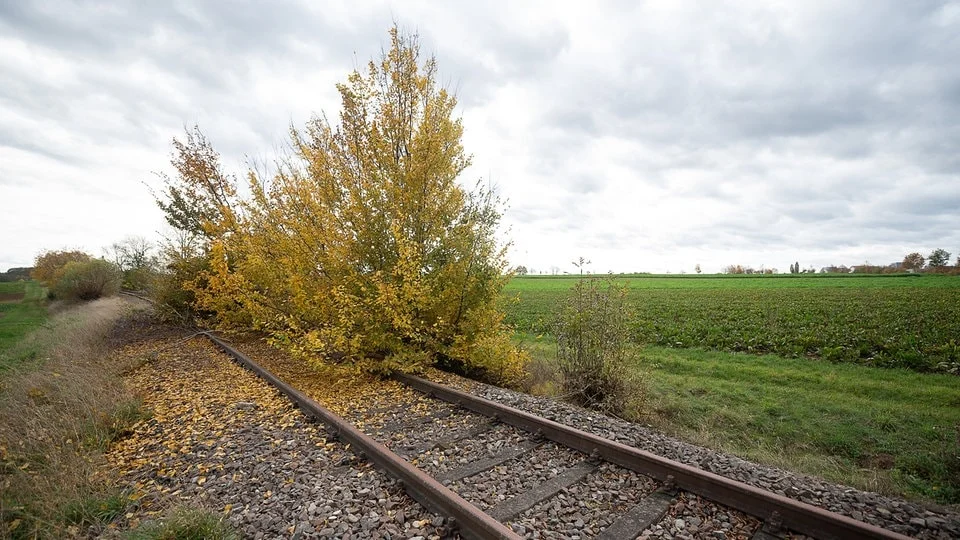
The debate over the future of rural mobility in Germany has reached a critical juncture. While the federal government pushes for a “traffic transition” (Verkehrswende) aimed at decarbonizing transport, the reality on the ground—particularly in states like Thuringia and Saxony-Anhalt—tells a story of systemic neglect. The Werrabahn, once a vital artery in southern Thuringia, serves as a poignant case study: a line silenced for over eight decades, now entangled in a web of cost-benefit analyses that seem to favor asphalt over steel.
The Werrabahn: A Symbol of Disconnection
The Werrabahn in southern Thuringia stands as a stark monument to the railway policies of the 20th century. Having seen its last scheduled train traverse its tracks more than 80 years ago, the line is a ghost of a bygone era of regional connectivity. Today, any hope for its reactivation remains slim, strangled by economic projections that categorize the project as financially unviable.
According to recent calculations by the Thuringian Ministry of Transport, a full-scale reactivation would require an investment of up to 150 million euros. For policymakers, this figure represents a barrier that cannot be easily vaulted. Independent consultants have echoed this pessimism, arguing that given the sparse population density of the region, the operational costs would far outweigh the revenue generated by ticket sales. Consequently, the tracks remain overgrown, and the communities they once served continue to rely on dwindling bus services or private automobiles.
Chronology of Decline: From Expansion to Obsolescence
To understand the current crisis, one must look at the historical arc of the East German railway network.
- The Golden Age (Late 19th – Early 20th Century): During the era of rapid industrialization, the railway network in Thuringia and Saxony-Anhalt was a sprawling, interconnected web. It was the lifeblood of rural commerce, transporting goods and workers to factories and regional hubs.
- The Post-War Fracturing: Following the Second World War, the division of Germany led to a strategic shift. Many cross-border lines were severed. In the GDR, the focus shifted toward rail for heavy industry, but regional "branch lines" (Nebenbahnen) began to suffer from a lack of maintenance.
- The Post-Reunification Wave of Closures (1990s): Following 1990, the Deutsche Reichsbahn and the newly formed Deutsche Bahn faced the challenge of integrating two vastly different networks. In an attempt to modernize and cut costs, thousands of kilometers of track were decommissioned. The Werrabahn was already largely a relic by this point, but the 90s cemented the fate of many similar secondary routes.
- The Current Stagnation (2010s–Present): Despite federal commitments to expand rail infrastructure, the focus has largely remained on high-speed corridors (ICE networks) and metropolitan commuter lines (S-Bahn systems). The "rural gap" has widened, with very few reactivation projects actually breaking ground in the eastern states.
Supporting Data: The Economic Disparity
The argument against reactivating rural lines is almost exclusively framed in economic terms. The “Standardized Evaluation” (Standardisierte Bewertung) used by German authorities to approve infrastructure projects relies heavily on a benefit-cost ratio. If a project does not hit a certain threshold of potential passengers per kilometer, it is discarded as "unprofitable."
However, critics argue that this data is inherently biased against rural areas.
- Population Density: The regions surrounding lines like the Werrabahn have suffered from significant demographic decline since 1990. Lower population numbers translate to lower projected ridership, creating a self-fulfilling prophecy of obsolescence.
- Capital Costs: The cost of modernizing old infrastructure—upgrading signals, electrifying lines, and repairing crumbling bridges—has skyrocketed due to labor costs and strict environmental regulations.
- The "North-South" Divide: In contrast to the densely populated Rhine-Ruhr area, where high passenger volume justifies almost any investment, rural East Germany operates on a different scale. The failure to adjust the evaluation criteria to include social and environmental benefits means that rural rail projects are essentially competing for funding they cannot mathematically win.
Official Responses and the "Lobby of the Rails"
The industry perspective is largely represented by organizations like Allianz pro Schiene (Pro-Rail Alliance). Their leadership has become increasingly vocal about the political danger of the current trajectory.
Dirk Flege, Managing Director of the alliance, has been a central figure in challenging the status quo. In a recent statement, he emphasized the psychological and social impact of these closures: “Rural regions, especially those in East Germany, must not have the feeling that they are being cut off from the rest of the country. That is why we hope for reactivation projects—even if they do not carry as many people as lines in North Rhine-Westphalia.”
Flege’s argument shifts the focus from pure accounting to social cohesion. He contends that the rail network is a public good, not a commercial enterprise that must turn a profit at every station. If the federal government is serious about its climate goals—which necessitate shifting traffic from roads to rails—then the economic framework must change.
Government officials in Thuringia and Saxony-Anhalt find themselves in a precarious middle ground. While they publicly support the idea of a "greener" transport infrastructure, they are constrained by limited state budgets and the strict oversight of the federal Ministry of Transport. They are caught between the mandate to provide services to all citizens and the fiscal reality that they cannot afford to subsidize underutilized rail lines without massive federal assistance.
Implications: A Nation Divided?
The failure to address the stagnation of rural rail has profound implications for Germany’s future:
1. The Erosion of Rural Trust
When infrastructure is stripped away, the message to residents is clear: your home is no longer a priority. This contributes to a sense of "second-class citizenship" among rural East Germans, which has been cited by sociologists as a breeding ground for political disillusionment and populism. The inability to travel easily to regional centers for work or education forces people to move to urban hubs, further accelerating the demographic decline of the countryside.
2. The Climate Paradox
Germany has committed to doubling rail ridership by 2030. Achieving this goal is mathematically impossible if the focus remains solely on the "golden routes." Without the "last mile" connectivity provided by regional and secondary lines, people in rural areas have no viable alternative to the car. By failing to reactivate lines like the Werrabahn, the government is effectively locking in carbon-intensive mobility patterns for the next half-century.
3. The Future of the "Standardized Evaluation"
The most critical implication is the need for a fundamental reform of how infrastructure projects are valued. If the German government continues to prioritize short-term profit over long-term sustainability, the rail network will continue to shrink. Policymakers are now facing calls to introduce a "rural factor" into the evaluation process—a weighting system that acknowledges the social necessity of rail in low-density areas.
Conclusion
The Werrabahn is more than just a rusted track in the woods of Thuringia; it is a litmus test for the German Verkehrswende. If the nation is to truly integrate its eastern and western regions and meet its environmental obligations, it must move beyond the narrow spreadsheets of the current transport bureaucracy.
The path forward requires a shift in philosophy: treating railways as the connective tissue of a modern, democratic society rather than a luxury that must pay for itself. Without a deliberate decision to invest in the periphery, the tracks of the east will remain silent, and the promise of a connected, climate-friendly Germany will remain an urban privilege rather than a national reality. As Dirk Flege and the Allianz pro Schiene have rightly pointed out, the cost of inaction—the alienation of rural citizens—is a price that Germany can ill afford to pay.















Leave a Reply