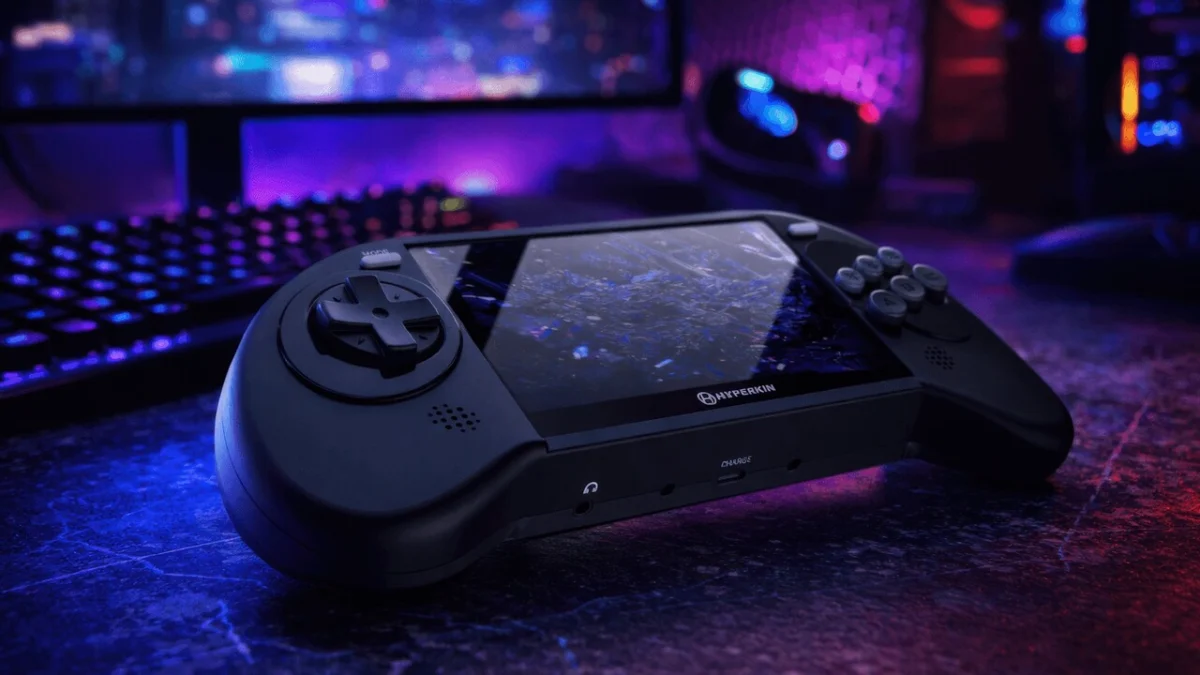
After a turbulent development cycle marked by repeated delays and high-profile technical hurdles, Hyperkin’s highly anticipated handheld, the Mega95, is finally approaching the finish line. The device, designed to serve as a modern spiritual successor to the legendary Sega Nomad, has moved past the volatile prototype phase. According to the latest updates from the manufacturer, research and development are complete, community-led stress testing has concluded, and the company is now preparing for the transition to mass production.
For retro-gaming enthusiasts who have followed the project since its initial announcement in early 2024, this represents a significant sigh of relief. With fresh video demonstrations showcasing the device in both handheld and docked configurations, the Mega95 is transitioning from a conceptual promise to a tangible consumer product.
The Technical Philosophy: Hardware-Level Authenticity
The primary appeal of the Mega95 lies in its architecture. In a market saturated with software-based emulators and FPGA (Field Programmable Gate Array) solutions, Hyperkin has chosen a more controversial, albeit purist, path: a hardware-level reproduction of the original Sega Mega Drive/Genesis architecture.
Why Hardware Matters
While emulation has improved significantly over the years, purists argue that it often fails to capture the precise timing, color palette, and audio quirks of the original 16-bit silicon. Hyperkin’s goal is to offer "native" support for original game cartridges, allowing players to insert their physical collections directly into the device. By replicating the actual chipset logic rather than simulating it through code, the manufacturer aims to provide an experience that is indistinguishable from playing on a console connected to a CRT television in 1995.
The Cost of Perfection
The development timeline for the Mega95 was significantly extended due to this rigid commitment to authenticity. Throughout 2023 and early 2024, Hyperkin faced persistent issues with video output. Internal testing revealed distracting graphics artifacts and screen tearing, which the company deemed "unacceptable" for a final product. Rather than rushing a flawed device to market, Hyperkin opted to halt production cycles to refine the hardware output. This decision—while frustrating for those awaiting the device—underscores a commitment to quality control that is increasingly rare in the niche retro-hardware market.
Chronology of a Challenged Development
The journey of the Mega95 is a case study in the complexities of reviving aging technology for a modern audience.
- Early 2024 (The Announcement): Hyperkin unveils the Mega95, promising a modern take on the 1995 Sega Nomad. Enthusiasm is high, but the roadmap remains vague.
- Mid-2024 (The Silence): As months pass without concrete updates, speculation grows. Community forums and social media channels become rife with rumors that the project has been silently cancelled, mirroring the fate of many other "vaporware" projects in the gaming space.
- January 2025 (The Reassurance): Hyperkin breaks its silence, confirming that development is active and that the delay is attributed to technical fine-tuning rather than abandonment.
- Q2 2025 (The Final Stretch): The company announces the successful conclusion of community-led testing, indicating that the hardware is now stable enough for the rigors of mass production.
The Hybrid Approach: Docked vs. Mobile
One of the most compelling aspects of the Mega95 is its versatility. The recent footage released by Hyperkin demonstrates a "Switch-like" capability: the unit functions as a standalone handheld, but can also be inserted into a dedicated docking station to output the signal to a modern television.
Hardware Versatility
This hybrid functionality bridges the gap between the mobile experience—reminiscent of the original Sega Nomad’s portable form factor—and the living room experience of the classic console. While the Nomad was notorious for its abysmal battery life and heavy footprint, modern advancements in power efficiency and screen technology suggest that the Mega95 will avoid the pitfalls that made the original Nomad a commercial failure in the mid-90s.
The Legacy of the Nomad
To understand the Mega95, one must acknowledge the shadow of the Sega Nomad. Released in October 1995, exclusively in North America, the Nomad was a marvel of its time—a handheld that could play the entire library of the Sega Genesis. However, it was hampered by high battery consumption, a dim display, and a hefty price tag. Hyperkin’s challenge is to succeed where Sega failed: delivering that same "plug and play" magic without the technical compromises that relegated the original to a collector’s curiosity.
Official Stance and Future Outlook
Hyperkin has been careful not to over-promise regarding a specific release date, likely to avoid further disappointment. However, their official stance is now one of transition. The focus has shifted from "Can we make this work?" to "How do we scale this for production?"
Moving Toward Pre-orders
While the exact window for consumer availability remains "forthcoming," the company has signaled that details regarding pre-orders will be released shortly. This shift indicates that the supply chain is likely locked and that the manufacturer is confident in the unit’s final stability.
The Role of Community Feedback
Hyperkin has leaned heavily on its relationship with the enthusiast community. By allowing select testers to put the device through its paces, the company effectively crowdsourced the debugging process. This "community-tested" badge of honor is intended to reassure potential buyers that the issues with tearing and artifacts have been systematically eliminated.
Implications for the Retro Gaming Market
The imminent launch of the Mega95 arrives at a fascinating moment in gaming history. There is a growing movement of players who reject digital-only storefronts in favor of physical media. By providing a portable, high-quality vessel for original cartridges, Hyperkin is positioning itself at the center of this "physical-first" revival.
Market Competition
The Mega95 will face stiff competition. High-end emulation handhelds from brands like Analogue (which uses high-fidelity FPGA) have set the standard for what premium retro-gaming looks like. Hyperkin’s unique selling point is its "hardware-level" approach. Whether this will be perceived as superior to FPGA or merely a different flavor of nostalgia will depend on the final retail price and the build quality of the chassis.
A Long-Term Investment?
If the Mega95 performs as advertised, it could serve as the gold standard for portable 16-bit gaming. If it fails to overcome its historical technical baggage, it will serve as a cautionary tale about the difficulties of hardware reproduction. However, the extra time taken to fix the graphical anomalies suggests that the final product will be a polished, professional piece of hardware rather than a rushed attempt to capitalize on nostalgia.
Final Thoughts: The Wait May Be Worth It
In the world of consumer electronics, "delayed" is a word that usually precedes a flop. Yet, in the specific niche of retro-hardware development, patience is often rewarded. By refusing to compromise on the video output and taking the time to solve the "unacceptable" artifacts, Hyperkin has demonstrated a level of integrity that should serve the project well.
As the industry pivots toward the era of mass production, the Mega95 is no longer just a project—it is a promise being kept. For the Sega faithful, the wait for a true successor to the Nomad is nearing its end. Whether this device becomes a permanent fixture in the gaming bags of collectors or remains a niche curiosity, its arrival will undeniably be a milestone in the ongoing effort to keep 16-bit history alive in the palm of our hands.
The upcoming announcement of pre-order details will be the final hurdle. For now, the retro-gaming community watches, waits, and prepares their dusty cartridge collections for a potential rebirth.