It is a feat that defies the traditional boundaries of human endurance and geographical imagination. Karl Bushby, a former British paratrooper with an unyielding spirit, embarked on a journey that would eventually span over a decade, crossing continents, frozen straits, and political minefields. The "Goliath Expedition" is not merely a long walk; it is a profound testament to the limits of human perseverance.
Main Facts: The Concept of the Impossible Walk
The Goliath Expedition is an ongoing, multi-year attempt to walk around the world, encompassing a total distance of approximately 36,000 miles (57,936 kilometers). Bushby’s mission, which began in 1998, is defined by a strict set of rules: he must cross the world on foot, he cannot use any form of transport, and he must cross at least one ocean.
The route was meticulously planned to take him from the tip of South America, through the length of the Americas, across the Bering Strait, through the vast expanse of Russia, across Europe, and finally back to his starting point. This is not a hike; it is an expedition of survival. Bushby has faced temperatures dipping to -40 degrees Celsius, the bureaucratic hostility of international borders, and the physical degradation that comes with constant, long-term exertion.
Chronology: A Timeline of Endurance
The Departure (1998–2006)
Bushby began his trek in Punta Arenas, Chile, on November 1, 1998. The first few years were characterized by the sheer scale of the South and North American continents. Crossing the Darién Gap—a dense, lawless jungle connecting Panama and Colombia—was perhaps the most harrowing initial test, involving navigating both hazardous terrain and the presence of paramilitary groups.
The Bering Strait Crossing (2006)
In March 2006, Bushby and his then-partner Dimitri Kieffer achieved what many deemed impossible: they walked across the frozen Bering Strait from Alaska to Russia. Navigating shifting sea ice and treacherous currents, they reached the Russian coast, only to be immediately detained by the Russian Federal Security Service (FSB) for entering the country without a proper visa stamp. This incident marked the beginning of a years-long struggle with Russian border authorities.
The Russian Odyssey (2007–2015)
The middle phase of the journey was defined by the vastness of the Siberian wilderness. Bushby faced isolation, extreme weather, and continuous visa struggles. He was forced to leave Russia multiple times due to expired paperwork, only to return and resume his steps exactly where he had left off. This period highlighted the immense logistical challenge of his journey; he wasn’t just battling nature, he was battling the red tape of global geopolitics.
The Final Stretch (2016–Present)
As of the latest reports, Bushby continues to push through the Eurasian landmass. He has become a symbol of persistence, moving slowly but surely toward his goal. Each step in the last decade has been an exercise in maintaining focus after years of accumulated fatigue.
Supporting Data: The Logistics of a Global Walk
To understand the scale of the Goliath Expedition, one must look at the data behind the journey:
- Total Projected Distance: 36,000 miles.
- Countries Traversed: Over 25 nations, each with unique visa requirements and climatic conditions.
- Caloric Expenditure: An estimated 5,000 to 7,000 calories per day during peak trekking periods.
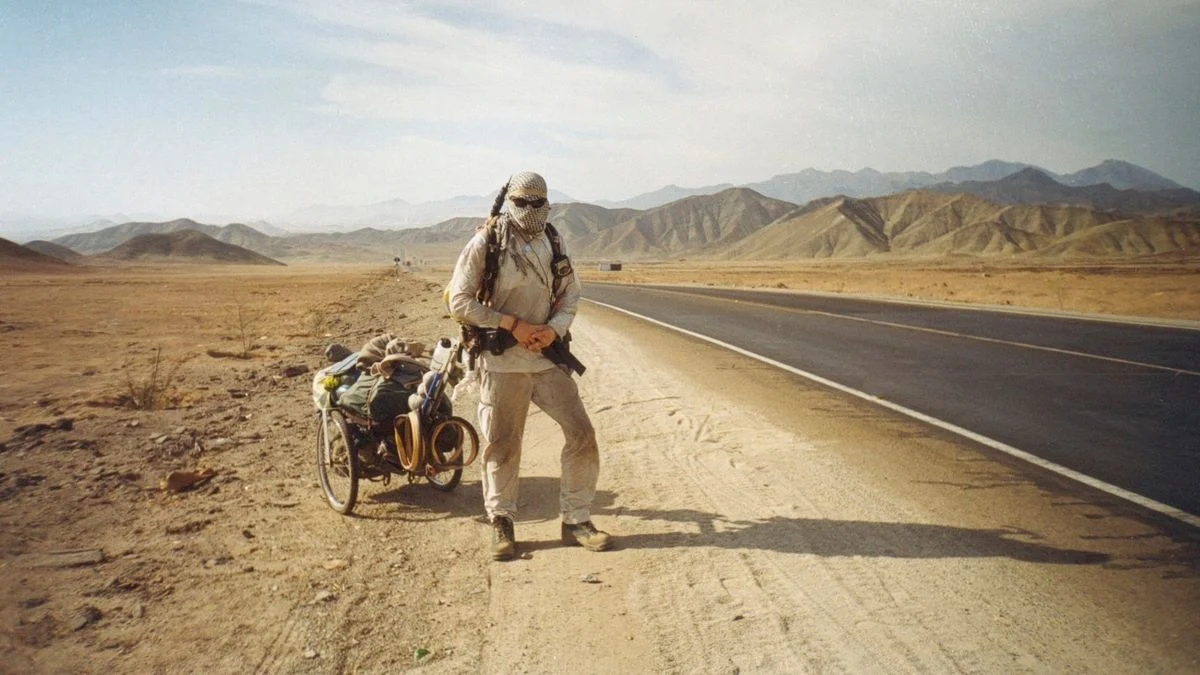
- Equipment: Bushby utilizes a specially designed sledge (or "pulka") to carry his supplies, weighing between 100 and 150 kilograms depending on the terrain.
- Duration: Originally estimated to take eight years, the journey has stretched into its third decade due to border closures, injuries, and the necessity of pausing for fundraising.
The equipment is a marvel of modern survival engineering, yet it remains primitive enough to be repaired in the field. From solar panels to satellite communication devices, the technology serves as a thin lifeline to the outside world, ensuring that his position is tracked and his safety can be monitored in the most remote areas of the planet.
Official Responses and Geopolitical Hurdles
The Goliath Expedition has often found itself at the mercy of international relations. The Russian authorities, in particular, have viewed Bushby’s movements with intense suspicion. During his 2006 crossing, he was initially treated as a potential infiltrator.
In subsequent years, Bushby has engaged in high-level diplomacy to secure the necessary permissions to continue. His success in navigating these bureaucratic waters is often cited by experts as an example of "soft power"—where an individual’s personal mission becomes a bridge between nations. However, the official response from various embassies has ranged from helpful to obstructive, proving that in a post-9/11 world, a man walking across borders is a conceptual anomaly that state security services struggle to categorize.
Implications: What Goliath Teaches Us
The implications of Bushby’s journey are manifold. First, it challenges our modern perception of "distance." In an era of rapid air travel, we have lost the visceral understanding of the Earth’s scale. Bushby reclaims this scale, forcing us to recognize the interconnectedness of our continents.
Second, the expedition serves as a study in psychological resilience. The "Goliath" is not the distance; it is the mental toll of waking up every day to face the same, monotonous, and dangerous challenge. Bushby has provided data for psychologists studying long-term endurance, noting that the primary barrier to completion is not the body, but the mind’s tendency to succumb to the "boredom of the extreme."
Finally, the expedition highlights the fragility of our borders. Bushby has walked through areas where the map suggests a line, but the reality is a porous, shifting, and often dangerous frontier. His journey reminds us that the world is not merely a collection of nations, but a singular, continuous environment.
The Future of the Journey
As Karl Bushby inches closer to his final destination, the conversation around the Goliath Expedition has shifted from "can he do it?" to "what comes after?" The journey has been documented in various media forms, and his archives provide a unique look at the changing climate of the Arctic and the shifting social fabric of remote Russian villages.
His walk is a reminder that in the 21st century, there is still room for exploration. While the maps of the world are largely filled in, the human experience of the world remains an open book. Bushby has not just walked around the world; he has mapped the limits of what a single human being can endure.
Whether he completes the journey in one year or five, the legacy of the Goliath Expedition is already cemented. It stands as a testament to the idea that the longest journey truly does begin with a single step—and that the most profound discoveries are made when we decide to keep taking that step, long after the rest of the world has turned its attention elsewhere.
Summary of Key Takeaways:
- Resilience: The ability to endure extreme isolation and physical hardship over decades.
- Bureaucracy: The significant role of international visa and border policies in impeding global travel.
- Scale: A physical appreciation of the Earth’s size, moving away from modern "instant travel" perspectives.
- Documentation: The expedition acts as an informal longitudinal study on both geography and human psychology.
As we watch the final chapters of this odyssey unfold, the world remains witness to a singular, relentless pursuit of a horizon that, for most, would have remained a dream.