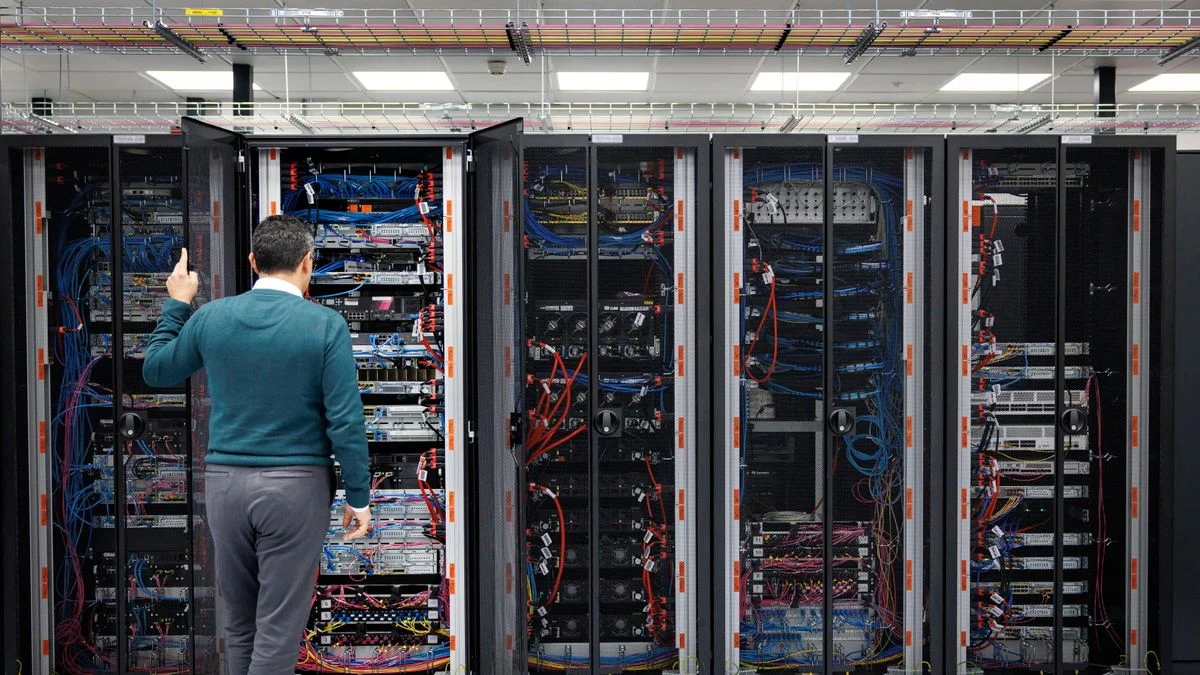
Germany stands at a pivotal crossroads in the digital age. As the global race for artificial intelligence supremacy accelerates, the nation is confronting a stark reality: the very infrastructure required to power this technological revolution is hitting a wall of energy constraints. New data from the digital association Bitkom reveals that the electricity demand of German data centers is projected to skyrocket, threatening the country’s position as a competitive digital hub.
The Magnitude of the Energy Surge
The digital transformation of the German economy, fueled by generative AI and widespread cloud adoption, has triggered an unprecedented hunger for electricity. According to recent surveys by Bitkom, data centers and smaller IT installations in Germany will consume approximately 23 billion kilowatt-hours (kWh) of electricity in 2026.
To put this figure into perspective, it represents the entire annual electricity consumption of roughly 6.5 million households. This is a staggering volume—exceeding the combined total of every private household in either North Rhine-Westphalia or Bavaria. This consumption is not a static baseline; it is a rapidly growing trajectory.
By 2030, analysts anticipate this demand will climb to between 35 and 38 billion kWh. Looking further ahead to 2035, the numbers become even more daunting, with projections suggesting a consumption level between 56 and 70 billion kWh. This exponential growth is forcing policymakers and industry leaders to reconsider how Germany manages its energy grid and industrial strategy.
A Chronology of Digital Growth
The transition from traditional IT infrastructure to high-performance computing (HPC) and AI-optimized facilities has happened in a remarkably short timeframe.
- 2023–2024 (The Pre-AI Boom): While data centers were already growing due to cloud migration, the sudden mainstreaming of generative AI created a sudden, unexpected spike in demand for GPU-dense facilities.
- 2026 (The Current Inflection Point): Investment into German data centers is reaching a record-breaking 23.5 billion euros, a 57% increase compared to the previous year. Approximately 20% of the total capacity is now dedicated specifically to AI and high-performance computing.
- 2030 (The Infrastructure Threshold): Market maturity is expected to see a shift where nearly 40% of all data center energy is consumed by AI-related processes.
- 2035 (The AI Dominance): Projections indicate that 55% of all German data center capacity will be allocated to AI and high-performance computing. In terms of absolute power load, this translates to a nearly eight-fold increase from today’s 670 megawatts to approximately 5,300 megawatts.
Supporting Data: The Anatomy of a Bottleneck
The data from the Borderstep Institute paints a clear picture of the primary hurdle. When asked about the greatest challenges facing the sector, roughly 80% of operators and industry experts pointed to limited grid connection capacities.
This is not merely an issue of "finding space" for servers; it is a fundamental challenge of physical energy infrastructure. The German power grid, historically designed for industrial manufacturing and residential supply, is struggling to integrate the concentrated, high-voltage demands of modern hyperscale data centers.
The economic indicators are equally telling. Despite the operational difficulties, the capital influx remains strong. The 23.5 billion euro investment figure for 2026 confirms that international tech giants and domestic firms see Germany as a vital location for AI infrastructure. However, the disconnect between the willingness to invest and the ability to connect to the grid is creating a "wait-and-see" environment that risks stifling innovation.
Official Responses and Political Friction
The alarm bells are ringing at the highest levels of the digital industry. At the German government’s Digital Summit, Bitkom President Ralf Wintergerst did not mince words regarding the urgency of the situation.
"The AI competition is also a competition for computing power," Wintergerst stated. "Whoever falls behind in infrastructure will also quickly lose the connection in the AI race."
The industry’s demands are focused on three core pillars:
- Fiscal Relief: Bitkom is calling for targeted reductions in electricity prices, either through a lower electricity tax or a dedicated "industrial electricity price" tailored for data centers, which are 24/7 energy consumers.
- Regulatory Acceleration: The industry is pleading for significantly faster planning and approval procedures. Currently, the time it takes to secure permits often outlasts the rapid cycles of AI hardware innovation.
- Grid Prioritization: There is an urgent call for the Federal Network Agency to streamline the process of connecting critical digital infrastructure to the high-voltage grid.
The Geopolitical and Economic Implications
The debate surrounding data center energy consumption has moved beyond technical discourse into the realm of national sovereignty. Kilian Wagner, head of sustainable digital infrastructures at Bitkom, highlights the futility of trying to stop this demand.
"We don’t actually have a choice about whether these data centers are built," Wagner argues. "The companies will not put their digital transformation on hold, and we as a private population will not use fewer digital services just because we don’t have enough data centers in Germany."
The implication is stark: if Germany cannot provide the necessary infrastructure, the capital, the jobs, and the technological control will migrate elsewhere. If German data remains stored and processed in foreign-owned facilities due to domestic energy failures, the nation loses both economic value and digital autonomy.
Furthermore, the environmental aspect adds a layer of complexity. As Germany pushes toward a green energy transition, the high power consumption of data centers creates a public perception challenge. However, industry proponents argue that modern data centers are increasingly efficient and often contribute to district heating systems, turning their "waste heat" into a municipal asset.
Conclusion: A Strategic Imperative
The challenge facing Germany is a classic "wicked problem." It requires balancing the immediate, massive energy requirements of the AI economy with the long-term goals of energy transition and grid stability.
If Germany fails to modernize its grid and cut through the bureaucratic red tape, it faces a two-fold threat: a loss of digital sovereignty and a stagnation of its domestic AI industry. As 2030 approaches, the focus must shift from simply "permitting" data centers to actively integrating them as critical infrastructure—much like roads or power plants.
The data centers of the future are not just peripheral IT assets; they are the factories of the 21st century. Whether Germany succeeds in this race will depend on whether it can provide the electricity—and the political will—to keep the lights on in the digital age. The clock is ticking, and for the digital German economy, the margin for error is shrinking by the megawatt.