

"Come to my festival, or I’ll hack your toaster—yours, AI." The provocation is as humorous as it is unsettling, a tongue-in-cheek digital ultimatum that greets visitors to the Staatstheater Darmstadt. As the world grapples with the rapid integration of artificial intelligence into daily life, the theater has decided to move beyond theory and into the realm of live performance. Until May 17, the stage in Darmstadt is being transformed into a testing ground, forcing audiences and artists alike to confront the question: Can an algorithm truly write a better story for the stage?
The festival, the first of its kind at the Staatstheater, is an ambitious, cross-disciplinary endeavor involving all major departments—music theater, drama, dance, and symphony concerts. It is not merely a showcase of technology, but a profound inquiry into the nature of creativity, authorship, and the shifting boundary between human expression and machine output.
The Choreography of Code: Real-time Digital Interaction
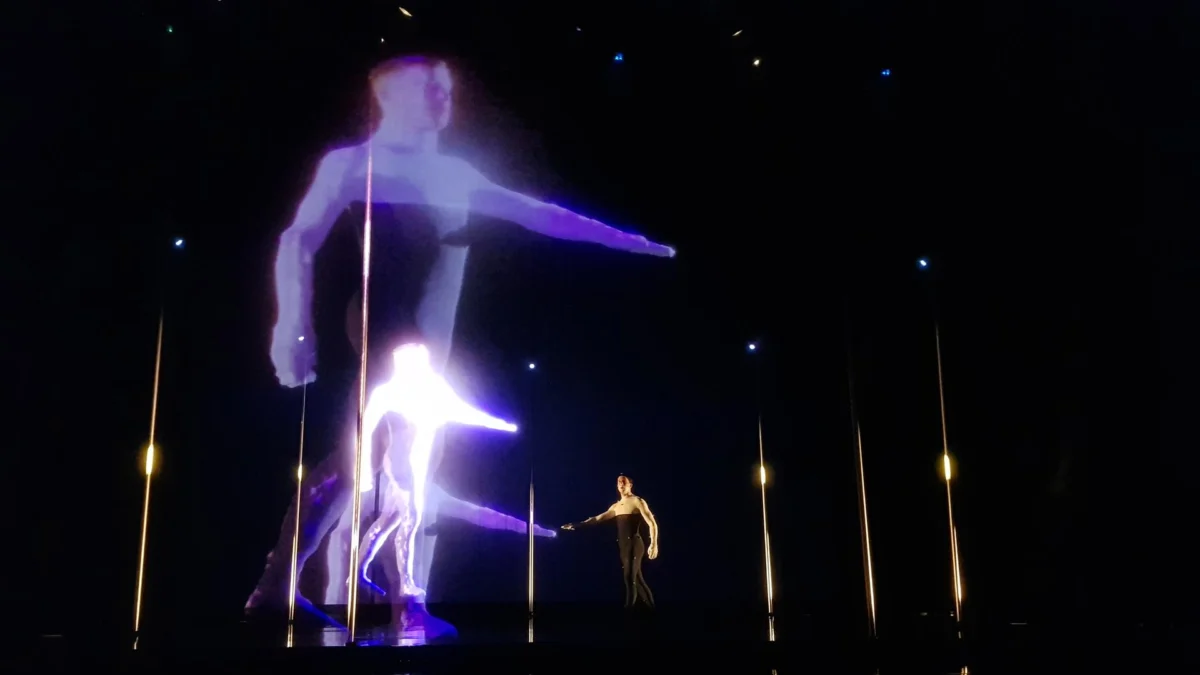
The festival’s centerpiece, the ballet Mirror, offers a visceral glimpse into the synergy between biology and binary. On stage, a dancer performs with fluid, expansive movements, but they are never alone. Projected onto an ethereal, invisible screen is their digital shadow—a towering, spectral avatar that mimics, distorts, and evolves in response to the dancer’s physical presence.
This is not a pre-rendered visual effect; it is a live, computational performance. The dancer is equipped with dozens of precise motion sensors, surrounded by an array of cameras that feed data into a high-performance computer. An AI model processes this stream in milliseconds, generating the avatar on the fly.
"The dancers are tracked by seven cameras," explains Bruno Heynderickx, director of the Hessisches Staatsballett. "The AI creates an avatar that develops an independent existence." Because the system interprets the human movement in real-time, no two performances are identical. The AI’s "decisions" on how to render the dancer’s shadow lead to a different visual experience every night, creating a unique dialogue between the mortal performer and the digital entity.
Chronology of a Digital Transformation
The integration of AI at the Staatstheater did not happen overnight. According to Intendant Karsten Wiegand, the institution began experimenting with machine learning long before the festival was conceived. The journey can be categorized into three distinct phases of adoption:
- The Administrative and Design Phase: The theater began using AI as a tool for visual communication, generating promotional posters and conceptual imagery. This allowed designers to iterate on stage sets, using text-to-image AI to visualize complex ideas without the immediate, high-cost requirement of building physical models.
- The Conceptual Integration: The theater began using AI to analyze thematic overlaps between disparate artistic works. This led to the creation of the music theater piece Anima mea – Where are you, my soul?, where the AI identified a bizarre, historical commonality between 17th-century Norwegian villagers and Italian nuns: the trade of dried cod, or Skrei.
- The Performative Phase: The current festival represents the final step, where AI is no longer just a support tool, but an active, improvisational partner on stage, capable of influencing the trajectory of a live performance.
Data and Disruption: The Logic of the Machine
The festival challenges the traditional notion of the "red thread" in storytelling. In Anima mea, the AI acted as a dramaturgical researcher, surfacing connections that would likely escape a human historian. By mapping the socio-economic impact of the dried fish trade across continents, the algorithm provided a structural spine for a production that might otherwise have felt fragmented.
However, this reliance on data-driven storytelling comes with implications. While the AI can find logical links between historical events, it lacks the emotional nuance that a human dramaturg provides. The festival explores this tension: Can a machine possess "soul"? In the production Anfänge (Beginnings), the audience is confronted with a "perfect," immortal, yet bodiless AI voice. As the piece progresses, this voice eventually finds a physical form through a dance duet, forcing the audience to grapple with the "uncanny valley"—the moment when technology becomes so lifelike that it induces fear rather than admiration.
Official Perspectives: Navigating the Ethical Frontier
Karsten Wiegand, the mastermind behind the festival, views the technology with a mix of pragmatism and caution. "We all know that AI will not disappear," he notes. "We want to take this development seriously and meet the phenomenon with curiosity rather than fear."
This curiosity extends to the ethical and surveillance implications of modern technology. The motto about the "hacked toaster" is more than a joke; it is a commentary on the "Internet of Things." Wiegand highlights that modern households are filled with sensors and chips that constantly transmit data. "Perhaps the toaster is listening to us, sending data somewhere, and we no longer know what our appliances are doing. AI is involved in so many things. We want to reflect on that together at the festival."
Ayla Pierrot Arendt, the director of Anfänge, takes a more critical stance. Her work specifically explores the "world-ending" anxiety generated by autonomous systems. "I was interested in the question: How far do we already delegate the big questions of life to machines?" she asks. She points to the use of AI in military defense systems, where algorithms make life-or-death decisions without human intervention, as the ultimate, chilling manifestation of this delegation.
The Implications for Future Theatre
The Darmstadt festival serves as a microcosm of a broader societal shift. As the theater industry begins to incorporate AI into its workflows, several key implications emerge:
1. The Death of the "Standard" Performance
As seen in Mirror, the use of AI-driven improvisation means that the concept of a "definitive version" of a play or dance is becoming obsolete. Theater is shifting from a static, repeatable performance to an organic, evolving system.
2. The Redefinition of Artistic Labor
If AI can generate set designs, write dialogue, or compose music, the role of the artist changes. The human artist becomes more of a "curator" or "prompt engineer," guiding the machine rather than executing every minute detail by hand. This shift raises questions about the future of creative labor and the value we place on human craft.
3. The Ethical Imperative
The festival highlights that theater has a vital role in humanizing complex, cold technology. By putting AI on stage, the theater allows the public to experience the "anxiety of the machine" in a controlled environment. It forces the audience to consider the agency of the systems they invite into their homes.
4. Technical Literacy as an Artistic Skill
The collaboration between the Hessisches Staatsballett and the Alexander Whitley Dance Company demonstrates that future dancers and actors will need to be part-technicians. Understanding sensors, data streams, and algorithmic behavior is becoming as essential as mastering stage presence or choreography.
Conclusion: A Mirror to Humanity
The Darmstadt AI Festival is not an endorsement of a machine-dominated future. Rather, it is a sophisticated, critical, and at times terrifying reflection of our present. By allowing the AI to "speak" through voice, to "move" through avatars, and to "think" through historical research, the artists at the Staatstheater are holding up a mirror to the audience.
Whether the AI actually writes "better" stories remains a subjective debate, but one thing is certain: it is writing different stories. As the festival continues through May 17, it remains a vital checkpoint for anyone interested in the future of the arts. The toaster might not be hacked just yet, but the traditional boundaries of the stage have been permanently breached by the digital revolution. The question for the audience is no longer whether they should accept AI, but how they intend to live with it once the curtain falls.











Leave a Reply