Dillingen, Germany — The air in the Bavarian countryside is thick with the scent of pine and damp earth, punctuated by the rhythmic, mechanical stutter of machine-gun fire. For a fleeting moment, the forest erupts into chaos; orders are barked, positions are shifted, and then—abrupt silence. The enemy has vanished, or perhaps they have merely retreated into the shadows. A surveillance drone ascends, a silent sentry hovering above the tree line. In modern warfare, you do not trust a moment of peace. Only after the digital reconnaissance confirms the perimeter is clear do the soldiers of the Bundeswehr emerge from their fortified positions, moving with the practiced caution of those who know that information, not just firepower, dictates survival.
This is the reality of basic training for the IT-Bataillon 292 of the German Bundeswehr in Dillingen. Far from the sterile environments of server rooms and air-conditioned command centers, these soldiers are learning the raw, physical "craft of war." Their mission, however, remains firmly rooted in the 21st century: the protection of mobile data centers—the beating digital hearts of a modern, networked army.
The New Reality: Warfare at the Speed of Data
The conflict in Ukraine has served as a brutal, high-stakes laboratory for the evolution of modern military doctrine. It has stripped away the illusions of slow-paced maneuvering, revealing a landscape where the "Kill Chain"—the sequence of steps from target acquisition to engagement—has been compressed into mere seconds.
"The Kill Chain has accelerated at an incredible rate due to sensor data fusion and the integration of autonomy in weapon systems," explains Frank Sauer, a researcher at the Bundeswehr University who specializes in the intersection of technology and international security. Where commanders once had hours to deliberate, they now have seconds to act. In this environment, the side that processes data the fastest, shares it the most effectively, and secures its digital infrastructure the most robustly, holds the decisive advantage.
A General on the Frontline
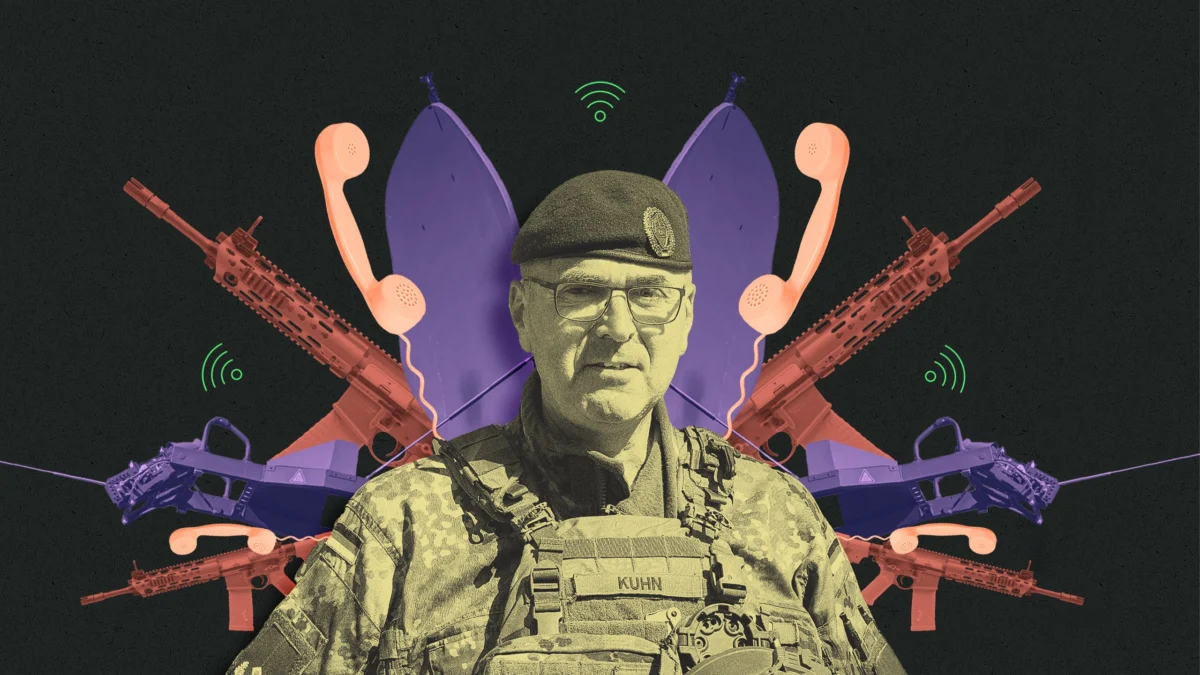
In the thick of the training exercise stands Major General Lutz Kuhn, the newly appointed "Commander of Task Forces and Military Intelligence." Clad in full combat gear—Schutzweste, tactical helmet, and uniform—Kuhn cuts a striking figure that defies the stereotype of a desk-bound IT strategist.
For Kuhn, physical presence among the troops is not merely a morale-building exercise; it is a fundamental philosophy. "We are not here to act like the animals in George Orwell’s Animal Farm—where all are equal, but some are more equal than others," Kuhn remarked while observing the field operations. "That is precisely why I enjoy being out here with the troops. You cannot understand the vulnerabilities of a digital network if you don’t understand the physical conditions under which it must operate."
His presence underscores a shift in military culture: the recognition that IT specialists are not just "support staff," but frontline combatants in a theater where a severed fiber optic cable or a jammed signal can be as fatal as a tank shell.
Chronology of Modernization: The Shift to "Multi-Domain Operations"
The Bundeswehr’s focus on mobile data security represents a broader strategic pivot toward "Multi-Domain Operations" (MDO). To understand how the German military reached this point, one must look at the evolution of their operational philosophy over the last decade:
- The Legacy Era (Pre-2014): Operations were largely decentralized. Units operated with independent communication systems, and "data sharing" was often a manual, analog process.
- The Realization (2014–2022): The annexation of Crimea and subsequent developments in Eastern Europe forced a rethink. The Bundeswehr recognized that their legacy systems were too slow to keep pace with modern electronic warfare.
- The Integration Phase (2022–Present): With the full-scale invasion of Ukraine, the need for a unified digital battlefield became existential. The IT-Bataillon 292 and similar units were re-tasked from purely "administrative IT" to "tactical field IT."
- The Future Outlook: The goal is the seamless, real-time integration of every asset—from satellites and surveillance drones to infantry squads and main battle tanks—into a single, resilient digital fabric.
Supporting Data: Why Connectivity Equals Survival
The strategic necessity of the Dillingen training is backed by staggering advancements in military technology. In a Multi-Domain environment, the Bundeswehr aims to synchronize:
- Sensor Fusion: By combining data from overhead satellite imagery, low-altitude drone feeds, and ground-based thermal sensors, the military can create a "common operating picture" (COP).
- Latency Reduction: The goal is to move from a 15-minute sensor-to-shooter cycle to a sub-30-second cycle.
- Resilience: Because mobile data centers are high-value targets, they must be highly modular and capable of rapid redeployment. The training in Dillingen focuses on "Shoot-and-Scoot" tactics for IT infrastructure—defending, transmitting, and moving before the enemy can triangulate their position.
Official Responses and Strategic Implications
The push toward a fully networked force has received strong backing from the German Ministry of Defense, though it remains a subject of intense internal debate regarding budget allocation and technical feasibility.
The Technological Challenge
The primary challenge for the Bundeswehr remains the "interoperability gap." While modern systems are being developed, integrating them with legacy hardware—some of which dates back decades—is a logistical nightmare. "It is not just about having the best software," a senior procurement officer noted anonymously. "It is about ensuring that a soldier in a foxhole can pull data from a satellite feed on a device that is ruggedized, encrypted, and easy to use under fire."
The Strategic Implication
The implications of the work being done in Dillingen are global. As the Bundeswehr evolves, it is setting a standard for NATO’s eastern flank. The ability to defend mobile data centers means that German forces can maintain command and control even in a degraded electromagnetic environment, where GPS and radio signals are being jammed by adversaries.
The Road Ahead: Human-Machine Teaming
As the exercise concludes and the sun sets over the Bavarian woods, the soldiers of the IT-Bataillon pack up their portable servers and encrypted terminals. They are exhausted, but they have proven that the link between the digital and the physical is now unbreakable.
The future of the Bundeswehr is not just found in the development of new weapon systems, but in the training of a new generation of soldiers who are as comfortable with a soldering iron and a software patch as they are with a rifle. Major General Kuhn’s presence in the field is a symbol of this synthesis. The "IT-General" understands that while the algorithms may fight the battles of the future, it is the soldiers on the ground—in the mud, in the tents, and under the watchful eye of the drones—who determine whether those algorithms hold up under the pressure of war.
In Dillingen, the message is clear: the battlefield has expanded into the cloud, but the price of failure remains measured in the physical reality of the front line. The Bundeswehr is not just upgrading its hardware; it is upgrading its mindset for an era where information is the most dangerous weapon of all.