By Reiner Wandler
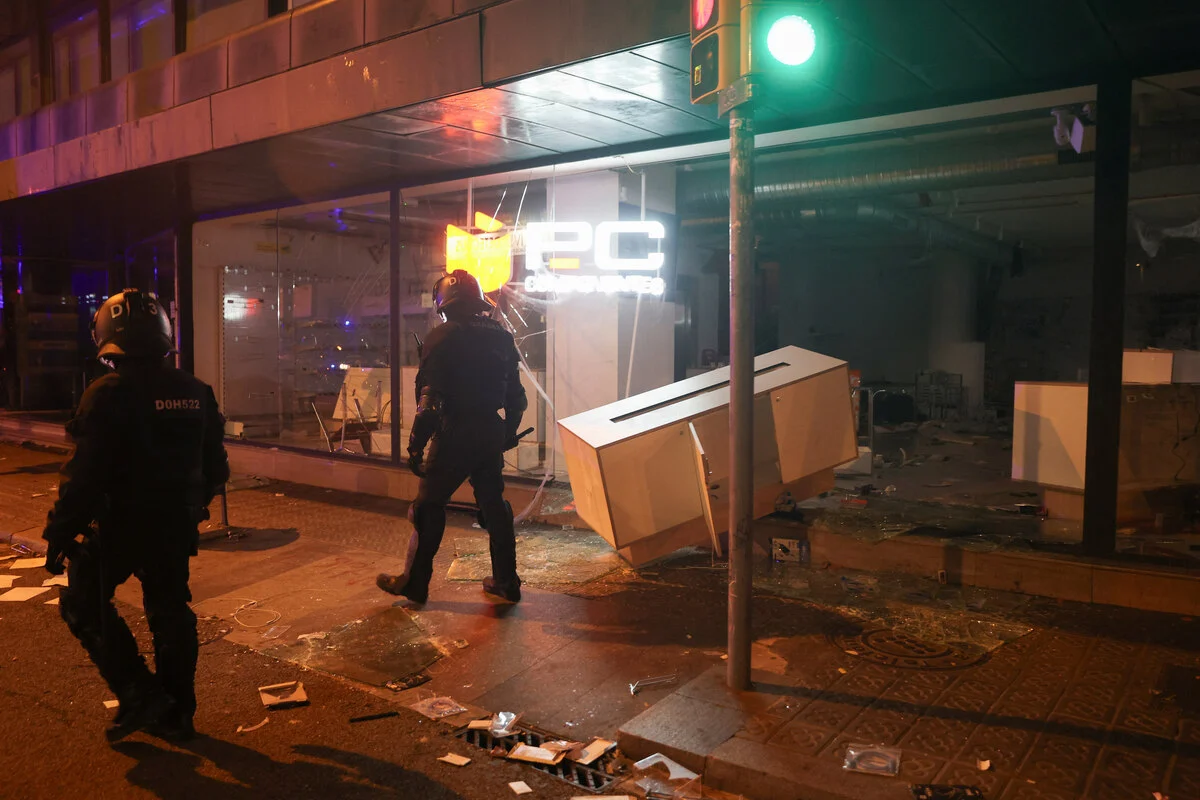
In the heart of Barcelona, the weekend is typically a time for leisure, tourism, and civic engagement. However, last Saturday, the city center—specifically the iconic Plaça de Catalunya—became the stage for a disturbing and highly anomalous eruption of violence. A coordinated group of approximately 500 individuals, clad in black and masked, descended upon the city center not to protest, but to dismantle. By the time the dust settled, 23 businesses had been damaged, 14 of which were systematically looted, four police officers were hospitalized with serious injuries, and 128 arrests had been made.
More than a week later, the incident remains a profound mystery, baffling authorities and analysts alike. The event lacked the hallmarks of traditional political unrest, leaving investigators to grapple with a chilling question: Was this a spontaneous outburst of criminal opportunism, or a sophisticated, perhaps even state-sponsored, provocation designed to destabilize the political climate ahead of Spain’s upcoming November 29 elections?
The Anatomy of the Chaos: A Chronology of Destruction
The events of last Saturday did not follow the established patterns of Catalan protest culture. Historically, mass mobilizations in Barcelona—whether regarding independence, labor rights, or social housing—are marked by slogans, banners, and specific political demands. This event was entirely different.
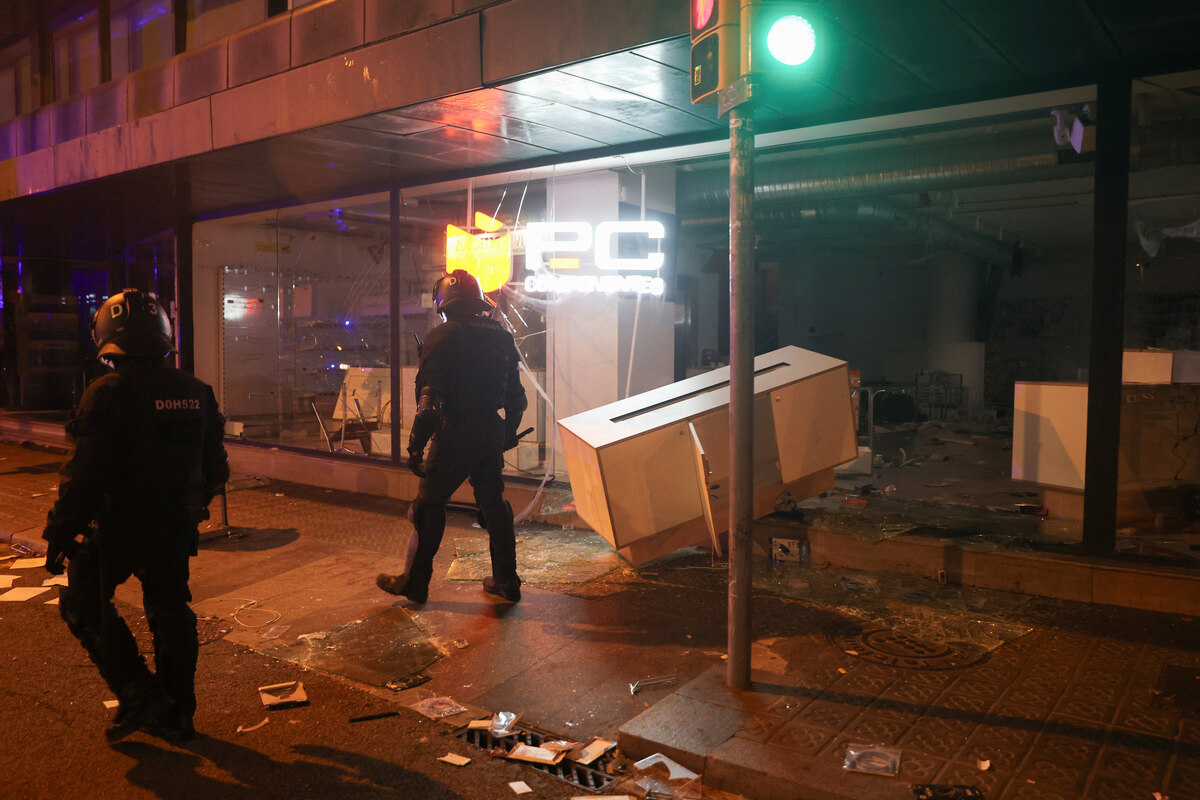
The participants, mostly young and dressed in black, arrived at the Plaça de Catalunya with a singular purpose. There were no speeches, no political chants, and no manifesto. Instead, the group immediately split into smaller units and began a synchronized assault on commercial infrastructure. They constructed barricades from street furniture and set fires to block transit routes, while simultaneously breaking into storefronts.
The efficiency of the operation suggested a high degree of pre-planning. By the time the Mossos d’Esquadra (the Catalan police force) could respond in force, the damage had been done. The violence was not targeted at state buildings or symbols of authority, but almost exclusively at private property, turning the city’s commercial hub into a scene of chaotic pillage.
Supporting Data: Who Were the Perpetrators?
Perhaps the most startling revelation from the initial police investigation is the background of the 128 individuals taken into custody. Contrary to initial assumptions that the riot was the work of established "Black Bloc" activists or radicalized anti-fascist groups common to Barcelona’s political landscape, the demographic profile tells a different story.
Of those arrested, 72 were minors, indicating a disturbing trend of youth involvement in organized crime. Furthermore, the criminal records of the detainees paint a clear picture of common criminality rather than political militancy. Only two of the 128 had any prior history related to political protest or ideological civil disobedience. In stark contrast, 25 of the individuals possessed established records for conventional criminal offenses, including robbery, theft, and assault.

This data suggests that the "protest" was merely a facade. The individuals involved appear to be less interested in challenging the status quo and more interested in the raw, tangible rewards of looting.
The Digital Footprint: The "Blocus" Phenomenon
Investigators have turned their attention to the digital sphere to understand how such a large, disparate group was mobilized so effectively. Several TikTok accounts had circulated content under the hashtag "Blocus," utilizing AI-generated imagery and vague, pseudo-political slogans.
The messaging was intentionally superficial. While some graphics invoked the imagery of the French protest movements—specifically the desire for "better quality" in schools—there was no attempt to link these slogans to the reality of the Catalan context. Notably, the symbols used were disjointed; the Catalan independence flag appeared in some AI-generated content, yet there was a complete absence of the Catalan language in the messaging.
Journalists from eldiario.es managed to infiltrate the encrypted communication channels on WhatsApp and Telegram used to coordinate the chaos. What they discovered was shocking in its simplicity: the groups, numbering up to 1,500 members in total, were devoid of political discourse. Instead of debating public policy or social grievances, the chat logs were filled with messages such as "I want to steal" and, subsequently, photos of stolen goods. Once the looting concluded, these groups were rapidly dismantled, suggesting that the organizers were aware of the digital trail they were leaving behind.

Official Responses and Political Finger-Pointing
The ambiguity surrounding the riot has created a vacuum that has been swiftly filled by political opportunism. With the national elections scheduled for November 29, the incident has become a convenient cudgel for the opposition.
Alberto Núñez Feijóo, the leader of the conservative Partido Popular (PP), drew criticism for his seemingly prescient remarks. Hours before the riots began, Feijóo was already framing the narrative, asking, "Do we want the riots like those in France? Do we really want to get used to violence being part of politics?" His supporters argue he was merely highlighting a growing concern, but critics and political opponents have raised questions about how the PP leader seemed to possess such specific foresight regarding a breakdown of public order in Barcelona.
The far-right party VOX, currently seeking to form a coalition with the PP, has taken a more aggressive stance, accusing the socialist Prime Minister Pedro Sánchez of orchestrating the unrest. VOX leader Santiago Abascal went as far as to label the looters as "Sánchez’s militias," claiming the Prime Minister is so "desperate" to maintain power that he would incite violence to distract from his own political failings. These accusations have been dismissed by government officials as inflammatory, yet they have successfully dominated the news cycle, deepening the polarization within the Spanish electorate.
Implications: A New Era of Hybrid Instability?
The events in Barcelona have far-reaching implications for Spanish democracy. If this was indeed a case of "astroturfing" a riot—using social media and criminal elements to create a false sense of national instability—it represents a new and dangerous frontier in political warfare.

There is a growing body of speculation that these tactics may be influenced by foreign actors. Observers have noted similarities between this incident and the organized, online-fueled surge on the border of the Spanish exclave of Ceuta last July. Some analysts suggest that right-wing movements in the United States and Israel, which have historically been critical of Spain’s current left-leaning coalition government, may have an interest in manufacturing a narrative of a "failing state." By destabilizing the urban environment and highlighting the government’s perceived inability to maintain order, these external actors—or their local proxies—could be aiming to tilt the electoral outcome in favor of a more conservative administration.
The incident also raises questions about the vulnerability of modern cities to AI-coordinated mobilization. When digital tools can be used to recruit hundreds of disaffected, crime-prone youths, and provide them with real-time instructions for theft, the traditional methods of law enforcement struggle to keep pace. The "protest" of the future may not be a protest at all, but a weaponized form of social chaos that thrives on the inability of the state to distinguish between genuine dissent and organized, predatory crime.
Conclusion
The "riddle of the 500 looters" in Barcelona remains, at its core, a test for the Spanish authorities. The Mossos d’Esquadra are still sifting through the digital evidence and the testimony of the 128 arrested. However, the damage has already permeated the political discourse. Regardless of whether the riot was a purely local criminal enterprise or a calculated move by political strategists, the result is the same: a heightened sense of insecurity and a radicalized political environment.
As Spain approaches its November 29 elections, the events of that Saturday serve as a grim reminder of how fragile civic order can be in an age of digital disinformation. Whether the catalyst was a desire for loot or a desire for power, the victims were the businesses and citizens of Barcelona, who find themselves collateral damage in a battle they did not choose to fight. The question now is whether the authorities can uncover the true architects of this chaos, or if the "Blocus" will remain a permanent, haunting precedent for future elections.