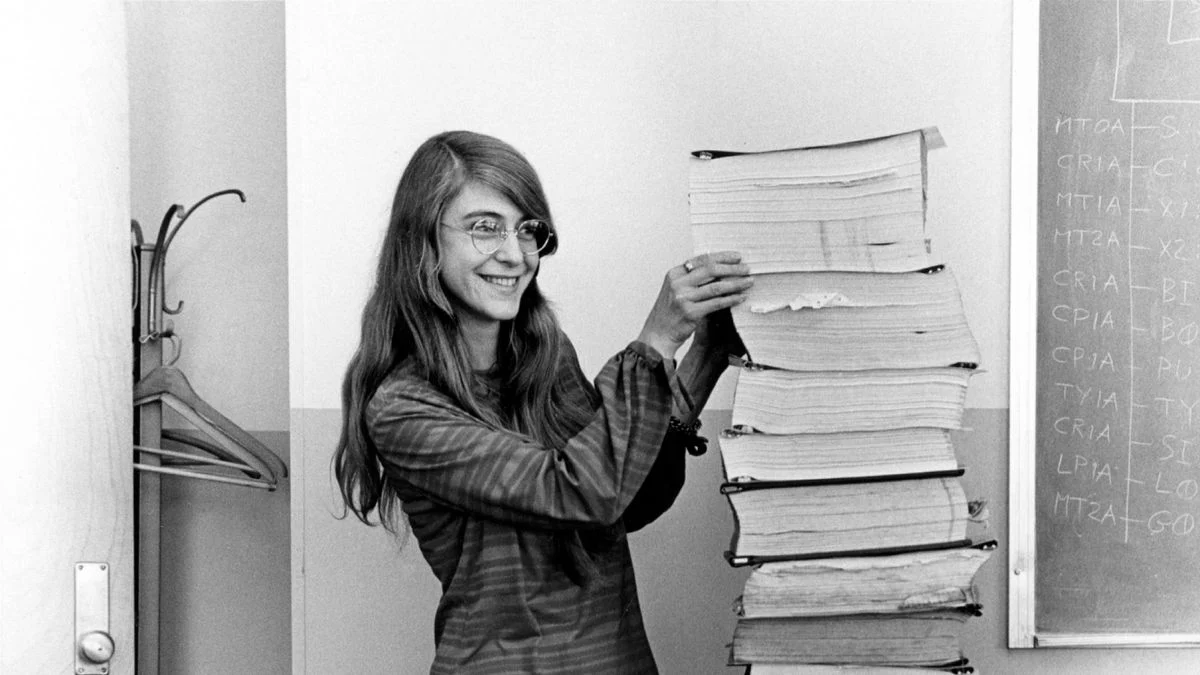
The history of space exploration is often painted with the broad strokes of heroic astronauts and the thunderous roar of Saturn V rockets. Yet, behind the scenes of humanity’s greatest technological leap, the foundation was laid by lines of code—meticulously crafted by a woman who turned software engineering from a whispered afterthought into a critical discipline. Margaret Hamilton, the visionary mathematician and computer scientist who led the team responsible for the Apollo Guidance Computer (AGC) software, has passed away at the age of 90. Her death, confirmed by the Massachusetts Institute of Technology (MIT) on October 7, 2026, marks the end of an era for the pioneers who first ushered humanity into the digital age.
A Legacy Written in Code
Margaret Hamilton’s contribution to the Apollo program was nothing short of revolutionary. During an era when "software" was not yet a recognized professional field, Hamilton was already managing the software engineering division of the MIT Instrumentation Laboratory. From 1959 through the mid-1970s, she served as the intellectual engine room for the NASA mission that would eventually place two men on the lunar surface.
She did not merely "write code"; she conceptualized the very architecture of fault-tolerant systems. At a time when computers were massive, fragile, and prone to catastrophic failure, Hamilton’s team created software that could "think" for itself—prioritizing essential tasks over background processes to ensure that, no matter what, the mission would not fail.

Chronology of a Trailblazer
Born in 1936, Hamilton’s journey into the heart of the space race was as unconventional as her career path. While studying mathematics, she taught herself the nascent art of programming. In her mid-twenties, she found herself at MIT, initially taking a position to support her husband’s legal studies. What began as a temporary role quickly transformed into a lifelong vocation.
By the early 1960s, NASA turned to the MIT Instrumentation Laboratory to solve the gargantuan problem of navigating a spacecraft to the Moon. Hamilton was tasked with leading the team of over 100 developers. It was here that she coined the term "Software Engineering." At the time, the phrase was greeted with skepticism and even mockery by her male colleagues, who viewed software as an auxiliary to hardware. "When I first used the term, it was considered quite amusing," Hamilton famously recalled in a 2018 interview. "For a long time, it was the subject of jokes. People teased me about my radical ideas."
Her persistence paid off. Her team’s code was responsible for the flight software of the Command Module and the Lunar Module, guiding the Apollo 11 mission to its historic touchdown in 1969.

The 1202 Alarm: A Defining Moment
The true genius of Hamilton’s design was tested during the final descent of the Lunar Module, Eagle, in July 1969. Moments before landing, the onboard computer began flashing "1202" alarms, signaling that the system was being overwhelmed with data. In a less robust system, this would have triggered a total mission abort.
However, because of the architecture Hamilton had championed, the AGC was programmed to recognize the overload. It ignored non-essential tasks and prioritized the landing maneuver, allowing Neil Armstrong and Buzz Aldrin to focus on the terrain while the software kept the spacecraft stable. Hamilton had designed the computer to "observe itself," a concept that is now standard in modern computing but was essentially science fiction in the 1960s.
"Software was seen as a black box," Hamilton noted years later. "It was something mysterious that appeared in the flight computer like magic. Because of that, the managers gave us full freedom and total trust."

Beyond the Moon: Professional Recognition
While her influence was felt in every orbit of the Apollo missions, public recognition for Hamilton came much later. In 2003, she was awarded the NASA Exceptional Space Act Award, a moment that highlighted a glaring gap in the agency’s history of acknowledging female contributors. One presenter at the ceremony expressed genuine shock that her "groundbreaking work" had gone so long without formal institutional recognition.
The crowning achievement of her public legacy came in 2016, when President Barack Obama bestowed upon her the Presidential Medal of Freedom. It was a long-overdue acknowledgement of a woman who had, in the words of MIT’s Department of Aeronautics and Astronautics chair Olivier de Weck, been "dramatically ahead of her time."
Implications for Modern Technology
The ripples of Hamilton’s work are present in every aspect of modern life. Every time a smartphone manages background applications to prevent a crash, or a modern aircraft relies on automated flight systems, it is, in some small way, a descendant of the logic Hamilton pioneered for Apollo. She elevated the craft of programming from "coding" to "engineering," insisting that the creation of software required the same rigorous standards of reliability, safety, and documentation as bridge-building or aerospace engineering.

Beyond her technical achievements, Hamilton stood as a beacon for women in STEM (Science, Technology, Engineering, and Mathematics). At a time when the tech industry was almost exclusively male-dominated, she occupied a position of absolute authority. She proved that the most important components of a mission to the Moon were not just the steel, fuel, and thrust, but the invisible, logical architecture that bridged the gap between human intent and machine execution.
Official Responses and Lasting Influence
Following the news of her passing, colleagues and leaders in the tech community have hailed her as a titan of the 20th century. While the specific cause of death remains undisclosed, the outpouring of tributes underscores her stature.
"To say Margaret Hamilton was a pioneer—to say she was ahead of her time—would be a dramatic understatement," said de Weck. Her life’s work serves as a reminder that history is not just made by those who travel to the stars, but by those who write the instructions that allow us to get there.

As we look toward future missions to Mars and beyond, the spirit of Margaret Hamilton remains woven into the fabric of space exploration. She leaves behind not just a legacy of successful missions, but a fundamental shift in how humanity interacts with machines. She taught the world that software is not merely a tool, but the essential infrastructure of modern existence.
In the final assessment, Hamilton’s career was defined by a quiet, persistent defiance of convention. From her early, "amusing" attempts to formalize software engineering to her role as the guardian of the Apollo missions, she remained a steadfast advocate for the power of logical rigor. Her life serves as a testament to the idea that with enough foresight, innovation, and unwavering confidence in one’s own ideas, one can indeed reach for the Moon—and ensure that, when we arrive, the systems we rely on are ready to support us.
Margaret Hamilton has finished her final program, but her code continues to run through the heart of every technological advancement we make today. She was, and remains, the silent architect of the digital frontier.