Düsseldorf, Germany – September 27, 2026 – The mighty Rhine River, a vital artery for European trade and a symbol of Germany, has once again plunged to unprecedented record low water levels across North Rhine-Westphalia (NRW). The alarming descent, exacerbated by a prolonged drought, signals a deepening crisis for shipping, industry, and the environment along one of the continent’s busiest waterways.
In Düsseldorf, the gauge recorded a critically low reading of minus 5 centimetres at 13:00 local time on Sunday, September 27th. This marks a further significant drop from the minus 3 centimetres reported just the day before, according to data released by the Federal Waterways and Shipping Administration (WSV). The grim figures underscore a relentless trend that has seen the Rhine’s water levels dwindle to precarious depths, raising widespread concerns about the resilience of infrastructure and the broader economy.
The situation is equally dire in other key locations along the Rhine. In Cologne, the water level fell by 3 centimetres from Saturday’s reading, settling at a shallow 42 centimetres. Further north, in Duisburg-Ruhrort, a crucial hub for inland shipping, the gauge plummeted from 130 to 127 centimetres on Sunday, establishing a new low for the area. These measurements, while not directly comparable due to varying zero points at different stations, collectively paint a stark picture of a river under severe stress. The navigable channel, which allows barges to pass, is significantly deeper than the bankside gauge readings. For instance, in Düsseldorf, while the gauge shows minus 5 centimetres, the actual remaining depth in the main shipping channel is 1.54 metres, down from a regulated depth of 1.59 metres. This seemingly small reduction has profound implications for the operational capacity of vessels.
The recurrence of such extreme low water events has prompted renewed calls for urgent action and long-term strategies to mitigate the impacts of climate change on Germany’s hydrological systems. Experts warn that what was once considered an infrequent anomaly is fast becoming a "new normal," necessitating a fundamental rethinking of water management and infrastructure adaptation.
Main Facts: A River in Crisis
The Rhine River, a lifeline for industry, trade, and millions of people, is currently experiencing one of its most severe low-water crises in recent history. The latest measurements reveal critical depths that are having immediate and far-reaching consequences across North Rhine-Westphalia and beyond.
- Record Lows: On September 27, 2026, the Rhine gauge in Düsseldorf registered an unprecedented minus 5 centimetres, a further decline from minus 3 centimetres the previous day. This figure represents the water level relative to a specific reference point at the gauge, indicating an extremely low state.
- Widespread Impact: Similar drastic drops were observed in other critical locations. Cologne’s gauge fell to 42 centimetres (from 45 cm), and Duisburg-Ruhrort, a vital industrial port, recorded 127 centimetres (from 130 cm), hitting a new low for that station.
- Navigability Concerns: While the visible gauge levels are alarming, the true concern lies in the navigable depth for commercial vessels. Despite a regulated channel depth of 1.59 metres in Düsseldorf, the current gauge reading means only 1.54 metres of water remain for barges, severely restricting their cargo capacity.
- Drought-Driven: The precipitous decline in water levels is directly attributable to a prolonged period of insufficient rainfall and elevated temperatures, characteristic of an intensifying drought gripping much of Central Europe.
- Economic Threat: The ongoing low water levels pose an existential threat to inland shipping, a cornerstone of Germany’s logistics and industrial supply chains. Barges are forced to carry significantly less cargo, leading to increased transport costs, delays, and potential diversions to more expensive and less efficient modes of transport.
- Environmental Strain: Beyond economic considerations, the ecological health of the Rhine is under immense pressure. Higher water temperatures, reduced oxygen levels, and increased concentrations of pollutants threaten aquatic life and riparian ecosystems.
This crisis is not an isolated incident but rather the latest manifestation of a worrying trend that highlights the vulnerability of major European waterways to the impacts of climate change. The immediate challenge is to manage the current disruptions, while the long-term imperative is to develop robust strategies for adaptation and resilience.
Chronology of Decline: A Relentless Descent
The current record-low water levels on the Rhine are not a sudden occurrence but the culmination of weeks, if not months, of adverse meteorological conditions. This latest crisis fits into a disturbing pattern observed over the past decade, with 2018 and 2022 standing out as particularly challenging years for the river.
The Genesis of the Current Crisis
The current hydrological stress on the Rhine began to manifest significantly in late spring and early summer of 2026. A winter with below-average snowfall in the Alps, the Rhine’s primary source, meant a diminished spring meltwater contribution. This critical deficit was compounded by an unusually dry and hot summer across much of Germany and its neighbouring countries. Meteorological data for the region indicates several consecutive months with rainfall totals significantly below the long-term average, particularly in the river’s catchment areas. Temperatures, conversely, have consistently exceeded seasonal norms, accelerating evaporation from the river surface and the surrounding landscape.
By late August and early September, the cumulative effect of these conditions became acutely visible. Gauge levels began a steady, alarming decline across the entire German stretch of the Rhine. Key monitoring stations, from the upper Rhine in Baden-Württemberg down to the crucial industrial ports of North Rhine-Westphalia, reported daily decreases. Shipping companies, accustomed to seasonal fluctuations, began to implement initial restrictions on cargo loads, a clear indicator of impending difficulties.
Echoes of Past Crises: 2018 and 2022
The memory of the devastating low water events of 2018 and 2022 looms large over the current situation. In 2018, the Rhine reached its lowest level in over a century at some points, virtually halting shipping for weeks and costing the German economy billions of euros. Industries reliant on the river for transport of raw materials like coal, oil, and chemicals, or for cooling water, faced severe disruptions. Power plants were forced to reduce output or even shut down.
The year 2022 brought another harrowing experience, with water levels dropping to critical thresholds, particularly at the Kaub gauge, a shallow choke point between Mainz and Koblenz. Although not as historically low as 2018, the prolonged period of reduced navigability again exposed the fragility of the supply chains dependent on the Rhine. These previous crises served as stark warnings, prompting calls for greater resilience and adaptation, yet the current situation demonstrates that fundamental vulnerabilities persist.
The 2026 Progression
The current descent below critical thresholds at multiple gauges in NRW, specifically the minus 5 cm in Düsseldorf and new lows in Cologne and Duisburg-Ruhrort on September 27th, underscores the severity of the 2026 drought. Unlike some previous years where a single choke point might have been the primary concern, the widespread nature of the current low levels suggests a more systemic problem affecting extensive stretches of the river. The sustained lack of precipitation, particularly in areas feeding into the Rhine, has left little prospect for immediate relief. Forecasts indicating continued dry weather in the short term only heighten anxieties among stakeholders, who are now grappling with the operational and financial implications of a prolonged period of restricted navigability. The progression from minor load reductions to potentially outright cessation of fully loaded traffic is a chilling echo of past economic disruptions.
Supporting Data: The Ripple Effect of a Shrinking River
The dramatic reduction in the Rhine’s water levels has a cascading effect, touching upon various sectors of the economy and the delicate ecological balance of the region. Understanding the underlying data and its implications reveals the true scale of the challenge.
Hydrological Specifics and Navigable Depths
The "gauge level" (Pegelstand) is a measurement of the water level at a specific point relative to a fixed zero point. It’s crucial to understand that these zero points differ from one station to another, meaning a direct comparison of raw numbers (e.g., 42 cm in Cologne vs. 127 cm in Duisburg) can be misleading without context. What truly matters for shipping is the effective navigable depth of the shipping channel.
The Federal Waterways and Shipping Administration (WSV) maintains specific minimum navigable depths for different sections of the Rhine. For the Düsseldorf section, this regulated depth is typically 1.59 metres. When the gauge reads minus 5 centimetres, it means the water surface is 5 centimetres below the established "low water mark" for that station. The calculation provided in the original report is vital: at a gauge reading of minus 5 cm, the actual depth available for barges in the channel is 1.54 metres (1.59 m – (-0.05 m) = 1.54 m). While 1.54 metres might sound sufficient, modern barges are designed to carry thousands of tonnes of cargo and often require depths well in excess of 2.5 to 3 metres when fully loaded. Each centimetre of lost depth translates directly into hundreds of tonnes of lost cargo capacity. For a typical barge that might carry 2,500 tonnes, a reduction of 50 centimetres in draught could mean having to shed half its load.
The Kaub gauge, located in Rhineland-Palatinate, is often considered the most critical bottleneck for Rhine shipping. When the Kaub level drops below approximately 78 centimetres, it becomes economically unviable for many barges to operate, as they can only carry a fraction of their usual load. While specific Kaub figures were not provided in the original snippet for this date, the widespread low levels in NRW strongly suggest that Kaub, too, would be experiencing extreme conditions, amplifying the disruption.
Economic Ramifications
The economic fallout from a shrinking Rhine is multifaceted:
- Shipping Industry: The immediate and most visible impact is on the inland shipping sector. Barges are forced to "light-load," meaning they transport significantly less cargo per trip to avoid running aground. This necessitates more trips to move the same volume of goods, driving up operational costs (fuel, labour) and increasing delivery times. Some smaller, older vessels might be unable to operate at all. The German inland shipping industry, which transports approximately 200 million tonnes of goods annually, faces severe financial strain.
- Industrial Supply Chains: Germany’s industrial heartland, particularly in NRW, relies heavily on the Rhine for the transport of bulk goods. Chemical plants depend on it for raw materials like naphtha and for distributing finished products. Steel manufacturers use it for iron ore and coal. Power plants, especially those running on coal, receive their fuel via the Rhine. When barge traffic is hampered, these industries face delays, increased logistics costs (as goods are forced onto more expensive rail or road transport), and potential production bottlenecks. Some companies have already begun building up strategic reserves, but this is a costly and limited solution.
- Energy Sector: Thermal power plants (coal and gas-fired) and nuclear power plants require vast amounts of cooling water, often drawn directly from the Rhine. Low water levels mean less available cooling water and, crucially, higher water temperatures. Regulatory limits exist for the temperature of water that can be returned to the river, meaning plants may have to reduce their output or even temporarily shut down to avoid overheating the river, impacting electricity supply. Hydroelectric power generation, though less dominant on the lower Rhine, also suffers from reduced flow.
- Agriculture: While the Rhine itself is a major transport route, the broader drought conditions impacting its levels also severely affect agriculture. Farmers face crop failures due to lack of rain, and in some areas, restrictions on water abstraction from rivers and groundwater sources are implemented, further straining irrigation needs.
- Tourism: River cruises, a popular tourist activity, are often cancelled or rerouted during periods of extreme low water, leading to financial losses for the tourism sector.
Environmental Consequences
The environmental toll of sustained low water levels is equally alarming:
- Water Quality: With less water in the river, pollutants from industrial and municipal discharges become more concentrated, reducing water quality and increasing stress on aquatic ecosystems.
- Ecosystem Health: Fish and other aquatic organisms suffer from higher water temperatures, reduced oxygen levels, and altered habitats. Fish migration patterns can be disrupted, and sensitive species may face local extinction.
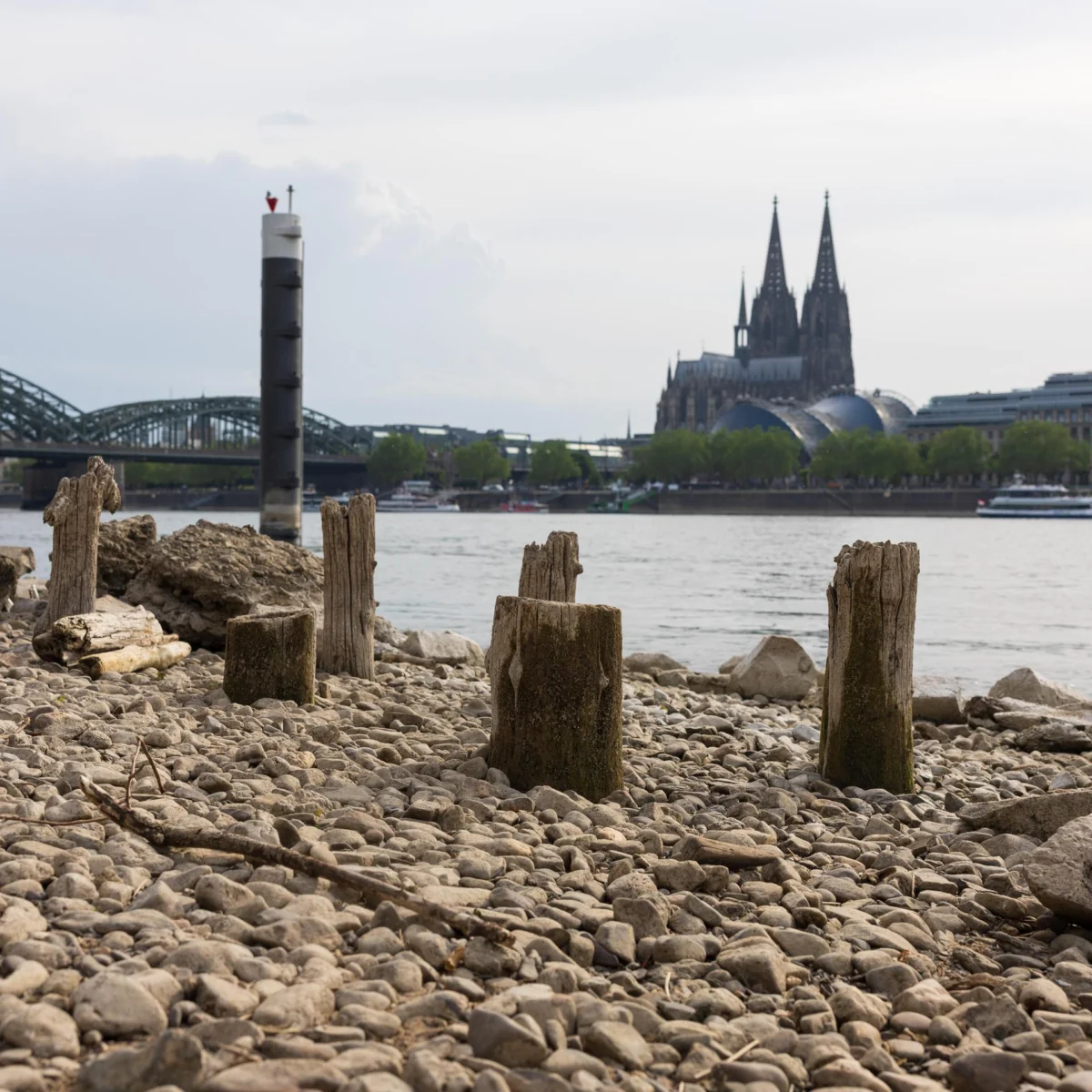
- Riparian Habitats: The exposure of gravel banks and old wooden piles, as seen in the Cologne-Deutz image, dramatically alters riparian habitats, affecting the plants and animals that depend on these fluctuating zones.
- Groundwater Levels: The Rhine’s water level is intricately linked to regional groundwater levels. A sustained drop in the river can lead to a corresponding decrease in groundwater, impacting drinking water supplies and terrestrial ecosystems.
- Sedimentation: Reduced flow can lead to increased sedimentation in certain areas, further exacerbating the problem of shallow depths and requiring costly dredging operations.
The data unequivocally points to a multifaceted crisis that demands a holistic and urgent response, integrating economic, environmental, and hydrological considerations.
Official Responses: Navigating the Crisis
The recurring low water events on the Rhine have prompted various stakeholders, from governmental bodies to industry associations and environmental groups, to respond with a mix of short-term measures and calls for long-term strategies.
Federal Waterways and Shipping Administration (WSV)
As the primary authority responsible for Germany’s federal waterways, the WSV plays a crucial role in monitoring water levels and providing critical information to shippers. Their daily updates, like the one cited for Düsseldorf, are essential for operational planning. In times of low water, the WSV issues official "low water notices" and sometimes imposes temporary restrictions on vessel dimensions or speeds to ensure safety and prevent groundings. They are also responsible for maintaining the navigable channel, which can involve surveying for sediment build-up and, in extreme cases, emergency dredging operations, though these are costly and often limited in scope. The WSV collaborates with neighbouring countries (France, Switzerland, Netherlands) through the International Commission for the Hydrology of the Rhine Basin (CHR) to share data and coordinate responses, acknowledging the transnational nature of the river.
German Federal Government
The German federal government, particularly the Ministry for Digital and Transport (BMDV) and the Ministry for the Environment, Nature Conservation, Nuclear Safety and Consumer Protection (BMUV), has been increasingly involved. Following the 2018 and 2022 crises, the government initiated various task forces and studies to assess the long-term implications of low water. Discussions have included:
- Infrastructure Investment: Exploring possibilities for deepening critical sections of the Rhine, though this is a complex and environmentally contentious undertaking.
- Multimodal Transport Strategies: Promoting shifts to rail and road when river transport is restricted, requiring investment in rail infrastructure and logistical hubs.
- Water Management Plans: Developing comprehensive national water strategies that integrate climate change adaptation, focusing on water retention, efficient usage, and protection of groundwater resources.
- Early Warning Systems: Enhancing hydrological forecasting and warning systems to give shipping companies more lead time to adapt.
However, critics often argue that the pace of implementation for these long-term strategies is too slow, given the accelerating frequency of extreme weather events.
Shipping and Industrial Associations
Industry bodies, such as the German Association for Inland Navigation (BDB) and the Federation of German Industries (BDI), have been vocal in expressing their concerns and demanding action. They highlight the severe economic impact on their members, ranging from increased operational costs to production losses. Their primary demands typically include:
- Reliable Navigability: Calls for guaranteed minimum navigable depths, possibly through dredging or other engineering solutions.
- Financial Support: Assistance for companies affected by the crisis, including subsidies for alternative transport or investment in shallow-draught vessels.
- Policy Dialogue: Active participation in government-led initiatives to develop long-term solutions for Rhine management.
- Innovation: Investment in new vessel designs that can operate efficiently in shallower waters.
Many individual companies have also begun to adapt by investing in smaller, more flexible vessels, or by establishing alternative logistics chains. However, for many, the Rhine remains the most cost-effective and environmentally friendly transport option.
Environmental Organizations
Environmental groups, such as BUND (Friends of the Earth Germany) and NABU (Nature and Biodiversity Conservation Union), emphasize the ecological dimensions of the crisis. They advocate for:
- Climate Action: More aggressive policies to reduce greenhouse gas emissions as the root cause of extreme weather events.
- Ecological River Restoration: Prioritizing measures that enhance the river’s natural resilience, such as restoring floodplains and natural riverbanks, which can help regulate water flow and temperature.
- Sustainable Water Use: Promoting responsible water abstraction and discouraging large-scale engineering projects like extensive dredging, which can have negative ecological consequences.
- Biodiversity Protection: Highlighting the severe impact on aquatic life and calling for measures to protect vulnerable species.
They often caution against short-sighted engineering solutions that might further damage the river’s ecosystem, instead urging a holistic approach that respects the river’s natural dynamics.
Scientific Community
Hydrologists, climatologists, and environmental scientists provide the crucial data and models that inform these discussions. They confirm the strong link between climate change and the increased frequency and intensity of droughts and heatwaves affecting the Rhine basin. Their research often focuses on:
- Climate Projections: Forecasting future hydrological scenarios for the Rhine under different climate change pathways.
- Water Management Innovations: Research into smart water management techniques, including groundwater recharge, reservoir optimization, and nature-based solutions.
- Ecological Impact Assessments: Studying the long-term effects of altered flow regimes on river ecosystems.
The collective response underscores the complexity of the Rhine crisis, requiring collaboration and compromise among diverse interests to secure the future of this vital European waterway.
Implications: Towards a Resilient Future for the Rhine
The current record-low water levels on the Rhine are more than just a temporary inconvenience; they are a stark warning of profound long-term implications for Germany’s economy, environment, and societal well-being. The challenge now lies in transitioning from reactive crisis management to proactive, sustainable adaptation strategies.
Short-Term Disruptions and Economic Fallout
In the immediate future, the primary implication is continued disruption to shipping and industrial supply chains. If significant rainfall does not materialize in the Rhine’s catchment areas, water levels could drop further, potentially leading to even more severe restrictions or even temporary cessation of commercial traffic on certain sections. This would inevitably translate into:
- Higher Consumer Prices: Increased transport costs for goods will likely be passed on to consumers.
- Production Delays: Industries dependent on the Rhine for inputs or outputs could face production cuts or temporary shutdowns, impacting economic output.
- Energy Security Concerns: Reduced power plant output due to cooling water issues could strain the electricity grid, especially during periods of high demand.
- Logistical Bottlenecks: The shift to rail and road transport is not a perfect substitute. Germany’s rail network already faces capacity constraints, and road transport is more carbon-intensive and prone to congestion.
The economic cost of these disruptions, as evidenced by previous low-water years, can run into billions of euros, impacting national GDP and potentially slowing economic recovery.
Medium-Term Adaptation and Infrastructure Needs
Looking ahead, the recurring nature of these events necessitates significant medium-term investments and policy adjustments:
- Infrastructure Modernization:
- Dredging and Channel Optimization: While controversial, targeted dredging of critical shallow spots might be considered to maintain minimum navigable depths, though environmental impact assessments are crucial.
- Port Infrastructure: Adapting port facilities to handle more diverse types of vessels or to facilitate easier transshipment between river, rail, and road.
- Shallow-Draught Vessels: Incentivizing the development and deployment of new barge designs that can operate more efficiently in shallower waters, perhaps with hybrid propulsion systems for environmental benefits.
- Multimodal Logistics: Further investment in rail and road networks to create a more resilient and integrated transport system that can absorb shocks to river transport. This includes expanding rail freight capacity and improving intermodal terminals.
- Water Management Systems: Developing sophisticated regional and national water management plans that account for climate change. This could involve:
- Reservoir Management: Better coordination of reservoir releases from Alpine regions to support Rhine levels.
- Groundwater Recharge: Projects to replenish groundwater aquifers, which can act as natural buffers.
- Water Conservation: Promoting efficient water use in agriculture, industry, and households.
Long-Term Resilience and Climate Change Adaptation
The ultimate implication is the imperative to fundamentally adapt to a climate-altered future. The Rhine crisis is a microcosm of a larger challenge facing interconnected natural and economic systems worldwide. Long-term solutions must address the root causes and build systemic resilience:
- Aggressive Climate Mitigation: The most critical long-term solution remains a rapid and comprehensive reduction of greenhouse gas emissions to limit global warming and the severity of future extreme weather events.
- Integrated Water Resource Management: A holistic approach that considers the entire Rhine basin, from its Alpine sources to the North Sea delta. This requires enhanced international cooperation among all riparian states (Switzerland, France, Germany, Luxembourg, Netherlands, Belgium) to manage shared water resources sustainably.
- Nature-Based Solutions: Investing in ecological restoration projects, such as restoring floodplains, rewetting peatlands, and increasing forest cover. These natural interventions can help retain water in the landscape, reduce evaporation, and improve water quality, offering more sustainable long-term solutions than purely technical fixes.
- Research and Innovation: Continued investment in climate science, hydrological modeling, and technological innovations for water management and resilient infrastructure.
- Public Awareness and Education: Fostering a greater understanding among the public about the value of water, the impacts of climate change, and the importance of conservation efforts.
The Rhine, often called the "economic backbone of Europe," is sending a clear message. Its dwindling waters are a tangible symptom of a changing climate that demands urgent, coordinated, and far-sighted action. Failure to address these implications comprehensively risks not only economic prosperity but also the ecological health of one of Europe’s most iconic and vital rivers.