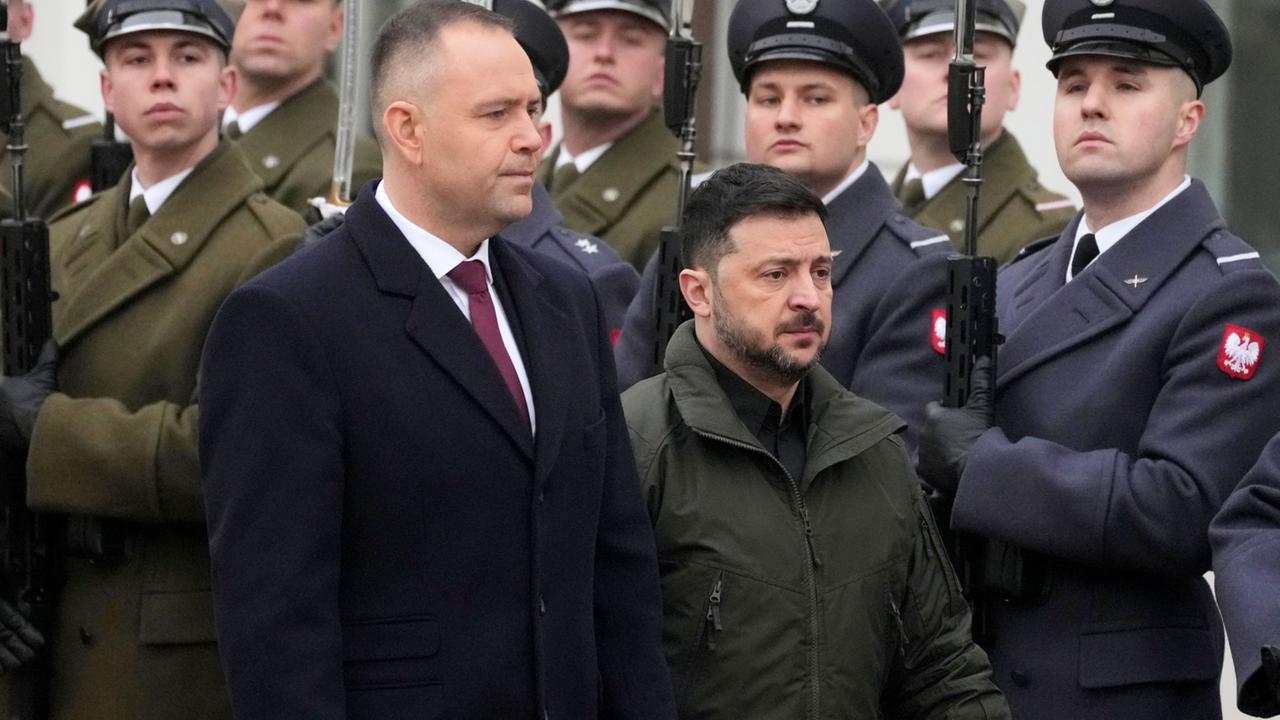
Warsaw, Poland – June 20, 2026 – A significant diplomatic rift has emerged between Poland and Ukraine, as Polish President Karol Nawrocki announced today the revocation of the nation’s highest honor, the Order of the White Eagle, bestowed upon Ukrainian President Volodymyr Zelenskyy. The decision, communicated via a video statement from the President’s office, marks a dramatic escalation in a simmering historical dispute, triggered by Ukraine’s naming of a military unit in honor of the Ukrainian Insurgent Army (UPA).
President Nawrocki stated that the withdrawal of the prestigious award was a measure to "preserve the memory of Polish citizens and the dignity of state symbols." He emphasized that the decision was not directed at the Ukrainian people and affirmed Poland’s continued readiness to cooperate with Ukraine. Furthermore, he stressed that this action would not alter Poland’s strategic security policy orientation towards Ukraine.
However, this move is widely anticipated to plunge the relationship between the two neighboring nations into a severe diplomatic crisis, occurring mere days before a crucial international conference in Gdańsk, Poland, dedicated to the reconstruction of Ukraine.
The Genesis of the Dispute: A Contested Legacy
The immediate catalyst for this unprecedented presidential action was President Zelenskyy’s decision in late May to confer the name "Heroes of the UPA" upon a Ukrainian army unit. The UPA, a nationalist paramilitary organization active during World War II, fought against both Soviet and Nazi German forces. However, its legacy is deeply contentious, particularly in Poland, where the UPA is inextricably linked to the brutal massacres of Polish civilians.
For decades, historical narratives surrounding the UPA have been a source of tension between Poland and Ukraine. While some in Ukraine view the UPA as heroic freedom fighters who resisted Soviet occupation and contributed to Ukraine’s eventual independence, Poland unequivocally condemns the organization for its role in ethnic cleansing and genocidal violence against Poles. Polish historical accounts detail the systematic killing of approximately 100,000 Poles by Ukrainian nationalists between 1943 and 1945, primarily in the Volhynia region of former eastern Poland. Thousands of Ukrainians also perished in retaliatory actions.
President Zelenskyy’s decision to honor a unit with the name "Heroes of the UPA" was met with widespread outrage and condemnation in Poland, reigniting painful historical grievances and challenging the carefully cultivated narrative of Polish-Ukrainian solidarity in the face of Russian aggression.
A Chronology of the Escalation
The awarding of the Order of the White Eagle to President Zelenskyy occurred in 2023, during the tenure of then-President Andrzej Duda. At the time, the award was presented in recognition of President Zelenskyy’s perceived contributions to deepening Polish-Ukrainian relations and his advocacy for human rights. This gesture symbolized a period of strong alliance and mutual support between the two countries, particularly in the context of Russia’s ongoing invasion of Ukraine.
The recent decision by President Zelenskyy to name a military unit after the UPA marked a stark departure from this period of perceived unity and opened a new chapter of historical contention. The immediate aftermath saw strong public and political reactions in Poland.
Key Timeline of Events:
- 2023: President Andrzej Duda awards the Order of the White Eagle to President Volodymyr Zelenskyy for his contributions to Polish-Ukrainian relations and human rights.
- Late May 2026: President Volodymyr Zelenskyy names a Ukrainian army unit "Heroes of the UPA."
- Early June 2026: Widespread condemnation and public outcry erupt in Poland following the announcement of the UPA unit naming. Polish historical organizations and political figures express deep dismay.
- Mid-June 2026: President Karol Nawrocki, who succeeded Andrzej Duda, publicly signals his intent to review the honor bestowed upon President Zelenskyy.
- June 20, 2026: President Nawrocki officially announces the revocation of the Order of the White Eagle from President Zelenskyy via a video statement.
- June 20, 2026: The Ukrainian Ministry of Foreign Affairs issues a statement criticizing the Polish decision as a "strategic mistake."
- June 22, 2026: A major international conference on the reconstruction of Ukraine is scheduled to take place in Gdańsk, Poland, raising concerns about the impact of the diplomatic rift on international support efforts.
Supporting Data: The Weight of the Order and the Shadow of the Past
The Order of the White Eagle is the highest state decoration in Poland, reserved for the most distinguished Polish citizens and esteemed foreign dignitaries. Its revocation is an exceptionally rare and symbolically potent act, signifying a profound disapproval of the recipient’s actions or policies.
The historical context of the UPA’s actions, particularly the Volhynia massacres, remains a deeply sensitive issue in Poland. Official estimates from Polish historical institutions place the number of Polish victims at around 100,000, a figure that underscores the scale of the tragedy. The narrative of Polish suffering at the hands of Ukrainian nationalists has been deeply ingrained in Polish collective memory.
In contrast, while acknowledging the tragic loss of life, some Ukrainian perspectives emphasize the UPA’s role as a resistance movement against foreign occupation, a complex historical interpretation that clashes sharply with the Polish narrative of victimhood. This divergence in historical interpretation lies at the heart of the current diplomatic impasse.
Official Responses and Diplomatic Fallout
The decision by President Nawrocki has elicited strong reactions from both sides of the diplomatic divide.
Polish Perspective:
President Nawrocki’s statement aimed to frame the revocation as a necessary act to uphold historical justice and national dignity, while simultaneously attempting to mitigate the damage to the broader Polish-Ukrainian relationship. He stated, "This decision is not directed against the Ukrainian people. Poland remains ready to cooperate with Ukraine. It also signifies no change in the strategic orientation of Polish security policy."
However, the severity of the action has led to considerable debate within Poland regarding its legal implications. Constitutional experts have pointed out that the Polish Constitution does not explicitly grant the President unilateral authority to revoke such honors. Historically, the Prime Minister, Donald Tusk, would also need to sign off on such a decision. Nevertheless, Polish media has largely portrayed the President’s decision as final.
Prime Minister Donald Tusk, while acknowledging the gravity of the situation, has urged for a measured response. He stated, "It is the task of President Zelenskyy and President Nawrocki to calm tempers, rather than to fuel tensions." His remarks suggest a desire to de-escalate the conflict and prevent it from overshadowing crucial international efforts.
Ukrainian Perspective:
Ukraine’s response has been one of strong criticism and disappointment. Ukrainian Foreign Minister Andriy Sybiha described the Polish decision as a "strategic mistake" in a post on Facebook. He wrote, "We regret that the Polish side has decided to escalate this conflict to an unacceptable and inappropriate level. No president of another country will dictate our history to us." This assertion underscores Ukraine’s determination to maintain its own historical narratives and resist external pressure on its interpretation of national heroes.
The Ukrainian government appears to view the Polish action as a politically motivated move that undermines the solidarity crucial for Ukraine’s continued defense against Russian aggression. The timing of the dispute, so close to the reconstruction conference, also raises concerns about the potential for diminished international support if diplomatic unity falters.
Implications for Polish-Ukrainian Relations and Regional Stability
The revocation of the Order of the White Eagle by Poland from President Zelenskyy represents a significant blow to what has been a remarkably close and supportive relationship between the two nations. The dispute over the UPA’s legacy threatens to overshadow the crucial shared objective of countering Russian aggression and rebuilding Ukraine.
Key Implications:
- Strained Bilateral Relations: The immediate consequence is a significant deterioration in diplomatic ties. This could lead to a period of frostiness, impacting cooperation on various fronts, including defense, economic development, and humanitarian aid.
- Impact on Reconstruction Efforts: The upcoming reconstruction conference in Gdańsk is now overshadowed by this diplomatic spat. Potential donors and international partners may become concerned about the stability of Polish-Ukrainian relations, potentially affecting the flow of aid and investment.
- Internal Political Dynamics: The decision is likely to have repercussions within both Poland and Ukraine. In Poland, it could be seen by some as a strong stance on historical justice, while others may view it as a damaging diplomatic misstep. In Ukraine, it could be interpreted as a betrayal of solidarity by a key ally.
- Erosion of Solidarity Narrative: The narrative of unwavering Polish-Ukrainian solidarity, so crucial in the face of the Russian invasion, is now under strain. This could be exploited by Russia, which has consistently sought to sow discord among Ukraine’s allies.
- Historical Reckoning and Reconciliation: The incident highlights the enduring challenges of historical reconciliation between Poland and Ukraine. It underscores the deep-seated nature of differing interpretations of past events and the difficulty of finding common ground on sensitive historical figures and organizations.
- Precedent for Future Disputes: The precedent set by the revocation of such a high honor could potentially embolden other nations to exert pressure on Ukraine regarding its historical narratives or internal policies.
While President Nawrocki has attempted to frame the decision as a localized issue concerning historical memory, its broader implications for regional stability and the ongoing struggle for Ukrainian sovereignty cannot be understated. The coming weeks and months will be critical in determining whether this deeply divisive issue can be navigated without irrevocably damaging a partnership that has been vital for European security. The challenge ahead lies in finding a path that respects historical memory while preserving the essential alliance between Poland and Ukraine.