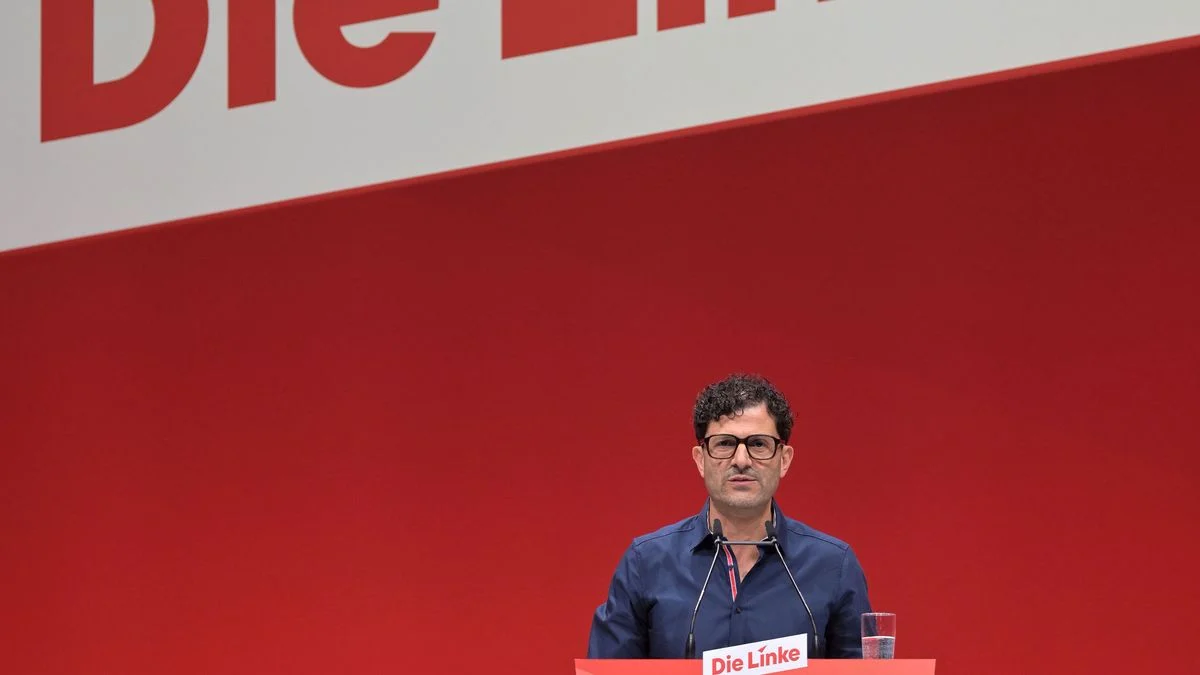
Berlin, Germany – Luigi Pantisano, the newly elected co-chair of Germany’s left-wing party Die Linke, has issued a significant apology for his recent controversial remarks that equated the Christian Democratic Union (CDU)’s policies with "fascist politics" and saw "no difference" between the CDU and the far-right Alternative for Germany (AfD). The statements, made shortly after his contentious election to the party’s leadership, ignited a firestorm of criticism across the political spectrum and even within his own party. Pantisano has now described his initial comparison as "abbreviated and in this form incorrect," expressing regret and specifically apologizing to those within the CDU who staunchly advocate for a clear "firewall" against the AfD.
While his apology signals an attempt to de-escalate the political fallout and repair damaged relationships, Pantisano simultaneously reaffirmed his "fundamental criticism of the Union’s rightward shift" and reiterated his "concern about a possible further political rapprochement between CDU and AfD." This nuanced retraction highlights the precarious position of Die Linke’s new leader, grappling with internal dissent and the challenge of defining his party’s stance amidst Germany’s evolving political landscape. The incident underscores the heightened sensitivity surrounding political rhetoric in Germany, particularly when invoking historical terms with profound national significance.
A Chronology of Controversy and Contrition
The controversy surrounding Luigi Pantisano unfolded rapidly, casting a shadow over his nascent leadership and exposing the deep ideological rifts within German politics.
The Initial Spark: "Bild" Interview and Party Congress
The initial spark was ignited on Friday when Pantisano, a prominent figure from Baden-Württemberg, gave an interview to the mass-circulation newspaper "Bild." In this interview, he controversially compared the policies of the CDU and the AfD, labeling both as "fascist." This explosive statement came at a critical juncture for Die Linke, as the party was holding its federal congress in Potsdam. The congress was tasked with electing new leadership to steer the party through a period of profound internal crisis and declining electoral fortunes.
Pantisano’s remarks were particularly jarring given the context of the party congress, which culminated in his election as co-chair alongside Ines Schwerdtner. However, his victory was far from a resounding mandate. He secured a mere 53.3 percent of the delegate votes, an exceptionally poor result for a party leader and a clear indicator of the deep divisions and lack of consensus within Die Linke regarding its future direction and leadership. The "Bild" interview, therefore, not only reflected Pantisano’s personal views but immediately amplified the challenges he would face in unifying a fractured party.
Escalation and Initial Attempts at Relativization
As the weekend progressed, Pantisano’s "fascist politics" accusation continued to reverberate. Initially, he attempted to relativize his statement, suggesting that "Bild" had taken his words out of context. This is a common tactic in political damage control, aiming to shift blame and temper public reaction. However, this attempt at damage control proved short-lived and ultimately ineffective.
In a move that further fueled the controversy, Pantisano reportedly repeated the "fascism" accusation after delivering his application speech at the party congress. This repetition, even if slightly rephrased, signaled to many that his initial statement was not a mere misstep or a quote taken out of context, but rather a deliberate and deeply held political assessment. The renewed accusation intensified the outrage, making it clear that Pantisano was not backing down, at least not immediately. Facing mounting pressure and widespread condemnation, he eventually began to soften his stance, later describing the statement as "unfortunate and abbreviated." This shift marked the beginning of his journey towards a more conciliatory position.
The Apology and Nuance
The full extent of Pantisano’s contrition became public in an interview with the German news agency dpa. It was here that he delivered his unequivocal apology, acknowledging the error in his initial comparison. "His statement that he currently saw no difference between the policies of the CDU and the AfD ‘was abbreviated and in this form incorrect’," Pantisano told dpa. "For that, I apologize, especially to those in the CDU who repeatedly emphasize the necessity of a clear firewall against the AfD."
This apology was carefully worded. By specifically acknowledging and apologizing to those within the CDU who uphold the "Brandmauer" (firewall) against the AfD, Pantisano attempted to differentiate between the CDU’s various factions and to signal a willingness to engage with the democratic mainstream. He subsequently reinforced this sentiment with a broader statement of regret: "We must not blur the distinction between political opponents within the democratic spectrum and those who want to abolish democracy." This recognition of the fundamental difference between mainstream democratic parties and anti-democratic forces was crucial for re-establishing a modicum of credibility and for signalling a return to accepted norms of political discourse.
Lingering Criticisms and Concerns
Despite his apology, Pantisano was careful not to completely retract his underlying political critiques. He reiterated his "fundamental criticism of the Union’s rightward shift," a long-standing point of contention for Die Linke, which views the CDU’s policies, particularly on immigration and social issues, as increasingly conservative and detrimental to the country’s social fabric.
Furthermore, the 46-year-old leader maintained his "concern about a possible further political rapprochement between CDU and AfD." This continued apprehension reflects a broader anxiety on the German left about the perceived erosion of the "Brandmauer" and the potential for mainstream conservative parties to move closer to, or even cooperate with, the far-right AfD, especially at regional and local levels. This stance indicates that while Pantisano regretted the inflammatory language, the core ideological disagreement and his fundamental worries about the direction of conservative politics in Germany remain firmly in place.
Supporting Data and Political Context
To fully grasp the magnitude of Pantisano’s statements and their subsequent impact, it is essential to understand the broader political context in Germany, particularly the state of Die Linke and the charged nature of certain political terms.
The State of Die Linke
Die Linke is currently navigating one of the most challenging periods in its history. Born from the fusion of the post-communist PDS and the WASG (an electoral alternative formed by disillusioned SPD members), the party has historically struggled to define its role in a rapidly changing political landscape. In recent years, it has faced declining electoral fortunes, internal strife, and a perceived lack of clear vision. Its representation in the Bundestag is precarious, having only secured seats in the last election due to winning three direct mandates, failing to clear the 5% national threshold.
Pantisano’s exceptionally low approval rating of 53.3% for a party leader is a stark indicator of this deep internal crisis. It suggests a party deeply divided over its strategic direction, its messaging, and its leadership. Many within Die Linke advocate for a more pragmatic, coalition-oriented approach to secure political influence, while others, including elements of the more radical wings, prefer a clear ideological stance, even if it means remaining outside mainstream governance. Pantisano’s election, and the immediate controversy, highlights the uphill battle he faces in uniting these disparate factions and providing a clear, electorally viable path forward for a party teetering on the brink of political irrelevance.
The "Firewall" Debate in German Politics
The concept of the "Brandmauer" or "firewall" against the AfD is a cornerstone of mainstream German political consensus. It refers to the resolute refusal of all established democratic parties – from the CDU/CSU on the center-right to the SPD, Greens, and FDP in the center and center-left – to cooperate or form coalitions with the AfD. This "firewall" is rooted in Germany’s post-war commitment to preventing the rise of extremist parties and safeguarding democratic institutions, a lesson learned from its own dark history.
Pantisano’s statement, equating the CDU with the AfD and labeling their policies as "fascist," directly challenged and undermined this fundamental consensus. By blurring the lines between a mainstream democratic party (CDU) and a party often accused of harboring anti-democratic and extremist tendencies (AfD), he struck at the very heart of this political "firewall." His specific apology to those in the CDU who uphold the "Brandmauer" demonstrates an understanding of how deeply his initial remarks transgressed this unwritten rule of German politics. The debate around the "Brandmauer" is ongoing, particularly at the local and state levels, where the AfD’s increasing strength sometimes forces uncomfortable questions about how to govern effectively without legitimizing the far-right.
The Weight of "Fascism" Accusations
In Germany, the term "fascism" carries an immense historical and moral weight. Its use is inextricably linked to the atrocities of the Nazi regime and the Holocaust. Consequently, deploying this term in contemporary political discourse is highly sensitive and often seen as an extreme escalation of rhetoric. It is generally reserved for movements or ideologies that genuinely advocate for authoritarianism, totalitarianism, and the suppression of democratic rights, often accompanied by racial hatred and violence.
Pantisano’s casual application of "fascist politics" to the CDU, a party that has been a foundational pillar of Germany’s democratic post-war order, was therefore perceived as not merely an insult but a dangerous trivialization of history. It risked cheapening a term that should evoke profound historical lessons and, in doing so, could inadvertently diminish the gravity of actual fascist threats. The widespread outrage was not just about the attack on the CDU, but about the perceived misuse of such a potent and historically loaded word in a democratic debate.
Official Responses and Widespread Outrage
The immediate aftermath of Pantisano’s "Bild" interview was characterized by a swift and almost universal condemnation, transcending traditional party lines.
Reactions from the CDU
Predictably, the CDU reacted with strong condemnation. Leaders within the party viewed Pantisano’s remarks as an unacceptable attack on democratic institutions and a profound insult. Prominent CDU figures immediately denounced the comparison as historically ignorant and politically irresponsible. They emphasized that while they are political opponents of Die Linke, the CDU operates firmly within the democratic spectrum and stands as a bulwark against extremism, including the AfD.
Statements from CDU politicians highlighted the danger of such rhetoric, arguing that it serves to legitimize extremist positions by falsely equating democratic parties with anti-democratic forces. Many pointed to the CDU’s consistent efforts to maintain the "Brandmauer" against the AfD, stressing that Pantisano’s comments were not only false but actively harmful to the necessary political consensus against the far-right. The apology was seen as a necessary, though perhaps insufficient, step to mitigate the damage.
Condemnation from SPD and Greens
Even parties ideologically closer to Die Linke – the Social Democratic Party (SPD) and The Greens – expressed their dismay and condemnation. This cross-party outrage underscored the severity of Pantisano’s transgression against accepted democratic norms. While the SPD and Greens often criticize the CDU’s policies, particularly its more conservative stances, they firmly distinguish between legitimate political opposition and the accusation of "fascist" tendencies.
Representatives from both parties stressed the importance of maintaining clear boundaries in political discourse and warned against the trivialization of terms like fascism. They highlighted that despite political differences, all democratic parties must uphold fundamental values and avoid language that blurs the lines between constitutional democracy and extremism. Their condemnation served as a powerful signal that Pantisano’s remarks were beyond the pale for the broader democratic left, not just the conservatives.
Internal Discord within Die Linke
Perhaps most damaging for Pantisano was the significant outrage that erupted within his own party. The low election result already indicated deep divisions, and his controversial statements immediately exacerbated these tensions. Many within Die Linke, particularly those who advocate for a more moderate and electable course, were dismayed by their new leader’s initial foray into the national spotlight. They feared that such radical rhetoric would further alienate potential voters, damage the party’s credibility, and undermine efforts to build alliances with other left-leaning parties.
Critics within Die Linke likely viewed the statements as a strategic blunder, jeopardizing the party’s already fragile standing and making it even harder to attract a broader electorate. The internal discord highlighted the existential struggle Die Linke faces: how to maintain its radical identity and core principles while simultaneously striving for political relevance and electoral success in Germany’s multi-party system. Pantisano’s apology, therefore, was not only directed at external critics but was also a crucial attempt to quell internal dissent and begin the arduous process of unifying his fractious party.
Implications for German Politics and Die Linke’s Future
The incident surrounding Luigi Pantisano’s remarks and subsequent apology carries significant implications for his leadership, the future of Die Linke, and the broader German political discourse.
Pantisano’s Leadership Under Scrutiny
Pantisano’s tenure as co-chair has begun under an intense cloud of scrutiny and controversy. His extremely low approval rating at the party congress already signaled a lack of strong internal mandate. The immediate fallout from his statements has further weakened his position, raising questions about his judgment, his ability to lead a diverse party, and his strategic acumen. His first major public appearance was dominated by damage control rather than the articulation of a clear vision for Die Linke.
Moving forward, Pantisano faces the daunting task of earning the trust and confidence of not only the German public but, more critically, his own party members. He must demonstrate that he can lead Die Linke effectively, unify its disparate factions, and articulate a coherent, electable message without resorting to rhetoric that alienates potential allies or the democratic mainstream. This incident suggests that his leadership will be characterized by a constant struggle to balance ideological purity with political pragmatism, a challenge that has historically plagued Die Linke.
The Future of the "Brandmauer"
Pantisano’s initial remarks, while quickly retracted, underscore the ongoing fragility of the "Brandmauer" against the AfD. While the consensus among mainstream parties remains strong at the federal level, local and regional pressures, particularly in eastern Germany where the AfD enjoys significant support, can sometimes strain this resolve. Statements that equate mainstream democratic parties with the far-right, even if later apologized for, can inadvertently contribute to a blurring of lines that ultimately benefits extremist narratives.
The incident serves as a reminder of the constant vigilance required to maintain the distinction between democratic competition and anti-democratic extremism. It highlights the responsibility of all political actors to use precise language and to avoid rhetoric that could inadvertently legitimize or normalize the AfD by placing it on par with established democratic forces. The debate about how to deal with the AfD – isolating it versus engaging with its voters – remains one of the most pressing challenges in German politics, and Pantisano’s comments only added another complex layer to this discussion.
Challenges for Die Linke’s Strategic Positioning
Die Linke’s very existence is currently at stake. To avoid fading into political irrelevance, the party needs to clearly define its strategic positioning. Pantisano’s incident reveals the inherent tension within the party: the desire to articulate a radical, anti-establishment critique versus the need to be perceived as a credible, coalition-capable partner in a democratic system.
For Die Linke to regain traction, it must find a way to distinguish itself effectively from other left-leaning parties (SPD, Greens) without resorting to language that is widely perceived as extreme or undemocratic. This means crafting a clear narrative that addresses social inequalities, climate change, and peace while respecting democratic boundaries and fostering constructive engagement with other parties. The initial misstep by its new leader suggests that this strategic clarity is still very much a work in progress. The party’s ability to navigate this challenge will determine its long-term viability in the German political landscape.
Broader Impact on Political Discourse
Finally, the entire episode underscores the critical importance of precise and responsible language in political discourse. In an era often characterized by increasing polarization and the spread of misinformation, the use of historically charged terms without careful consideration can have profound and damaging effects. It can erode trust, deepen societal divisions, and trivialize serious historical events.
Pantisano’s journey from inflammatory accusation to contrite apology serves as a cautionary tale for all political figures. While robust debate and sharp criticism are vital components of a healthy democracy, there is a clear line that, once crossed, can undermine the very foundations of democratic discourse. The challenge for German politics, and for Pantisano himself, will be to learn from this experience, foster a more respectful yet critical dialogue, and ensure that the pursuit of political goals does not come at the expense of democratic integrity and historical responsibility.