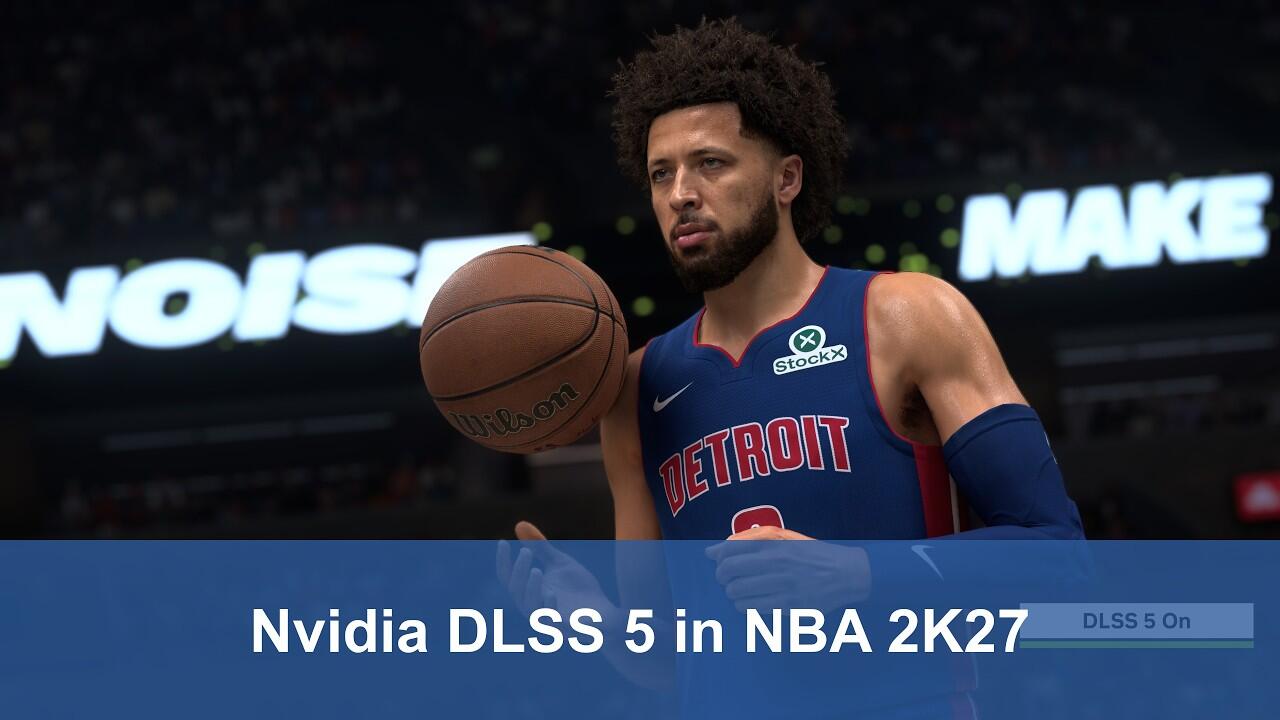
It has been roughly seven weeks since the debut of DLSS 5, Nvidia’s cutting-edge neural rendering technology. When it first launched within NBA 2K27, the feature was met with a mixture of awe and frustration. While it undeniably elevated the visual fidelity of the basketball simulation—delivering remarkably realistic lighting in close-ups without the "AI-slop" artifacts common in earlier machine-learning applications—the performance tax was staggering.
For many users, the visual benefits were eclipsed by a brutal drop in frame rates. Even the flagship GeForce RTX 5090 suffered a 57% performance hit in Ultra HD, with mid-range cards faring even worse. Today, however, Nvidia has released a significant model update that promises to reshape the narrative. By streamlining the neural pipeline, Nvidia claims to have boosted frame rates by up to 50% in some scenarios, effectively turning a "high-end only" experiment into a much more viable feature for a broader range of hardware.
The Technical Evolution: From "Unplayable" to Optimized
When DLSS 5 first arrived in early September, the industry was captivated by its potential but wary of its demands. In NBA 2K27, the technology was arguably too heavy for mainstream hardware. The "brutal" FPS drop mentioned in initial reports made it an exclusive playground for the absolute top-tier silicon.
However, Nvidia’s latest update, which arrived as a silent patch last Friday, tells a different story. According to official documentation, the new model effectively halves the runtime within the rendering pipeline. Through systematic optimizations and a 24% reduction in neural network parameters—down to 118 million—the feature has become significantly more efficient. Perhaps most importantly for users with memory-constrained cards, the VRAM footprint of DLSS 5 has been reduced by 20%.
This optimization is not merely theoretical. While initial testing on the RTX Spark platform (via ARM64 builds) hinted at a 30% uplift, real-world benchmarks on x86 Windows 11 systems with the RTX 50-series stack have proven even more impressive.
Chronology of the Update: A Fast-Track Improvement
The timeline of this update highlights Nvidia’s aggressive approach to iterative AI development.

- Early September: DLSS 5 launches in NBA 2K27. Visuals are praised for their realism, but performance metrics are condemned due to massive FPS overhead.
- Late October: Early reports emerge of a "next-gen" model being tested on RTX Spark laptops, showing a 30% performance increase.
- November (Present): The optimized model is deployed to the general public via an automatic patch. The patch requires no new drivers or specific user settings, demonstrating the seamless nature of DLSS model updates.
Interestingly, the patch also included minor internal updates to NBA 2K27 itself, which resulted in a negligible 1–5% performance decrease in the base game. Despite this, the gains provided by the improved DLSS 5 model are so substantial that they far outweigh the minor overhead added by the game’s own internal updates.
Supporting Data: Benchmark Performance Analysis
The performance delta between the original and updated DLSS 5 models is staggering. Our testing across the RTX 5070, 5070 Ti, 5080, and 5090 reveals a clear trend: the lower the tier of the card, the more "saved" performance we see, while the higher-end cards benefit from moving further away from CPU-bound limitations.
WQHD (1440p) Results
In WQHD, the GeForce RTX 5070 and 5070 Ti saw a massive 45% increase in frame rates. For the RTX 5070, this was the difference between a sluggish sub-60 FPS experience and a smooth 88 FPS. The RTX 5080 and 5090 also saw significant gains, though they hit a "CPU ceiling" on our Ryzen 7 9800X3D test rig, limiting their gains to 40% and 23%, respectively.
Crucially, the performance penalty of enabling DLSS 5 has been cut significantly. The RTX 5070’s overhead dropped from a 63% loss to a 46% loss. While still a significant investment in GPU resources, it is a much more palatable trade-off for the visual fidelity gained.
Ultra HD (4K) Results
The benefits in Ultra HD are even more pronounced. The GeForce RTX 5070 saw a 48% boost, while the RTX 5070 Ti saw a staggering 49% improvement. The RTX 5070 Ti, which previously struggled to maintain a playable 41 FPS, now sits comfortably above the 60 FPS threshold.
The RTX 5090 remains the undisputed king of this setup, now delivering 111 FPS at 4K with DLSS 5 active—a performance level that was practically science fiction just two months ago. It is clear that while DLSS 5 is still a heavy feature, it is moving into the realm of general utility rather than just a luxury benchmark tool.

Addressing the "Frame-Pacing" Elephant in the Room
It is important to note that while DLSS 5 has improved, NBA 2K27 suffers from inherent frame-pacing issues independent of Nvidia’s technology. The game’s output remains somewhat "unrounded," a factor that manifests in lower percentile FPS readings.
We observed that the lower the frame rate drops, the more noticeable this stutter becomes. Consequently, we have excluded certain percentile-based data points because they reflect the game’s own engine issues rather than any failure of the DLSS 5 model itself. Nvidia’s update fixes the speed of the rendering, but it cannot fix the fundamental frame-pacing inconsistencies inherent to the NBA 2K27 code base.
Official Responses and Industry Implications
Nvidia has been characteristically brief but optimistic regarding this update. In an official statement, the company noted: "The new, more performant DLSS 5 model will debut in NBA 2K27, boosting frame rates by up to 1.4X. And it will ship by default with future DLSS 5 games."
This is a critical point: this isn’t just a patch for one game. It is a refinement of the underlying DLSS 5 architecture that will be standard moving forward. Upcoming titles, such as Hogwarts Legacy, are expected to leverage this optimized model from day one.
Regarding image quality, Nvidia maintains that the new model offers "comparable" visual fidelity to the original. In our testing, we found no discernible difference in image quality. While it is always possible that some edge cases exist, for the purposes of standard gameplay, the "no-loss" performance gain is a massive technical achievement.
Conclusion: A New Standard for Neural Rendering
The rapid evolution of DLSS 5 raises an obvious, if slightly critical, question: Why did Nvidia launch with the initial, less efficient model?
A six-week delay to allow for these optimizations would have likely resulted in a much stronger, more positive reception. By launching with the first iteration and patching it shortly after, Nvidia essentially used early adopters as a stress test for their neural pipelines.
However, looking forward, the implications are overwhelmingly positive. We are seeing a shift where AI-driven rendering is becoming faster, lighter on VRAM, and more accessible. A 40–50% performance improvement in less than two months is unprecedented in the history of graphics technology. If this six-week cadence of optimization continues, or even if it becomes a standard quarterly update, the barrier to entry for high-fidelity, AI-enhanced gaming will continue to collapse.
For the owner of a GeForce RTX 50-series card, this update is a gift. It turns NBA 2K27 from a tech-demo that pushed hardware to its absolute limit into a genuinely playable, visually stunning experience. The lesson here is clear: the age of AI rendering is not just about the launch day; it is about the constant, iterative improvement of the models themselves. Nvidia has proven that with enough data and fine-tuning, "Neural Rendering" can become as efficient as it is beautiful.