The automotive landscape is undergoing a seismic shift, transitioning from simple driver assistance to complex, AI-driven automation. Mercedes-Benz, in close collaboration with the computing giant Nvidia, has announced the upcoming European rollout of its highly anticipated "MB.Drive Assist Pro." After successfully launching the system in the demanding markets of China and North America, the Stuttgart-based automaker is preparing to bring its point-to-point automated driving solution to German streets.
This development represents a critical milestone for Mercedes-Benz as it strives to maintain its technological edge in an era dominated by software-defined vehicles. The system, which handles intricate urban maneuvers such as navigating intersections, managing traffic lights, and executing precise lane changes, is slated for an early-access program in Stuttgart and Munich by the end of 2026, with a broader market launch expected in the first half of 2027.
The Core Facts: What is MB.Drive Assist Pro?
At its heart, MB.Drive Assist Pro is a sophisticated SAE Level 2 automated driving system. While industry marketing has often flirted with ambiguous labels like "Level 2++," Mercedes-Benz has clarified its positioning: the system is designed to provide comprehensive support throughout an entire navigation route, yet it strictly remains an assistance system.
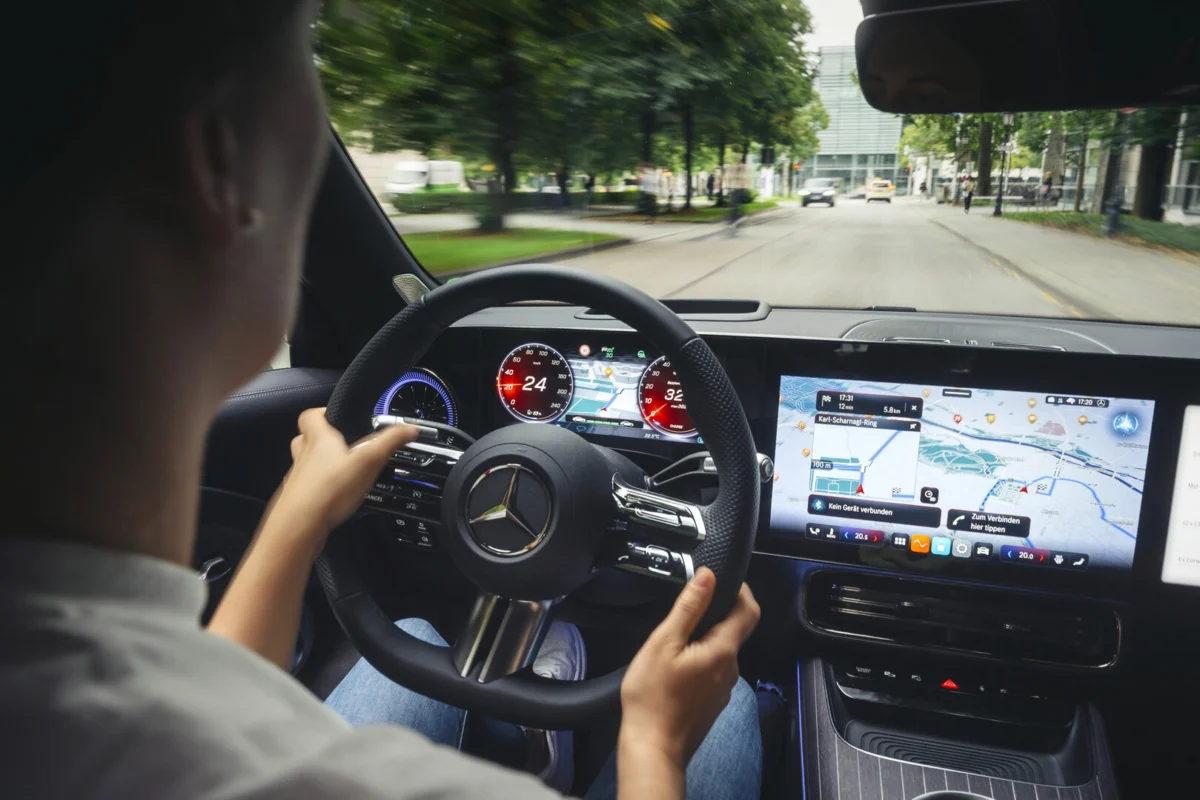
The primary function of the technology is to alleviate the cognitive load on the driver. Once a destination is set in the vehicle’s native navigation system, the driver can engage the assistant with a simple press of a button on the steering wheel. From that moment on, the car manages steering, acceleration, and braking, extending its reach beyond the highway and into the complexities of urban environments.
Key capabilities include:
- Autonomous Lane Management: The system automatically executes lane changes and maintains positioning within the flow of traffic.
- Intersection Handling: The vehicle is capable of identifying and navigating through traffic light-controlled intersections, including turning maneuvers.
- Traffic Flow Adaptation: The system manages stops and starts at traffic lights and adjusts speeds according to local regulations and road conditions.
Despite these advanced features, the system is not autonomous in the sense of a robotaxi. The driver is legally and functionally required to supervise the vehicle at all times, maintaining "hands-on" contact with the steering wheel. This cooperative human-machine interface is central to the current safety philosophy of Mercedes-Benz.
A Chronology of Development and Deployment
The path to the German market has been a methodical, iterative process. Mercedes-Benz has spent years refining the software stack to ensure it meets the rigorous demands of European traffic laws and infrastructure.
- Early 2026 (San Jose): The technology was first demonstrated to the public and press at the Nvidia GTC conference in California. During these initial test drives, the system demonstrated a conservative, safety-first approach—prioritizing cautious behavior at intersections and adhering strictly to speed limits.
- Mid-2026 (Berlin): Following the US experience, testing moved to the heart of Berlin. This phase was crucial for adapting the AI to the unique challenges of European cities, such as dense cyclist traffic, complex historical street layouts, and the prevalence of non-standard signage or deactivated traffic lights during late-night hours.
- Late 2026 (Stuttgart/Munich): Mercedes-Benz will launch an invitation-only "Early Access Program." Selected customers will be among the first to experience the system in real-world German traffic conditions, providing the automaker with invaluable telemetry data to polish the software before the full rollout.
- First Half 2027 (Market Launch): The official commercial release of MB.Drive Assist Pro will occur. Customers will be able to access the feature through Over-the-Air (OTA) updates, provided their vehicles are equipped with the necessary hardware.
Supporting Data: The Power Under the Hood
The success of MB.Drive Assist Pro is rooted in a robust hardware and software ecosystem. Mercedes-Benz has opted for a high-performance architecture that leverages the full breadth of Nvidia’s expertise.
Hardware Infrastructure
The vehicle utilized for the demonstration—a current-generation CLA—serves as the blueprint for the system’s sensory suite. To achieve its level of environmental awareness, the car is equipped with 27 distinct sensors:

- 10 Cameras: Providing high-resolution visual input for lane detection and object recognition.
- 5 Radar Sensors: Offering long-range detection for distance control and obstacle avoidance.
- 12 Ultrasonic Sensors: Essential for close-range maneuvering and parking tasks.
Computing Power
All raw data from these sensors is funneled into an Nvidia Orin processor. With a computational capability of 254 TOPS (Trillions of Operations Per Second), the system is capable of processing complex scenarios—such as navigating a construction site with yellow lane markings—in real-time. This processing power is coupled with the Nvidia Hyperion platform and the Alpamayo software stack, creating a secure, modular environment that allows for continuous updates.
Official Perspectives and Safety Philosophy
During recent demonstrations in Berlin, the performance of the system provided a glimpse into the future of urban driving. In a metropolis known for its chaotic mix of delivery trucks, cargo bikes, and aggressive cyclists, the system remained remarkably composed.
Mercedes-Benz engineers have emphasized that the system is designed to be "cooperative." While it can handle the nuances of a city center, it does not aim to be the most "aggressive" driver on the road. Instead, it is programmed to avoid risks. If a gap in traffic is tight, the system is likely to wait, prioritizing passenger safety over rapid progression.
However, the industry remains divided on the long-term trajectory of these systems. While Mercedes-Benz is firmly rooted in the "supervised" model for the foreseeable future, competitors like Volvo have signaled that they are aiming for a "hands-off" point-to-point experience by 2030. Mercedes, meanwhile, argues that the current "hands-on" approach is the most responsible way to transition consumers into the era of automation, ensuring that the driver remains an active participant in the safety loop.
Implications for the Future of Mobility
The implications of the MB.Drive Assist Pro rollout are twofold: technological and commercial.
Technological Maturity
The fact that a legacy automaker like Mercedes-Benz can now offer a system that handles complex urban intersections without "degrading" or requiring immediate human intervention in a city like Berlin is a testament to the progress in AI and machine learning. By regionalizing the technology—adjusting for the specific signage and cyclist behaviors of German cities—Mercedes is moving beyond "one-size-fits-all" software.
Commercial Strategy and OTA Adoption
Perhaps the most significant business implication is the shift to software-as-a-service. Mercedes-Benz is banking on the ability to update existing vehicle fleets via OTA technology. This transforms the car from a depreciating asset into a platform that can gain new capabilities years after the initial purchase. By offering a "free trial" month, Mercedes is creating a low-friction entry point for consumers to experience the value of the software before committing to a purchase.
The Human Factor
Finally, there is the sociological implication. As these systems become more prevalent, the role of the driver will continue to evolve from an "operator" to a "supervisor." The transition period—the time between now and true Level 4 autonomy—remains the most critical window for automakers. If Mercedes-Benz can prove that its system reduces driver fatigue and accidents in the urban jungle of Germany, it will set a new benchmark for what is expected of premium vehicles in the late 2020s.
As we look toward 2027, the success of MB.Drive Assist Pro will likely hinge on the delicate balance between trust and capability. For now, the system represents a significant step forward, promising a future where the stress of urban navigation is mitigated by the silent, digital intelligence working beneath the hood.