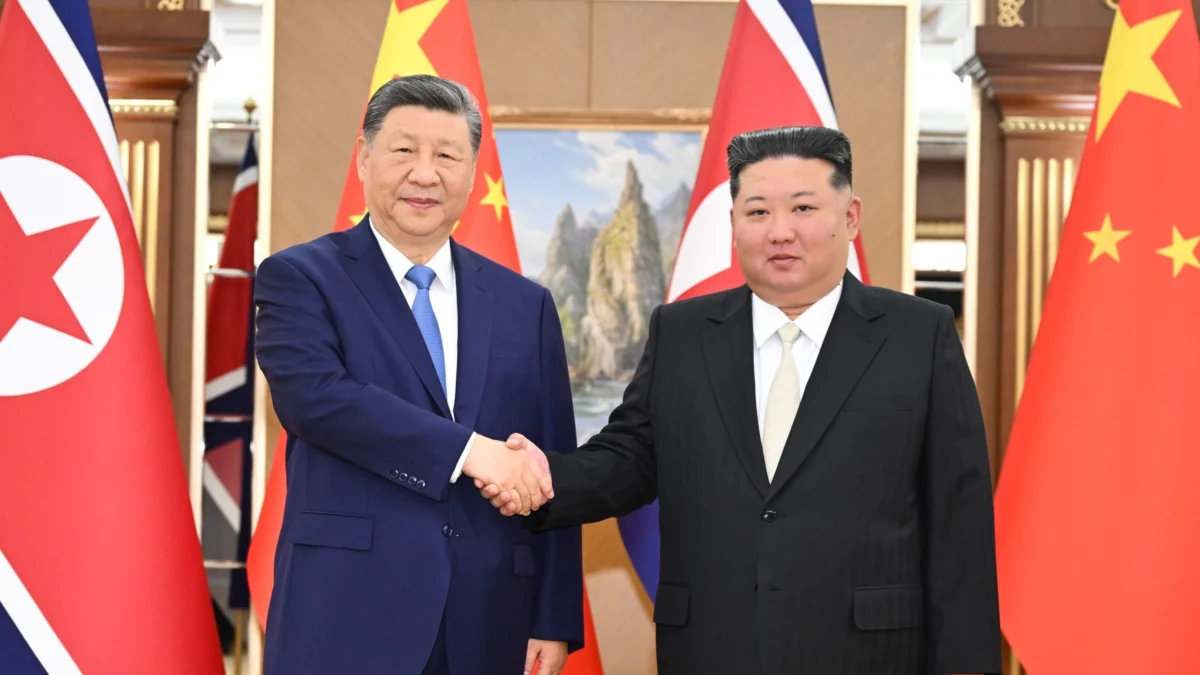
SEOUL, South Korea – North Korean leader Kim Jong Un has reportedly made an unexpected visit to Dandong, a Chinese border city, sparking intense speculation about the revitalisation of ties between Pyongyang and Beijing. According to South Korea’s official news agency Yonhap, citing an anonymous government source in Seoul, Kim arrived in Dandong via a newly inaugurated border bridge and is believed to have met with Chinese Premier Li Qiang. This unconfirmed visit, coming on the heels of a series of high-level engagements and infrastructure developments, underscores a determined effort by both nations to fortify their strategic alliance amidst a complex global landscape.
The purported arrival of the reclusive leader in Dandong, a crucial economic gateway between the two countries, marks a significant moment. While neither Chinese nor North Korean authorities have officially confirmed the visit, heightened security measures in the Chinese city in the days leading up to the report lent considerable credence to the South Korean intelligence assessment. Such unannounced movements are characteristic of Kim Jong Un’s diplomatic travels, often shrouded in secrecy until after their conclusion, reflecting the highly sensitive nature of North Korea’s foreign relations.
The timing of this alleged visit is particularly salient, coinciding with the anniversary of China’s entry into the Korean War (1950-53), an event commemorated in China as the "War to Resist US Aggression and Aid Korea." This historical backdrop adds a layer of symbolic significance, reinforcing the long-standing, albeit sometimes strained, alliance that has defined much of Northeast Asian geopolitics for decades. The potential meeting with Premier Li Qiang, rather than President Xi Jinping, could indicate either a preliminary engagement or a strategic move to manage expectations, though the implications for broader bilateral relations remain profound.
Chronology of Events and Bilateral Developments
The alleged visit by Kim Jong Un to Dandong is not an isolated incident but rather the latest in a series of calculated moves by both Beijing and Pyongyang to bolster their partnership. These developments paint a picture of a renewed commitment to cooperation, particularly in economic and strategic spheres.
The Alleged Arrival in Dandong
Reports from South Korea suggest Kim Jong Un’s entry into Dandong was made possible by a bridge over the Yalu River that was officially opened just weeks prior. This new infrastructure link, designed to facilitate cross-border movement, appears to have been immediately put to use for high-level diplomatic purposes. Dandong, a city bustling with trade, has long served as the primary conduit for goods flowing between China and North Korea. Any visit by Kim Jong Un to this critical juncture would inherently carry significant economic and political weight, signaling a desire to deepen the practical aspects of their relationship. The reported meeting with Premier Li Qiang, China’s second-highest-ranking official and head of government, suggests discussions likely focused on economic cooperation, trade normalisation, and potentially joint strategic planning, even if a full summit with President Xi Jinping did not immediately materialise. The complete absence of official statements from either capital, however, ensures a veil of ambiguity, leaving analysts to piece together the narrative from external intelligence and local observations.
The Newly Opened Yalu River Bridge
A pivotal element in the narrative of revitalised Sino-DPRK ties is the official opening of the new Yalu River bridge in October. This imposing structure, a four-lane road bridge spanning approximately three kilometres, connects Dandong with North Korea’s Sinuiju. Its completion and inauguration, after years of delay, symbolise a tangible commitment to enhancing connectivity and trade. The bridge was initially completed in 2014 but remained unused, largely due to North Korea’s failure to construct connecting roads on its side, reflecting the period of strained relations and international sanctions. Its recent opening signals a critical shift, indicating Pyongyang’s readiness to engage more robustly with its most crucial economic patron. The bridge is expected to significantly ease the flow of goods and people, potentially breathing new life into cross-border commerce that has been severely restricted by international sanctions and the COVID-19 pandemic. For North Korea, improved infrastructure access to China is a lifeline, offering a more efficient pathway for essential imports and limited exports.
Heightened Security Measures in Dandong
Prior to the South Korean reports, local accounts and observations indicated a noticeable increase in security presence and restrictions in Dandong. Such measures, including roadblocks, increased police patrols, and temporary closures of certain areas, are standard protocols whenever a high-ranking North Korean official, particularly Kim Jong Un, is expected to travel through China. These security enhancements serve to protect the visiting dignitary, control public access, and prevent any unauthorised dissemination of information about the sensitive visit. The sheer scale and meticulousness of these operations often provide the first concrete hints of an impending high-level North Korean presence, underscoring the secretive nature of Pyongyang’s diplomatic movements and China’s commitment to ensuring the security and discretion of its ally.
Previous High-Level Engagements
The alleged Dandong visit follows a period of intensifying diplomatic activity between Beijing and Pyongyang. In June, Chinese President Xi Jinping undertook a historic state visit to North Korea, the first by a Chinese leader in 14 years. That visit was seen as a powerful reaffirmation of the alliance, with both leaders exchanging warm words and pledging to deepen cooperation. Prior to that, Kim Jong Un made several unannounced trips to China in 2018 and 2019, meeting with Xi Jinping to coordinate strategies amid denuclearisation talks with the United States. These earlier meetings, often involving special trains traversing vast distances across China, laid the groundwork for the current phase of enhanced engagement. Beyond leadership summits, there have been numerous lower-level delegations and cultural exchanges, all contributing to the steady rebuilding of trust and coordination between the two nations after periods of relative coolness, particularly when China was seen to be more strictly enforcing UN sanctions.
Supporting Data and Context
The relationship between China and North Korea is one of the most complex and enduring in international relations, shaped by shared history, ideological resonance, and evolving geopolitical realities.
The Sino-North Korean Alliance: A Historical Perspective
The foundational bedrock of the Sino-DPRK alliance lies in the Korean War (1950-53). China’s direct military intervention, termed the "War to Resist US Aggression and Aid Korea," saved North Korea from collapse and solidified a bond forged in blood. This historical narrative is deeply ingrained in Chinese national consciousness and is a cornerstone of its foreign policy towards Pyongyang. The anniversary of China’s entry into the conflict is a significant commemorative event, and Kim Jong Un’s alleged presence during this period carries immense symbolic weight, reiterating the historical solidarity and shared strategic objectives against perceived external threats, primarily the United States. While North Korea’s juche (self-reliance) ideology has diverged significantly from China’s market-oriented communism, the historical camaraderie and strategic alignment remain potent forces. For China, North Korea has traditionally served as a crucial strategic buffer, preventing the direct presence of U.S. forces on its border and contributing to regional stability, albeit in a precarious manner.
Economic Lifeline Amidst Sanctions
China is undeniably North Korea’s most vital economic lifeline, accounting for over 90% of its total trade. This asymmetric economic relationship is critical for North Korea, a nation grappling with chronic food shortages, severe energy deficiencies, and the debilitating impact of international sanctions. The United Nations Security Council, often with China’s reluctant assent, has imposed extensive sanctions on North Korea in response to its illicit nuclear weapons and ballistic missile programs. These sanctions target key North Korean exports like coal, iron ore, seafood, and textiles, and restrict imports of refined petroleum products.
However, China has historically walked a tightrope, balancing its commitment to UN resolutions with its imperative to maintain stability on its border and prevent a collapse of the North Korean regime. While China does implement many sanctions, it also allows for humanitarian aid and certain forms of cross-border trade that are not explicitly prohibited, or are difficult to monitor. The revitalisation of trade facilitated by infrastructure like the new Yalu River bridge suggests a deliberate effort to boost North Korea’s struggling economy. This includes the potential for increased legitimate trade in permissible goods, but also raises concerns about the potential for enhanced grey-market activities or increased difficulty in enforcing sanctions. For Pyongyang, access to Chinese markets and goods is not just about economic growth but about regime survival and the ability to continue its military development programs.
Geopolitical Chessboard
The alleged visit unfolds against a complex geopolitical backdrop, particularly the triangular dynamics involving the United States, China, and North Korea. China’s engagement with North Korea is often viewed through the lens of its broader rivalry with the United States. By strengthening ties with Pyongyang, Beijing can project influence in Northeast Asia, potentially challenging the U.S.-led alliance system involving South Korea and Japan. A stable, albeit isolated, North Korea serves China’s interests by providing a buffer and a potential point of leverage in its strategic competition with Washington.
Moreover, renewed Sino-DPRK cooperation could complicate international efforts towards denuclearisation. While China officially supports a denuclearised Korean Peninsula, its priority often lies in regional stability, which can sometimes conflict with stringent denuclearisation demands. Closer ties could embolden North Korea to resist international pressure or provide it with the necessary economic breathing room to continue its weapons programs. The implications for South Korea and Japan are significant. Both nations, staunch U.S. allies, view increased Sino-DPRK collaboration with concern, fearing it could undermine regional security and potentially lead to a more assertive North Korean stance.
Official Responses and Lack Thereof
A hallmark of North Korean diplomacy, especially concerning high-level visits, is the profound silence from official channels until the event has concluded, or sometimes indefinitely.
The Silence from Beijing and Pyongyang
The lack of immediate confirmation from both Chinese and North Korean state media is entirely consistent with historical patterns. Pyongyang meticulously controls the narrative surrounding its leader’s movements, often announcing them only after the fact through its official Korean Central News Agency (KCNA). This allows the regime to manage international reactions, project an image of strategic autonomy, and maintain operational security. Similarly, China often defers to North Korea’s preference for secrecy regarding Kim’s visits, reflecting diplomatic courtesy and a shared desire to avoid international scrutiny, particularly from the United States and its allies, who would undoubtedly scrutinise the implications of any such meeting. This deliberate opacity is a strategic tool, allowing both nations to conduct sensitive diplomatic exchanges away from the glare of immediate public and media attention.
South Korea’s Role in Dissemination
South Korea’s intelligence agencies and media outlets, such as Yonhap, frequently serve as the primary, albeit unofficial, sources for information regarding North Korean internal affairs and leadership movements. Seoul possesses sophisticated intelligence gathering capabilities, including human intelligence, signals intelligence, and satellite surveillance, enabling it to monitor activity across the border. When such reports emerge from South Korea, they are generally treated with cautious credibility by the international community, given the historical accuracy of many past intelligence leaks. However, the anonymous nature of the source cited by Yonhap also underscores the sensitivity and covert nature of the information, as official confirmation from Seoul would carry significant diplomatic weight.
Potential Official Confirmation
Should the visit indeed have taken place, an official confirmation would likely come in the form of a joint communiqué or separate reports from KCNA and Xinhua (China’s state news agency), typically days or even weeks after Kim’s return to Pyongyang. Such reports would carefully craft the narrative, highlighting themes of traditional friendship, mutual support, and shared goals, while often omitting specific details of discussions that might provoke international criticism or reveal sensitive strategic coordination. The absence of immediate confirmation also allows for a period of observation and analysis of international reactions before a formal statement is issued.
Implications and Future Outlook
Kim Jong Un’s alleged visit to Dandong carries significant implications for regional stability, the future of the Sino-DPRK alliance, and the broader geopolitical balance.
Strengthening the Alliance
This visit, if confirmed, unequivocally signals a deepening of the strategic alliance between China and North Korea. It reinforces the idea that despite international pressure and past fluctuations, Beijing remains Pyongyang’s most crucial partner and benefactor. The consistent high-level engagements and infrastructure projects demonstrate a long-term commitment to mutual support, potentially solidifying an "axis of convenience" that challenges the U.S.-led order in Northeast Asia. This strengthened alliance could provide North Korea with greater confidence and resilience in pursuing its national objectives, including its weapons programs.
Impact on Regional Stability
The implications for regional stability are complex. On one hand, China’s engagement might be seen as a stabilising force, preventing North Korea’s isolation from leading to even more unpredictable behaviour. On the other hand, a closer Sino-DPRK relationship could embolden Pyongyang to adopt a more confrontational stance towards the United States and its allies, knowing it has Beijing’s implicit or explicit backing. This could escalate tensions on the Korean Peninsula and complicate efforts to resume denuclearisation talks. South Korea and Japan will likely view this development with concern, potentially prompting them to strengthen their own security cooperation with the United States.
Economic Revival and Sanctions Evasion
The focus on the new Yalu River bridge and the alleged meeting with Premier Li Qiang strongly suggests that economic revival is a top priority for both nations. For North Korea, this means access to critical goods, investment, and markets. For China, it means maintaining a stable, functional neighbour and potentially expanding its economic influence in the border region. However, this raises serious questions about the enforcement of UN sanctions. While China maintains it adheres to sanctions, increased trade and cross-border activity inherently create more opportunities for circumvention. The international community will be closely watching for any signs that this renewed economic cooperation is undermining the sanctions regime designed to curb North Korea’s nuclear ambitions.
Kim’s Diplomatic Strategy
From Kim Jong Un’s perspective, this visit fits into a broader diplomatic strategy aimed at reducing North Korea’s isolation, securing external support, and diversifying its international engagements beyond Russia. By engaging with China, Kim seeks to bolster his regime’s legitimacy, gain economic relief, and potentially create leverage in future negotiations with the United States. It underscores a tactical flexibility, as Pyongyang simultaneously cultivates ties with Russia, indicating a multipolar approach to foreign policy designed to maximize its strategic options.
Potential for a Xi-Kim Summit
While the immediate reports suggest a meeting with Premier Li Qiang, the possibility of a full-fledged summit with Chinese President Xi Jinping cannot be discounted. The Dandong visit could be a preparatory step, a signal of intent, or a preliminary discussion ahead of a more formal engagement in Beijing. A full Xi-Kim summit would carry even greater weight, sending a powerful message to the international community about the enduring strength and strategic depth of the Sino-DPRK alliance, further complicating the geopolitical landscape of Northeast Asia. The trajectory of this critical relationship will continue to be a focal point for global observers in the coming months.