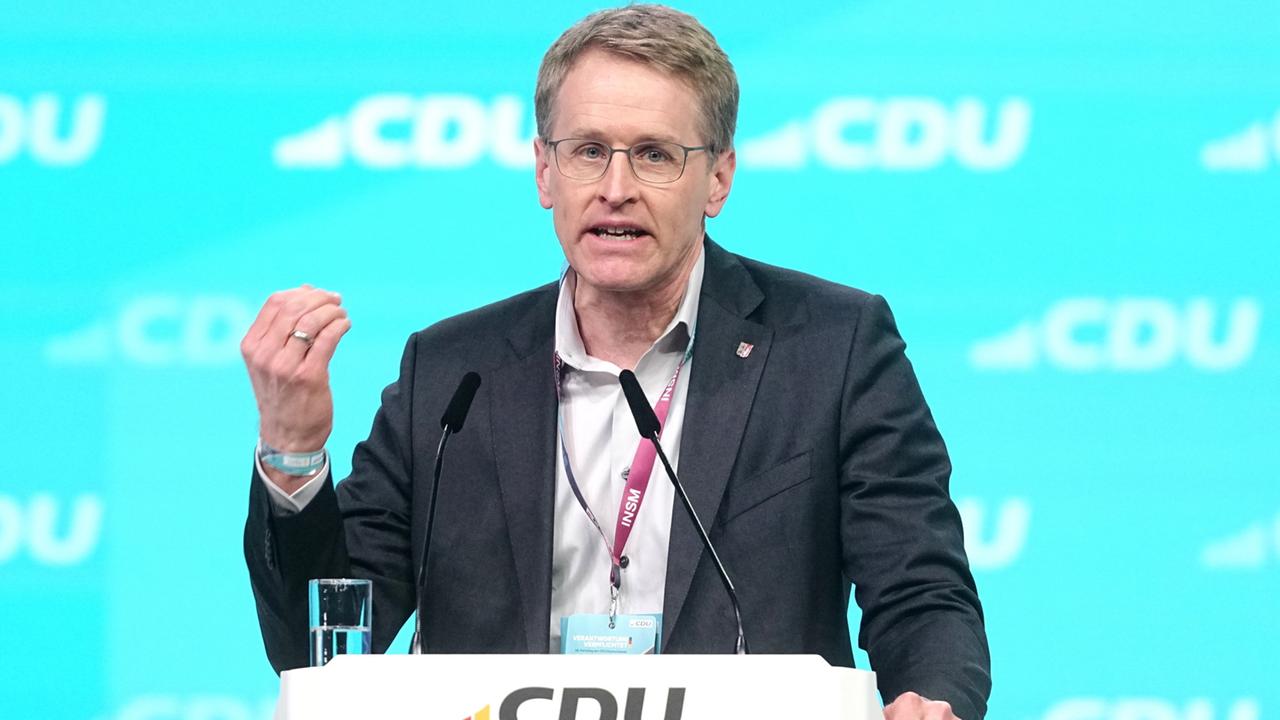
Kiel/Potsdam – June 22, 2026 – German politics has been plunged into a fresh storm of controversy after Daniel Günther, the Christian Democratic Union (CDU) Minister-President of Schleswig-Holstein, vehemently called for the immediate resignation of Luigi Pantisano, the newly elected co-chair of The Left Party (Die Linke). The demand comes in the wake of Pantisano’s explosive remarks, where he accused the CDU of engaging in "fascist politics" and equated them with the far-right Alternative for Germany (AfD) and fascists themselves. The incident has ignited a fierce debate over political rhetoric, historical memory, and the boundaries of democratic discourse in Germany.
Günther’s sharp condemnation, published initially in the Bild newspaper, highlights the gravity of the accusation, especially within the German political landscape still deeply scarred by its Nazi past. "Anyone who equates the CDU with fascists and the AfD has disqualified themselves from any serious democratic exchange," Günther declared, adding that such statements were "historically ignorant." He concluded by stating that Pantisano could not be considered a legitimate partner for democrats and should "swiftly withdraw from politics."
The dramatic escalation underscores the increasing polarization in German politics and the heightened sensitivity surrounding comparisons to totalitarian ideologies. Pantisano’s remarks, made shortly before his election to co-chair, have not only provoked outrage from the CDU but also raised questions about The Left Party’s strategic direction and its ability to engage constructively across the political spectrum.
Chronology of a Political Firestorm
The contentious remarks by Luigi Pantisano emerged just as The Left Party was concluding its federal party conference in Potsdam. On Saturday, June 21, 2026, Pantisano was elected as the new co-leader, succeeding Jan van Aken, who did not seek re-election. His election, however, was met with a notably lukewarm mandate, securing only 53 percent of the delegate votes – a result that immediately signaled internal divisions and a challenging road ahead for his leadership. In stark contrast, his co-chair, Ines Schwerdtner, was overwhelmingly confirmed in her position with a robust 86 percent of the vote.
The catalyst for the current uproar was an interview Pantisano gave to Bild newspaper shortly before the leadership vote. In a video segment from that interview, Pantisano delivered the incendiary statement that has since sent shockwaves through the German political establishment: "Ultimately, there is also currently no difference between the CDU, which pursues fascist politics, the AfD, or the fascists themselves."
This statement was particularly jarring given that Pantisano had, in the same interview, previously indicated a willingness to consider alliances with the CDU at the state level. He had suggested such tactical cooperation could be necessary to prevent the AfD from gaining power in regional governments – a pragmatic stance seemingly at odds with his later, far more radical condemnation.
The immediate fallout from the Bild interview was swift and severe. Senior figures within the CDU and across other mainstream parties expressed shock and condemnation. By Sunday morning, Minister-President Daniel Günther’s demand for Pantisano’s resignation was widely reported, crystallizing the outrage felt by many.
In an apparent attempt to mitigate the damage, Pantisano appeared on the ZDF program Berlin Direkt on Sunday. During the broadcast, he sought to clarify his controversial statement, acknowledging it as a "shortened representation" on his part. He explained, "I want to make it clear that it was a shortened representation on my part. My intention was to express my concern that the CDU is adopting positions and policies of the AfD." While intended as a clarification, this softened stance did little to quell the indignation, particularly among Christian Democrats, who viewed it as an insufficient retraction of a deeply offensive accusation.
Supporting Data and Political Context
Pantisano’s precarious mandate, achieved with a mere 53 percent of the vote, provides crucial context to the ensuing controversy. This weak showing at The Left Party’s federal conference in Potsdam suggests a leadership lacking broad internal consensus from the outset. For a party already struggling with declining electoral fortunes and an ongoing identity crisis, a co-leader with such a narrow base of support faces an uphill battle to unite factions and project a coherent vision. The poor result stands in stark contrast to the overwhelming support for co-chair Ines Schwerdtner, highlighting a potential fissure in the party’s new dual leadership.
The Left Party, as a direct successor to the Party of Democratic Socialism (PDS), which itself originated from East Germany’s ruling Socialist Unity Party (SED), has long grappled with its historical legacy and its place in contemporary German democracy. Its traditional voter base in former East Germany has been eroding, with many disaffected voters shifting to the AfD. The party has also struggled to appeal to younger, urban voters, facing competition from the Greens and the Social Democratic Party (SPD). The current internal debate within The Left Party revolves around whether to pursue a more radical, protest-oriented course or to embrace greater pragmatism and seek alliances with other left-leaning parties. Pantisano’s initial willingness to consider alliances with the CDU, juxtaposed with his later incendiary remarks, epitomizes this internal tension.
The CDU, Germany’s dominant center-right party, holds a foundational position in the Federal Republic’s post-war democratic order. Accusations of "fascist politics" carry an especially heavy weight for a party that views itself as a bulwark against extremism from both the left and the right. Given Germany’s history, any comparison to fascism is considered a profound breach of political etiquette and often interpreted as an attempt to delegitimize an opponent entirely. This sensitivity is further amplified by the rise of the AfD, a party that has indeed been criticized for nationalist rhetoric, historical revisionism, and proximity to extremist elements. Mainstream parties, including the CDU, are constantly walking a tightrope, trying to draw clear lines of demarcation against the AfD without alienating voters who might feel unheard or frustrated by established politics. Pantisano’s claim that the CDU is adopting AfD positions touches on a real concern among some voters, but his articulation of it as "fascist politics" is what transformed it into an unforgivable offense for the CDU.
Minister-President Daniel Günther, a prominent figure in the CDU known for his moderate yet firm stance, represents the more centrist wing of the party. His strong reaction is indicative of the CDU’s resolve to defend its democratic credentials and reject what it perceives as an attempt to blur the lines between democratic parties and extremist movements. His demand for Pantisano’s resignation is not merely a political maneuver but a statement about the fundamental principles of political discourse in Germany.
Official Responses and Widespread Condemnation
Beyond Minister-President Günther’s forceful declaration, Pantisano’s remarks have drawn widespread condemnation from across the German political spectrum, further isolating The Left Party’s new co-leader.
Leading figures within the CDU were quick to echo Günther’s sentiments. Friedrich Merz, the federal chairman of the CDU and Leader of the Opposition in the Bundestag, released a statement calling Pantisano’s comments "an unacceptable assault on democratic decency and historical truth." He added, "Such rhetoric has no place in a serious democracy. Mr. Pantisano must understand the gravity of his words and their implications for inter-party relations." Several other CDU state premiers and Bundestag members expressed similar outrage, emphasizing that the party would not engage in dialogue with someone holding such extreme views of its core principles.
The Social Democratic Party (SPD), traditionally The Left Party’s closest ideological neighbor, also distanced itself sharply. Lars Klingbeil, co-leader of the SPD, while not calling for resignation, stated that Pantisano’s remarks were "deeply regrettable and counterproductive to fostering a culture of respectful debate." He stressed that while robust political disagreement is essential, comparisons to fascism cross an immutable red line. "We expect all democratic parties to uphold a common understanding of our democratic order and its history," Klingbeil remarked. This response from the SPD is particularly damaging for The Left Party, as it undermines any potential for future coalition building on the left.
The Greens, another potential coalition partner, expressed similar concerns. Omid Nouripour, co-leader of Alliance 90/The Greens, described the comments as "unacceptable and damaging to the political climate." He emphasized the importance of distinguishing between legitimate criticism and historically charged accusations, particularly in Germany. "Such language trivializes the horrors of fascism and does a disservice to our democratic institutions," Nouripour stated, effectively closing ranks with the mainstream parties in condemning Pantisano.
Even within The Left Party itself, Pantisano’s remarks have caused significant discomfort and internal strife. While co-chair Ines Schwerdtner has not publicly called for his resignation, her silence on the matter, coupled with her own much stronger mandate, speaks volumes. Several prominent Left Party members, particularly those from the more pragmatic wing who advocate for greater governmental responsibility, have reportedly expressed dismay privately. Some have voiced concerns that Pantisano’s radical rhetoric will further marginalize the party and make it impossible to forge alliances, even with the SPD and Greens. There are whispers of a potential internal challenge or a call for Pantisano to issue a more unequivocal apology to salvage the party’s reputation.
The AfD, ironically, seized on the controversy to further their own narrative of being unfairly targeted by the "establishment." While not defending Pantisano’s comparison of them to fascists, they used his accusation against the CDU to highlight what they describe as the "hypocrisy" of other parties. A spokesperson for the AfD stated, "While we reject Pantisano’s outrageous characterization of our party, his comments about the CDU reveal the true nature of the German political class and its willingness to demonize anyone who dares to challenge them." This opportunistic response, though predictable, further complicates the political landscape.
The broader consensus among political commentators and civil society organizations is that Pantisano’s statement represents a dangerous escalation in political rhetoric. Organizations dedicated to historical remembrance and democratic education have issued warnings about the casual use of terms like "fascism," stressing that such language risks desensitizing the public to the true meaning of these historical atrocities.
Implications for German Political Discourse and The Left Party’s Future
The fallout from Luigi Pantisano’s "fascist politics" accusation and Minister-President Daniel Günther’s subsequent demand for his resignation carries profound implications for German political discourse, the future of The Left Party, and the broader landscape of inter-party cooperation.
For The Left Party: This incident immediately casts a long shadow over Pantisano’s nascent leadership. His weak mandate (53%) was already a sign of internal dissent, and this controversy further erodes his authority. The party, which has been struggling for relevance and a clear political direction, now faces intensified pressure to either firmly back its co-leader, risking further isolation, or to distance itself from his radical statements. The latter could lead to internal power struggles and potentially even calls for Pantisano’s ousting, especially if the party’s electoral prospects continue to dim. The party’s ability to form alliances with the SPD and Greens, crucial for any future governmental aspirations, appears to be severely damaged. Pantisano’s own prior mention of tactical alliances with the CDU to counter the AfD now rings hollow and exposes a glaring contradiction in his political strategy. This incident could push The Left Party further into a corner, making it harder to attract moderate voters or engage in constructive policy debates.
For CDU-Left Relations: Günther’s unequivocal demand for resignation signals a complete breakdown in any potential for dialogue between the CDU and The Left Party, at least while Pantisano remains in his position. While direct federal coalitions between the two parties have historically been unthinkable, regional cooperation has occasionally been explored. Pantisano’s remarks have effectively poisoned this well, reinforcing the CDU’s perception of The Left Party as an unreliable and ideologically extreme partner. This hardening of positions makes any cross-party collaboration, even on specific issues, significantly more challenging.
For German Political Culture: The controversy highlights a worrying trend in German political discourse: the increasing use of highly charged and historically loaded language. While robust debate is a cornerstone of democracy, the casual invocation of terms like "fascism" risks trivializing historical atrocities and blurring the lines between legitimate political differences and existential threats. Such rhetoric contributes to a climate of polarization, making it harder for parties to find common ground or even engage in respectful disagreement. It also puts a strain on public trust in political institutions, as citizens may perceive political debate as overly aggressive and disingenuous. The incident serves as a stark reminder of the unique sensitivity surrounding Germany’s past and the responsibility of its political leaders to choose their words carefully.
For the Broader Political Landscape: The episode will likely empower those who advocate for drawing clear "firewalls" against both the far-right (AfD) and what they perceive as the extremist elements of the far-left. Mainstream parties will feel compelled to reinforce their commitment to democratic principles and reject rhetoric that undermines them. It could also fuel debates about the role of media in amplifying controversial statements and the speed with which political controversies can escalate in the digital age.
In the coming weeks, the focus will be on how The Left Party navigates this crisis. Will Pantisano issue a more comprehensive apology? Will internal pressure force him to reconsider his position? Or will the party choose to stand by its co-leader, risking further marginalization? Regardless of the immediate outcome, Luigi Pantisano’s "fascist politics" accusation has irrevocably altered the political atmosphere in Germany, leaving a deep rift that will be challenging to bridge. The incident serves as a powerful testament to the enduring weight of history in German politics and the constant vigilance required to uphold democratic values.