The fiscal horizon for the state of Hessen has darkened as the latest tax estimate reveals a sobering reality for the 2026 budget. While the long-term outlook suggests a potential stabilization, the immediate future is characterized by significant revenue shortfalls, prompting the state government to reinforce its commitment to fiscal austerity and structural reform.
According to the latest figures released by the Hesse Ministry of Finance, the state is bracing for a shortfall of approximately 203 million euros for the current 2026 fiscal year compared to original budget projections. With total projected tax revenues now estimated at 27.8 billion euros, policymakers are faced with the immediate challenge of managing a deficit that threatens to derail planned spending programs.
The Core Facts: A Deficit in the Hundreds of Millions
The figures, derived from the semi-annual assessment conducted by the Working Group on Tax Estimates (Arbeitskreis Steuerschätzungen), underscore the volatility of the current economic environment. For a state that relies heavily on a mix of robust corporate presence and income tax returns, a shortfall of over 200 million euros is not merely a rounding error; it is a significant disruption to the budgetary planning cycle.
Finance Minister Alexander Lorz (CDU) confirmed the figures this past Friday, emphasizing that while the numbers are disappointing, they are consistent with the broader economic stagnation affecting Germany at large. The primary drivers of this shortfall include sluggish growth in income tax receipts and the lingering effects of an industrial sector that continues to grapple with high energy costs, geopolitical uncertainty, and global supply chain disruptions.
Chronology of a Fiscal Squeeze
To understand how Hessen reached this point, one must look at the sequence of economic indicators over the past 24 months:
- 2024 Retrospective: The state began the 2024 cycle with cautious optimism, betting on a post-pandemic recovery. However, high inflation and interest rate hikes by the European Central Bank began to curb consumer spending and private investment.
- Early 2025 Forecasts: Initial budget planning for 2026 was predicated on a modest recovery in the German economy. These assumptions were largely based on projections of stabilization in the automotive and chemical sectors—industries that are vital to the Hessian economy.
- Late 2025 Re-evaluation: As corporate tax prepayments lagged behind expectations throughout the latter half of 2025, the Ministry of Finance began internal revisions. It became clear by the end of the year that the revenue targets for 2026 were increasingly unrealistic.
- The February 2026 Snapshot: The official release of the spring tax estimate confirmed the worst fears of the budgetary planners. The gap between expectation and reality solidified at 203 million euros, forcing an immediate pivot toward tighter spending controls.
Supporting Data: Municipalities as the "Wildcard"
While the state-level outlook remains strained, the situation for Hessen’s municipalities presents a more complex, bifurcated narrative. Projections suggest that between 2026 and 2030, the state’s cities and towns could see a cumulative revenue increase of roughly two billion euros.
This growth is largely attributed to anticipated upticks in the Gewerbesteuer (trade tax), a cornerstone of local government financing in Germany. However, experts warn that this aggregate number may mask deep regional disparities. The central question remains: will this wealth be distributed broadly, or will it remain concentrated in the traditionally affluent urban centers like Frankfurt or the prosperous towns within the Rhine-Main metropolitan area?
The Ministry of Finance has expressed caution, noting that it is currently impossible to predict whether the benefits of this revenue growth will reach rural, structurally weaker municipalities or whether the "north-south divide" within the state will continue to widen. For many smaller towns, the potential increase in tax revenue may be entirely offset by rising social welfare costs and the need to maintain crumbling infrastructure.
Official Responses: The Call for Austerity
Finance Minister Alexander Lorz has been clear in his messaging: the current tax estimate provides no room for new spending initiatives. In a statement released shortly after the data was made public, Lorz emphasized that the state must maintain a rigorous course of "budgetary consolidation."

"In the coming years, we can expect a kind of ‘perfect landing’ relative to our previous plans," Lorz stated, attempting to put a positive spin on the long-term outlook. However, he quickly tempered this by noting that the state lacks the fiscal "breathing room" to launch new programs. He argued that the economic situation remains fragile and that the state must continue to prioritize debt reduction and structural efficiency.
Lorz’s rhetoric is emblematic of a broader political consensus in Wiesbaden: the era of easy money is over. With structural challenges in the German economy—ranging from an aging workforce to the ongoing energy transition—Lorz has signaled that any fiscal policy shift must be grounded in the reality of limited resources. Furthermore, he noted that the current estimate does not account for the potential impact of pending federal tax reforms, specifically regarding income tax adjustments. Because the current calculation ignores any legislative changes not yet ratified, the actual revenue could potentially be even lower should the federal government proceed with significant tax relief measures.
The Mechanism: How Tax Estimates Are Formed
Understanding the gravity of these figures requires an understanding of the methodology behind them. The Working Group on Tax Estimates, which functions as the gold standard for German fiscal forecasting, does not rely on a single source. Instead, it aggregates data from multiple, independent entities:
- Economic Research Institutes: Leading German institutes analyze consumption patterns, wage developments, and corporate profitability.
- The Bundesbank: The German central bank contributes monetary policy expertise and broad macroeconomic modeling.
- Federal Ministry of Finance: This body provides the administrative framework and data on existing tax legislation.
Once these national figures are aggregated, the Hessian Ministry of Finance adapts them to the state’s specific tax structure. This involves a rigorous process of peer review, where representatives from the ministry and outside experts debate the validity of each assumption. This ensures that the estimate is not merely a political tool but a cold, analytical assessment of what the treasury can expect to collect in the coming years.
Implications: The Long Road to 2030
The 2026 forecast acts as a pivot point for the state’s political agenda. If the current trajectory holds, the modest growth projected between 2027 and 2030 (approximately 100 million euros annually) will barely cover the rising costs of inflation-indexed civil servant salaries and the mandatory investments required for public services.
The Risks Ahead
- Geopolitical Instability: Hessen’s export-oriented economy is highly susceptible to trade disputes and energy market volatility. Any escalation in international conflicts could lead to a further downturn, rendering the 2026-2030 projections overly optimistic.
- Fiscal Consolidation vs. Investment: The government faces a classic "scissors trap." On one hand, it needs to cut spending to satisfy the constitutional debt brake (Schuldenbremse); on the other, it must invest in digitalization, infrastructure, and education to remain competitive.
- Legislative Uncertainty: As noted, federal tax reforms remain a significant variable. If the federal government reduces the tax burden on citizens, the state and its municipalities will see their revenue bases shrink further, potentially forcing an even sharper round of budget cuts in 2027.
Conclusion
Hessen is currently navigating a period of fiscal transition. The news of a 203-million-euro shortfall in 2026 serves as a wake-up call for policymakers in Wiesbaden. While the long-term forecast offers a glimpse of stabilization, the reality is that the state’s room for maneuver is effectively zero.
For the citizens of Hessen, this means that the coming years will likely be defined by a focus on "doing more with less." Whether through the modernization of public administration or a more disciplined approach to project financing, the state government is locked into a policy of prudence. As the legislative session progresses, the debate over how to prioritize limited funds—balancing the needs of struggling municipalities against the requirements of a modern, efficient state apparatus—will become the defining challenge for the current administration.
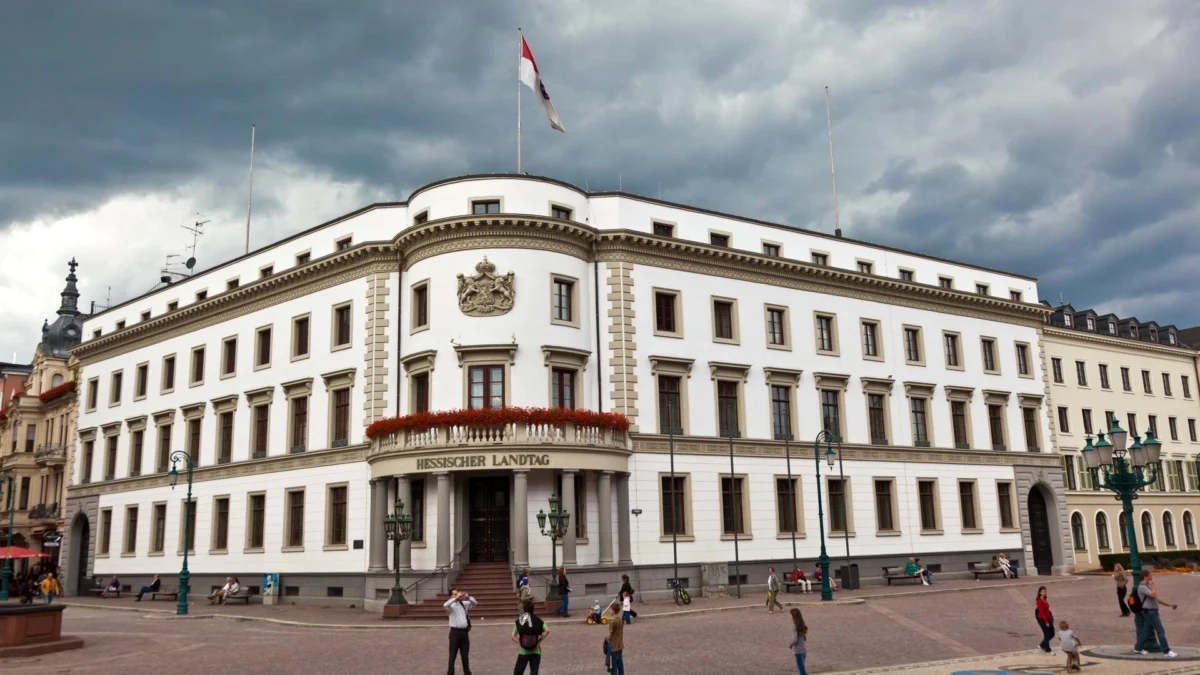
The "dull clouds" hanging over the Hessian Landtag, as seen in the imagery accompanying the report, serve as an apt metaphor for the state’s current economic climate. While the storm is not a hurricane, the steady, cold rain of fiscal restraint is likely to persist for some time, forcing every ministry to justify its existence and every euro to be accounted for with unprecedented scrutiny.