The Incident: A Final Whistle Descent into Chaos
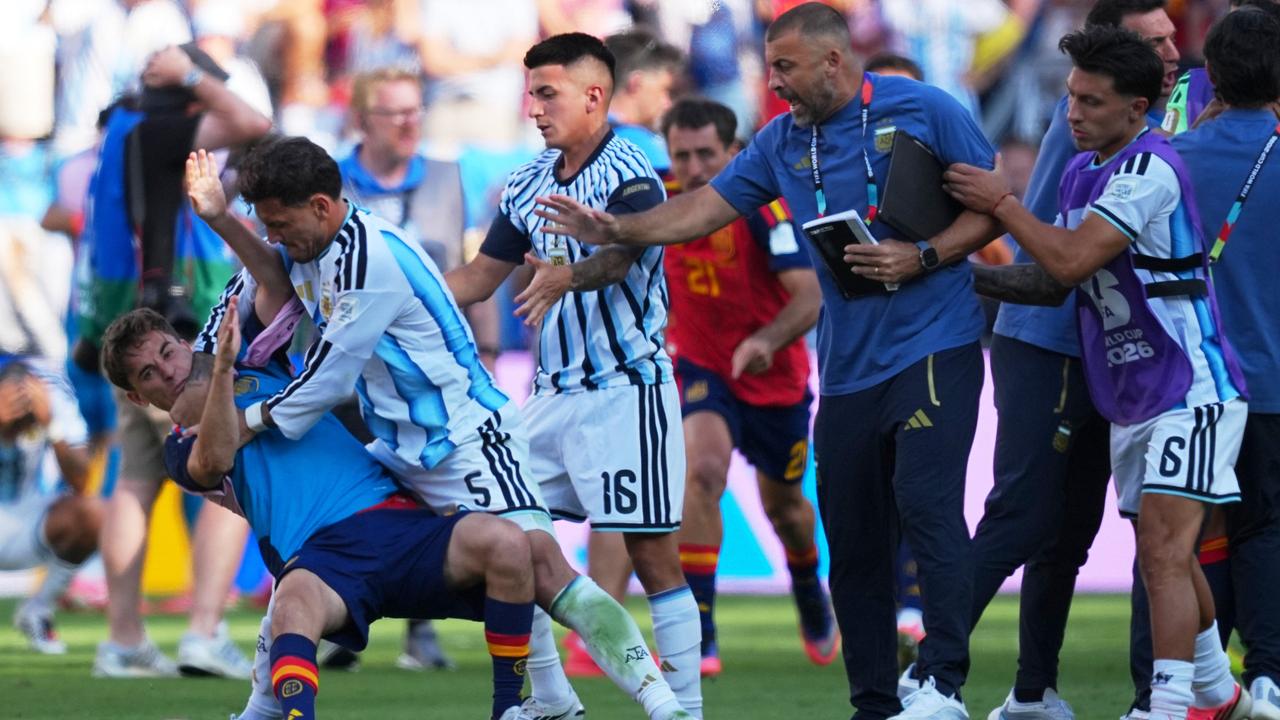
The atmosphere at the stadium was electric, fitting for a match of such high stakes. However, what should have been a moment of reflection following a tense 0:1 defeat for Argentina at the hands of Spain quickly devolved into a display of unbridled aggression. As the final whistle blew, signaling the end of extra time and the elimination of the Argentine side, the pitch became a theater of confrontation.
At the center of the controversy stands Leandro Paredes. Television cameras captured the Argentine midfielder losing his composure in the immediate aftermath of the match. Caught in a series of heated altercations, Paredes was seen grabbing Spain’s Gavi by his jersey, striking him in the face with his hand, and forcefully shoving the young midfielder to the ground. This came only moments after a similar aggressive encounter with Spain’s Eric Garcia.
While initial reports circulated that Paredes had been issued a red card for his conduct, the situation has become increasingly opaque, triggering a formal intervention by the world football governing body.
FIFA’s Official Stance and the Disciplinary Inquiry
On Monday, July 21, 2026, the FIFA Disciplinary Committee issued a formal statement announcing that an investigation is underway. The committee has appointed a dedicated disciplinary and ethics investigator to scrutinize the events that transpired after the match. The core mandate of this investigation is to determine whether the actions of the Argentine players and coaching staff constitute a breach of the FIFA Disciplinary Code.
Perhaps the most confusing element of this saga is the discrepancy regarding the official match record. Initially, media outlets, including the BBC, reported that referee Slatko Vincic had shown Paredes a red card for his post-match outbursts. However, FIFA has since clarified that the official match report does not list a red card for the incident. According to the governing body’s current records, Paredes only received a yellow card during the actual gameplay.
This contradiction—between the visual evidence of a player being sent off and the official paperwork—has raised serious questions about the administrative integrity of the match officiating and the subsequent reporting process. FIFA has confirmed to international press that no immediate disciplinary measures were taken against Paredes on the pitch, a revelation that has sparked outrage among fans and pundits alike, who argue that such violent conduct should result in automatic, non-negotiable sanctions.
A Chronology of the Confrontation
To understand the gravity of the situation, one must look at the timeline of the match’s breakdown:
- During the Match: The intensity was palpable throughout the 120 minutes. Argentina’s Enzo Fernández was dismissed during the match following a second yellow card, leaving his team at a numerical disadvantage. This set a precedent for the frustration that would eventually boil over.
- The Final Whistle: Upon the conclusion of extra time, the physical tension between the two squads reached a breaking point.
- The Paredes Incident: Leandro Paredes engaged in a series of physical altercations, first targeting Eric Garcia and subsequently escalating his aggression toward Gavi.
- The Coaching Staff Involvement: Reports have surfaced suggesting that the hostility was not limited to the players. Co-trainer Roberto Ayala is alleged to have become physically aggressive, specifically accused of striking Spanish player Dani Olmo.
- Post-Match Confusion: Initial reports suggested a red card was issued to Paredes, which was later omitted from the official report, prompting the current FIFA investigation.
Expanding the Scope: Beyond Paredes
While Leandro Paredes is the primary focus of the inquiry, the investigation is expected to widen. Media reports indicate that the disciplinary committee is also reviewing the conduct of defender Nahuel Molina. Furthermore, the allegations against assistant coach Roberto Ayala are viewed as particularly serious. In professional football, the role of a coaching staff member is to de-escalate tensions; for a member of the technical staff to allegedly strike an opposing player is a severe violation of the "Fair Play" charter that FIFA prides itself on upholding.
The inclusion of coaching staff in the investigation underscores the severity with which FIFA is approaching these "post-match events." The governing body is clearly aiming to send a message that the lack of discipline displayed in the final moments of the tournament will not be tolerated, regardless of the status of the individual involved.
Supporting Data: The Disciplinary Code
Under the FIFA Disciplinary Code, players and officials are held to strict standards regarding "offensive, insulting, or abusive language and/or gestures" and "acts of violence."
Article 12 of the code, which deals with misconduct, explicitly prohibits physical assaults on opponents. If found guilty, those involved face a range of penalties, including:
- Match Suspensions: A ban from future international fixtures.
- Financial Penalties: Fines levied against both the players and the national football association.
- Educational Mandates: Required participation in conduct and behavioral workshops.
The challenge for the FIFA ethics investigator will be to reconcile the visual evidence of the brawl with the absence of a red card in the referee’s report. If the investigator determines that the referee missed an act of violent conduct, FIFA has the authority to impose retrospective sanctions, a mechanism often used in leagues like the Premier League or La Liga, but one that is notoriously complex to apply at the international level.
Implications for International Football
The incident has ignited a debate regarding the officiating standards in high-pressure tournament environments. Critics argue that if a referee fails to act during the game, it places an undue burden on disciplinary committees to "fix" the outcome after the fact.
For Argentina, the potential loss of key players like Paredes for future qualification matches or tournament fixtures would be a significant blow. Beyond the tactical impact, the reputational damage to the Argentine Football Association (AFA) is considerable. International football relies on the mutual respect of its participants, and scenes of coaches striking players are fundamentally antithetical to the sport’s values.
Furthermore, this incident serves as a stress test for FIFA’s new, more rigorous approach to disciplinary oversight. Following criticisms in previous tournaments regarding inconsistent officiating, the organization has pledged to be more transparent and decisive. How they handle the "Paredes Case"—and the discrepancy between the reported red card and the final match sheet—will likely be scrutinized by member nations worldwide.
The Path Forward: What Happens Next?
The investigation is expected to take several weeks. During this period, the committee will review video footage from multiple angles, interview the match officials (including referee Slatko Vincic), and gather statements from both the Argentine and Spanish delegations.
If the allegations against Ayala and Paredes are substantiated, we can expect a swift announcement of sanctions. The public, the media, and the Spanish Football Federation are all watching closely. For the game of football, the hope is that this investigation acts as a deterrent, reminding players and staff that the game does not end when the final whistle blows—it ends when everyone has left the field with their dignity intact.
As the 2026 international calendar continues, the spotlight remains firmly on this investigation. Whether it results in heavy bans or mere reprimands, one thing is certain: the events that unfolded after Argentina’s exit have left a stain on the tournament that will take time to wash away. The integrity of the game is at stake, and FIFA’s response will be the final word on whether justice is served or if the chaos is allowed to pass with impunity.