Dolní Vltavice, Czech Republic – October 6, 2026 – A prolonged and intense drought gripping Central Europe has brought to light a haunting secret from the depths of the Lipno Reservoir in Southern Czechia. The receding waters have exposed the eerie remnants of Dolní Vltavice, a once-thriving German-speaking village deliberately submerged in the 1950s to create the vast hydroelectric dam. Among the most poignant discoveries are gravestones, bearing German inscriptions, which now stand as silent, water-lapped sentinels to a forgotten community.
The stark image of weathered headstones emerging from the mud and silt along the reservoir’s edge has captivated both locals and historians. What began as a tip from a curious reader to a local author has quickly escalated into a spontaneous but meticulously managed rescue operation, shining a spotlight on a complex and often overlooked chapter of Czech-German history – the post-World War II expulsion of ethnic Germans and the subsequent erasure of their cultural footprint.
"We stand here at the wall of the former cemetery, founded in 1899 in Dolní Vltavice," explained writer Jan Štifter to Czech Television, his voice echoing the solemnity of the moment. "The drought is so prolonged and intense that it is revealing places that are normally inaccessible." The gravestones, some still partially embedded in the damp earth, offer a visceral connection to a community that vanished beneath the waves over seven decades ago, their re-emergence a potent reminder of history’s enduring power.
Main Facts: A Resurfacing Legacy
The discovery at Dolní Vltavice, known in German as Untermoldau, represents a rare and deeply symbolic event. The Lipno Dam, constructed between 1952 and 1959, was a monumental engineering feat designed to provide hydroelectric power and flood control along the Vltava River. Its creation necessitated the flooding of several settlements, with Dolní Vltavice being one of the most significant. For decades, the village remained a submerged ghost, its memory largely preserved in archives and the fading recollections of former inhabitants and their descendants.
The current drought, however, has drastically lowered the reservoir’s water levels, exposing significant portions of the old village landscape. The most striking discovery has been a cluster of gravestones, many bearing clear German inscriptions from the late 19th and early 20th centuries. These markers belong to the former cemetery of Untermoldau, founded in 1899, whose existence was known but whose physical remnants were believed to be lost forever beneath the waters.
The initial finding was made by a keen-eyed hiker who, upon recognizing the historical significance of the exposed stones, promptly contacted local author Jan Štifter. Štifter, whose recent novel explores the very history of Untermoldau, quickly mobilized a team of volunteers, historians, and experts from the local monument protection office. Under their supervision, a careful operation was undertaken to extract the fragile gravestones from the mud and preserve them. Petr Hudičák, who heads the archive of the Seidel Photo Studio in nearby Český Krumlov and possesses extensive knowledge of the region’s historical imagery, has been instrumental in verifying the context and significance of the findings. The recovery effort is not merely about preserving artifacts; it’s about reclaiming a tangible piece of a complex past, marked by prosperity, displacement, and deliberate obliteration.
Chronology of a Lost World
The story of Dolní Vltavice is a microcosm of Central European history, encompassing centuries of development, shifts in geopolitical power, and profound human drama.
Ancient Origins: The Rise of Untermoldau
The roots of Dolní Vltavice, or Untermoldau as it was known for centuries, stretch back to the 13th century. Located strategically along a vital trade route connecting Passau in Bavaria with České Budějovice (Budweis) in Bohemia, the village flourished. Its position on the Vltava River further enhanced its economic importance, facilitating trade and cultural exchange across the Bohemian Forest region. For centuries, Untermoldau was a vibrant hub, characterized by its industrious inhabitants and rich local traditions.
The German Era and Cultural Identity
Throughout much of its documented history, Untermoldau was predominantly German-speaking. The Bohemian Forest (Böhmerwald) region, where the village was situated, was a deeply interwoven tapestry of Czech and German cultures, though many villages maintained a distinct linguistic and cultural identity. German settlers had arrived in the region over centuries, contributing significantly to its development. Before the tumultuous events of the 20th century, the German-speaking population of Untermoldau lived and worked alongside their Czech neighbors, building churches, schools, and homes that reflected their shared regional identity. The cemetery, founded in 1899, served as the final resting place for generations of these residents, their gravestones a testament to their lives and lineages.
Post-War Displacement: A Painful Exodus
The end of World War II dramatically altered the demographic and political landscape of Czechoslovakia. The Beneš Decrees, issued in 1945, mandated the expulsion of millions of ethnic Germans from Czechoslovakia, who were largely blamed for supporting Nazi Germany and its territorial claims. This forced migration, often carried out brutally and without due process, saw the entire German-speaking population of villages like Untermoldau uprooted from their ancestral homes. Their properties were confiscated, and their cultural presence was systematically erased or suppressed. This period represents a deep trauma for both the displaced Germans and for the Czech nation grappling with its own post-war identity and the legacy of its German minority.
The Dam’s Construction: A Village Submerged
In the early 1950s, the newly established Communist regime in Czechoslovakia embarked on ambitious industrialization projects, including the construction of the Lipno Dam. The dam, situated on the upper Vltava River, was designed to be the largest hydroelectric power plant in Czechoslovakia, crucial for the nation’s energy supply and for flood control. The project, however, came at a steep cost: the flooding of numerous valleys and the displacement of entire communities, many of which had already been emptied of their German populations.
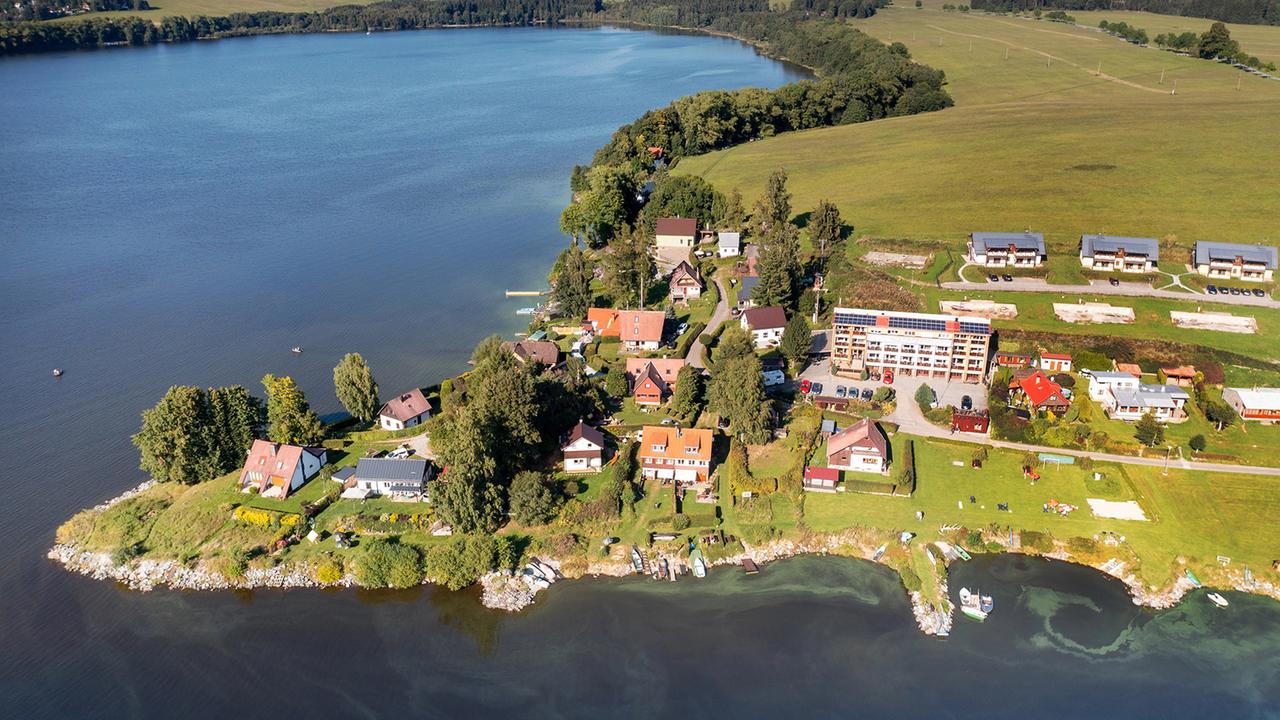
Untermoldau was one such village. The decision was made to submerge it entirely. Before the waters rose, a deliberate effort was made to clear the area, not just of buildings but of any overt reminders of the previous inhabitants. The village church, a central landmark, was not simply left to be covered by water; its tower, which would have protruded from the surface, was systematically demolished, leveling the entire edifice to ensure no trace remained visible. Similarly, the cemetery was treated with a shocking disregard for its sacred nature. While the remains of the deceased were eventually reinterred in a mass grave on a nearby, higher ground, the gravestones themselves were not moved with dignity. Instead, they were, as later evidence would reveal, unceremoniously pushed into a large pile behind the cemetery wall, destined to be swallowed by the rising waters and forgotten.
Decades Under Water: A Silent Vigil
For over seventy years, the Lipno Reservoir has served its purpose, generating power, attracting tourists, and regulating the Vltava. Beneath its surface, the remnants of Untermoldau lay hidden, a silent testament to a bygone era and a forgotten people. The village became a legend, a story whispered among those who remembered or those who studied the region’s history. Only the deepest droughts offered fleeting glimpses of submerged foundations or scattered debris, never before providing such a clear, poignant window into its lost past as the current conditions have allowed.
Unveiling the Past: Supporting Data and Details
The current re-emergence of Dolní Vltavice is not merely an archaeological curiosity; it is a rich vein of historical data and a potent symbol.
The Arid Reality: Climate Change’s Unintended Revelations
The unprecedented exposure of Untermoldau is a direct consequence of a severe and prolonged drought affecting Central Europe. Climate change is increasingly leading to more extreme weather patterns, including extended periods of low rainfall and high temperatures. Reservoirs across the continent are experiencing historically low water levels, revealing landscapes and structures that have been hidden for decades, sometimes even centuries. While detrimental to ecosystems and economies, these droughts are inadvertently offering archaeologists and historians unique opportunities to access and study submerged heritage sites. The Lipno Reservoir, known for its deep waters, has seen its levels drop significantly, creating a window into a past that would otherwise remain inaccessible.
A Writer’s Discovery: From Fiction to Fact
Jan Štifter, a Czech author, had already delved into the complex history of Untermoldau through his recently published novel. His literary exploration likely resonated with the region’s collective memory, prompting a reader to connect with him after stumbling upon the exposed gravestones. This serendipitous connection underscores the vital role that local knowledge and public engagement play in historical discovery. Štifter’s prior engagement with the village’s narrative prepared him to understand the profound significance of the finding and to act swiftly, mobilizing the necessary resources for a responsible recovery. His work, initially a fictionalized account, now takes on a new dimension as he becomes a witness to the literal re-emergence of the history he sought to portray.
Relics of Daily Life: The "Kompottgläser" Anecdote
Among the more evocative anecdotes shared by Štifter is the discovery of "Kompottgläser" (jars of preserved fruit) floating to the surface after excavators disturbed submerged house cellars. This detail provides a chillingly intimate glimpse into the lives that were abruptly interrupted. It suggests that many of the village’s houses, though flooded, retained their structural integrity to some extent, with their basements acting as time capsules. The preserved goods – likely fruit, vegetables, or jams – speak volumes about the domesticity and self-sufficiency of the former inhabitants. These jars, once a symbol of household provision, now represent a poignant, almost surreal, connection to the everyday routines of a people long gone, their last acts of preservation frozen in time by the floodwaters.
The Cemetery’s Secrets: German Inscriptions and Lost Identities
The gravestones themselves are the most tangible and emotionally resonant artifacts. Stuck in the mud at Štifter’s feet, their German inscriptions reveal names, dates, and sometimes even short epitaphs. These are not merely stones; they are monuments to individual lives, each representing a family story, a personal history, and a piece of the village’s social fabric. Petr Hudičák’s expertise from the Seidel Photo Studio Archive, which holds a vast collection of historical photographs from the Bohemian Forest region, was crucial here. By comparing the recovered stones with archival images of the old Untermoldau cemetery, Hudičák and his team could establish that the gravestones were not found in their original, orderly rows. Instead, they were discovered clustered behind what would have been the cemetery wall.
Forensic History: The Seidel Archive’s Contribution
The Seidel Photo Studio Archive in Český Krumlov is a treasure trove of historical visual documentation. Under Petr Hudičák’s direction, the archive’s collection of images from the Böhmerwald (Bohemian Forest) region became a critical tool in understanding the context of the unearthed gravestones. These photographs not only confirmed the gravestones’ authenticity but also provided crucial evidence regarding their original placement. The discrepancy between their current location and their historical one speaks volumes about the manner in which the village was prepared for flooding. This "forensic history" approach, combining physical discovery with archival research, allows for a more accurate and nuanced reconstruction of past events.
The Act of Disregard: Erasing the German Past
The revelation that the gravestones were not respectfully relocated but rather "carelessly thrown into a large pile" behind the cemetery wall before the flooding is profoundly significant. This act was not an oversight; it reflects a deliberate policy of the time. In the immediate post-war era, and particularly under the Communist regime, there was a concerted effort to erase or diminish the German presence in Czechoslovakia. This included renaming towns, destroying German-language records, and, as evidenced here, showing profound disrespect for the burial sites of the expelled German population. The treatment of the gravestones serves as a stark symbol of this broader historical and political agenda, aiming to remove all physical traces of a cultural group deemed undesirable or hostile.
Official Responses and Interpretations
The discovery has prompted a collaborative response, uniting local communities with historical and cultural preservation experts.
The Rescue Operation: A Community United
The "spontaneous rescue operation" initiated by Jan Štifter quickly garnered support from a diverse group of volunteers and professionals. Under the direct supervision of historians and experts from the Denkmalschutzamt (Monument Protection Office), the delicate task of extracting the gravestones began. Petr Hudičák highlighted the practical difficulties: "It was not easy to remove the mud, mire, and sand from the stones. But we had to get the equipment underneath them to pull them out." This collaborative effort underscores a shared commitment to historical preservation, transcending past political divides to honor the memory of the submerged village. The careful methodology employed ensures that the artifacts are recovered without further damage, allowing for future restoration and study.
Voice of Authority: Petr Hudičák on Historical Memory
Petr Hudičák’s statement is particularly impactful: "This example shows how historical memory was dealt with in the 1950s. This approach was reckless towards all those who had to leave here." This is a crucial acknowledgment from an authoritative figure within the Czech Republic of the historical injustices committed. His words resonate beyond the physical gravestones, addressing the broader issue of how a nation processes its complex past, particularly concerning ethnic minorities and forced displacement. It suggests a growing willingness within Czech society to confront and reconcile with these difficult historical chapters, moving towards a more inclusive understanding of national identity.
The Role of Historians and Local Authorities
The involvement of historians and monument protection experts ensures that the recovery process is conducted with academic rigor and respect for cultural heritage. While the article doesn’t detail specific official statements from regional cultural heritage departments or local government, their direct supervision of the rescue operation implies official recognition and support. This engagement is vital for legitimizing the findings, ensuring proper conservation, and integrating this rediscovered history into public narratives. It signifies a shift from past policies of erasure to current efforts of preservation and education.
Reconciliation and Remembrance: Bridging Divides
The careful and respectful handling of these gravestones can be seen as an act of reconciliation. By retrieving and honoring these symbols of a lost German-speaking community, current generations are actively working to bridge the historical chasm created by the expulsions and the subsequent attempts to erase memory. This effort contributes to a broader dialogue about remembrance, human rights, and the shared heritage of Central Europe, fostering a more nuanced understanding that acknowledges the suffering on all sides of historical conflicts.
Implications and the Future
The re-emergence of Dolní Vltavice and its gravestones carries profound implications, touching upon historical reconciliation, cultural preservation, and the unexpected consequences of climate change.
A Broader Historical Dialogue: Central Europe’s Shared Past
The story of Untermoldau is not unique, but its physical manifestation in the exposed gravestones makes it particularly powerful. It contributes to a broader historical dialogue in Central Europe concerning the legacies of nationalism, displacement, and the often-painful process of nation-building in the 20th century. This event can foster greater understanding and empathy between Czech and German communities, encouraging a joint exploration of their intertwined histories rather than allowing past grievances to remain unaddressed. It highlights how local histories resonate with larger regional and international narratives about identity, belonging, and the treatment of minorities.
Cultural Preservation and Education: A Dignified Future
The plans for the recovered gravestones represent a significant step towards cultural preservation and public education. The twelve 19th-century gravestones will undergo restoration to protect them from further deterioration. Crucially, they are destined for a "dignified place," ensuring they are not merely stored but displayed with respect and context. Furthermore, an exhibition about the community of Untermoldau is planned. This exhibition aims to go beyond the artifacts, seeking to incorporate the family histories of the deceased. By connecting the physical gravestones to the human stories they represent, the exhibition will offer a powerful educational experience, allowing visitors to understand the lives of the people who once called this submerged village home. This initiative transforms archaeological findings into a living history lesson, fostering empathy and remembrance.
The Legacy of Climate Change: Unearthing Hidden Histories
The role of drought in this discovery cannot be overstated. As climate change continues to impact global weather patterns, leading to more frequent and severe droughts, similar hidden historical sites are likely to emerge from receding waters around the world. From ancient cities in Iraq to forgotten villages in Spain, low water levels are inadvertently revealing archaeological treasures. Dolní Vltavice serves as a poignant example of how environmental shifts can unexpectedly reconnect us with forgotten pasts, offering new opportunities for historical research and cultural preservation, even as they signal environmental crisis.
The Human Element and Storytelling: Jan Štifter’s Role
Jan Štifter’s journey from writing a novel about Untermoldau to becoming an active participant in its physical rediscovery underscores the power of storytelling. His literary work likely cultivated an interest and sensitivity towards the village’s history, preparing the ground for the public’s engagement with the physical remnants. His initiative in organizing the rescue operation demonstrates how individuals, driven by historical awareness and a sense of responsibility, can significantly impact the preservation of heritage. The narrative of Untermoldau, once confined to archives and oral traditions, now has a tangible, visual dimension that Štifter and others are committed to sharing.
Unanswered Questions and Enduring Memory
While the recovery of the gravestones offers a profound connection to Untermoldau, Jan Štifter acknowledges that finding all remnants of the cemetery, let alone the entire village, will likely be impossible. The church, deliberately razed before the flooding, remains an unseen absence. Yet, the twelve recovered gravestones, once deemed lost forever, now offer a powerful, tangible link to a community that once thrived. They are more than just stones; they are silent witnesses to a complex history of prosperity, displacement, and deliberate erasure. Their re-emergence from the depths of the Lipno Reservoir ensures that the memory of Dolní Vltavice, and the lives of its German-speaking inhabitants, will no longer remain entirely submerged, but will rise to inform and enrich the collective historical consciousness of the region.