Berlin/Kyiv, October 13, 2026 – In a significant diplomatic maneuver, German Chancellor Friedrich Merz and Ukrainian President Volodymyr Zelenskyy have jointly called upon Russia to agree to an immediate ceasefire targeting all energy infrastructure. The urgent appeal, announced by a spokesperson for the German government following a pivotal phone conversation between the two leaders, underscores the severe and escalating humanitarian crisis unfolding in Ukraine as Russia intensifies its aerial bombardment of critical civilian facilities. This joint statement comes amidst a renewed and brutal campaign against Ukraine’s vital energy grid, threatening to plunge millions into darkness and cold as winter approaches.
The synchronized demand from Berlin and Kyiv highlights a shared concern over the systematic destruction of infrastructure essential for civilian survival, which international law increasingly recognizes as a potential war crime. Germany, a steadfast supporter of Ukraine, has consistently condemned such actions, and Chancellor Merz’s reaffirmation of solidarity during the call signals an unwavering commitment to Ukraine’s defense and resilience in the face of relentless aggression.
Main Facts: A United Front Against Energy Warfare
The core of the joint appeal, issued on October 13, 2026, is a direct challenge to Russia’s strategy of weaponizing winter and civilian suffering. Chancellor Merz and President Zelenskyy unequivocally urged Moscow to halt all attacks on Ukraine’s energy infrastructure and to commit to a comprehensive ceasefire around these critical assets. This demand transcends mere calls for de-escalation; it is a plea for the cessation of a specific, devastating form of warfare that directly impacts civilian populations.
During their extensive telephone conversation, President Zelenskyy provided Chancellor Merz with a detailed update on the continued, ruthless Russian air attacks. He highlighted the devastating impact on civilian targets and, specifically, the country’s energy infrastructure. Zelenskyy’s account painted a grim picture of widespread destruction and the dire humanitarian consequences already being felt across Ukraine. In response, Chancellor Merz unequivocally reiterated Germany’s unwavering solidarity with Ukraine, pledging continued support in all forms necessary to withstand the aggression and rebuild.
The urgency of this joint appeal was further amplified by President Zelenskyy’s personal disclosure on online platforms shortly after the call. He revealed that Russia had, on this very day, launched attacks against no fewer than six energy facilities across Ukraine. This immediate and verifiable intelligence served as a stark, real-time illustration of the crisis that prompted the joint call for a ceasefire, underscoring the immediate threat to the Ukrainian people’s ability to heat their homes, power their hospitals, and maintain essential services. The timing of these attacks, coinciding with diplomatic efforts, further highlights the Kremlin’s apparent disregard for international pleas for restraint.
Chronology of Escalation and Diplomatic Efforts
The Immediate Aftermath of the Call (October 13, 2026)
The phone call between Chancellor Merz and President Zelenskyy, culminating in their joint plea, was not merely a routine diplomatic exchange but a response to rapidly deteriorating conditions on the ground. President Zelenskyy’s online statements, detailing six separate attacks on energy facilities on October 13, 2026, provided concrete, immediate evidence of Russia’s intensified campaign. These attacks, reportedly occurring across various regions, demonstrated a renewed, coordinated effort to cripple Ukraine’s power generation and distribution capabilities. The strategic intent behind such widespread targeting, particularly as seasonal temperatures begin to drop, is to maximize humanitarian suffering, demoralize the population, and undermine Ukraine’s ability to sustain its war effort. The almost real-time reporting of these strikes by the Ukrainian President underscores the gravity of the situation and the immediate need for international intervention.
Preceding Diplomatic Overtures (Trump’s Proposal)
The current joint call for a ceasefire on energy infrastructure gains additional context when viewed against prior diplomatic overtures, particularly a recent claim made by former — and potentially future — US President Donald Trump. Trump had previously asserted that both Ukraine and Russia were prepared to refrain from attacking each other’s energy sectors. This statement, made without specific substantiation or public agreement from either warring party, created a fleeting moment of speculation regarding a potential, albeit informal, understanding.
President Zelenskyy, while not dismissing the general concept of de-escalation, had approached Trump’s assertion with caution and realism. He had publicly expressed openness to such a proposal, acknowledging its potential to alleviate immense civilian suffering. However, he simultaneously emphasized a crucial caveat: Russia had, to date, not reciprocated or formally agreed to any such arrangement. This discrepancy between Trump’s claim and the reality on the ground underscored the persistent challenge of engaging Russia in meaningful, verifiable agreements. It also highlighted a potential disconnect in diplomatic communications or an attempt by Trump to exert influence through public statements. Zelenskyy’s measured response reflected Ukraine’s consistent position that any agreement must be binding, verifiable, and genuinely implemented by Russia, rather than merely a rhetorical gesture.
A Pattern of Targeting: From Initial Invasion to Present Day
The deliberate targeting of Ukraine’s energy infrastructure is not a new development but a recurring, systematic feature of Russia’s full-scale invasion, which commenced in February 2022. Initially, attacks focused on military targets, but as the conflict progressed, Russia increasingly turned its attention to critical civilian infrastructure. The winter of 2022-2023 saw an extensive campaign of missile and drone strikes that severely damaged power plants, substations, and transmission networks, plunging millions of Ukrainians into prolonged blackouts. These attacks were widely condemned as attempts to break the will of the Ukrainian people and force concessions by making daily life unbearable.
Despite significant efforts by Ukrainian repair crews and international assistance, similar campaigns have resurfaced periodically, notably in the spring of 2024 and now, with renewed intensity, in late 2026. Each wave of attacks further degrades Ukraine’s energy grid, making it more fragile and vulnerable. The strategic rationale for these assaults remains consistent: to disrupt Ukraine’s economy, hinder its military logistics by affecting transportation and communication, and create a massive humanitarian crisis that could overwhelm international support systems and potentially trigger new waves of refugees. This long-standing pattern underscores that the current joint call from Merz and Zelenskyy is not a reaction to an isolated incident but a response to a calculated, enduring strategy of energy warfare.
Germany’s Role and Continued Support
Germany’s journey in supporting Ukraine has been a complex but ultimately resolute one. Initially perceived by some as hesitant due to its historical reliance on Russian energy and a cautious foreign policy, Berlin has evolved into one of Kyiv’s most crucial international partners. From providing humanitarian aid and financial assistance in the early stages of the full-scale invasion, Germany rapidly scaled up its military support, supplying an array of sophisticated weaponry, including air defense systems, artillery, and armored vehicles crucial for Ukraine’s defense.
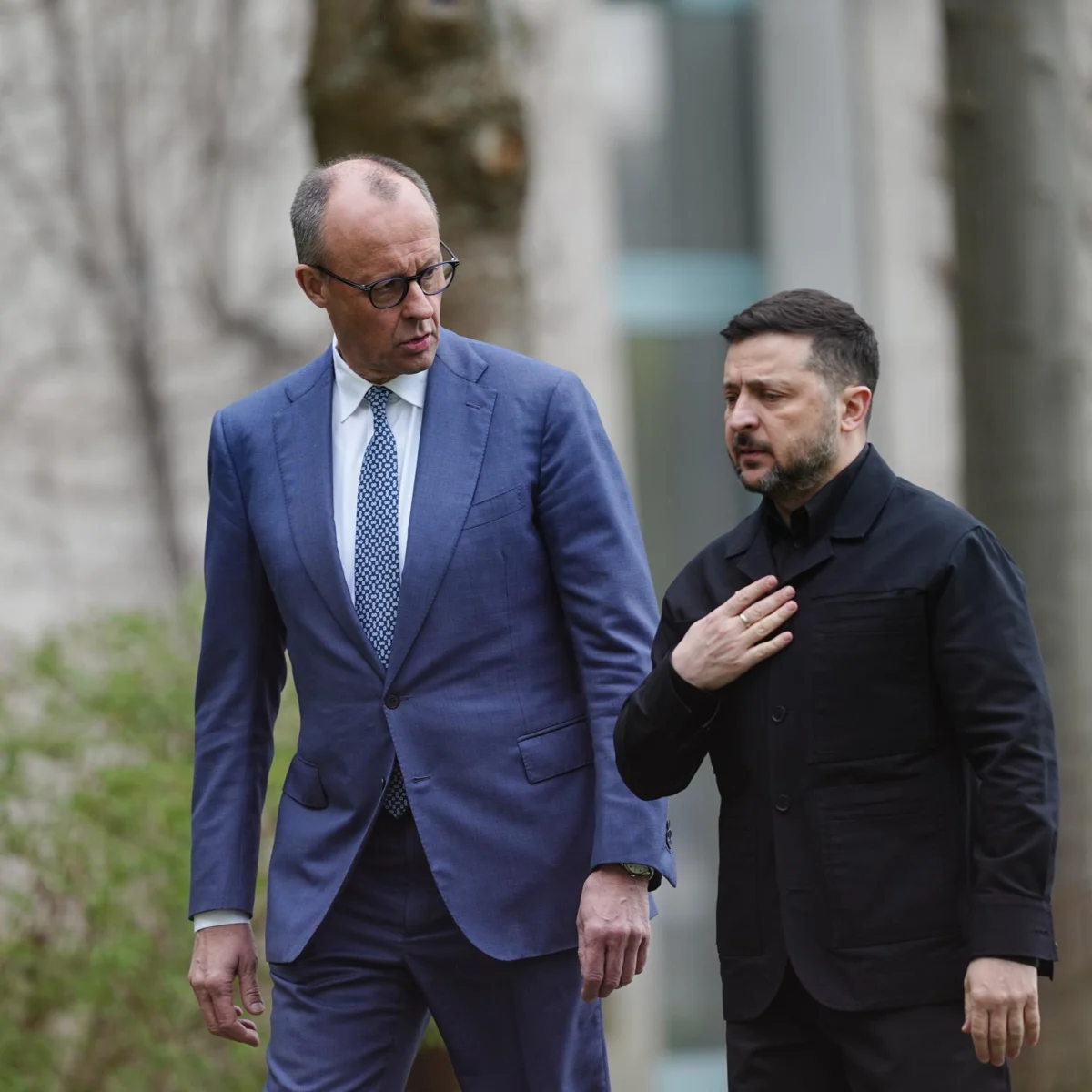
Chancellor Merz’s repeated reaffirmation of Germany’s solidarity is not merely symbolic; it is backed by substantial material and diplomatic commitment. The April meeting referenced in the image caption, featuring Chancellor Merz and President Zelenskyy, serves as a tangible representation of the ongoing high-level dialogue and strategic coordination between the two nations. These regular consultations ensure that German support remains responsive to Ukraine’s evolving needs, whether it be for urgent air defense capabilities to counter missile attacks on energy infrastructure or long-term assistance for reconstruction. Germany has also been a leading voice within the European Union, advocating for strong sanctions against Russia and robust financial packages for Ukraine, solidifying its position as a key pillar of international support.
Supporting Data: The Devastation of Ukraine’s Energy Sector
Scale of Destruction
The impact of Russia’s systematic attacks on Ukraine’s energy infrastructure has been catastrophic, pushing the country’s grid to the brink of collapse on multiple occasions. While precise, real-time figures are often difficult to ascertain in a conflict zone, estimates from Ukrainian officials and international monitoring bodies suggest that a significant portion of Ukraine’s electricity generation capacity has been severely damaged or destroyed since February 2022. Some reports have indicated that up to 50% or more of thermal power generation capacity, critical for baseload electricity, has been compromised. Substation networks, crucial for distributing power, have also been extensively targeted, leading to cascading failures across the grid.
Hundreds of missile and drone attacks have been directed specifically at energy facilities, including large thermal power plants, hydroelectric stations, and thousands of kilometers of transmission lines. The sheer volume and precision of these strikes, often using advanced cruise missiles and Iranian-made Shahed drones, demonstrate a deliberate strategy to dismantle Ukraine’s energy backbone. The resulting damage necessitates constant, arduous repair efforts, often conducted under fire, and requires massive infusions of international aid in the form of equipment and expertise to keep the lights on.
Humanitarian Crisis Amplified
The destruction of energy infrastructure directly translates into a severe and pervasive humanitarian crisis. When power plants and substations are hit, millions are left without electricity, which in turn cripples essential services. Heating systems, particularly vital during Ukraine’s harsh winters, cease to function, exposing vulnerable populations, including the elderly, children, and those in hospitals, to extreme cold. Water supply systems, reliant on electric pumps, often fail, leading to shortages of potable water and sanitation issues that heighten the risk of disease outbreaks.
Beyond basic utilities, prolonged blackouts disrupt communication networks, hindering emergency services and isolating communities. Medical facilities struggle to operate, forcing reliance on generators that are often in short supply, impacting everything from life-support machines to basic diagnostic equipment. Schools and universities are forced to close or operate intermittently, further disrupting education. The constant threat of energy blackouts and the reality of living without basic services create an immense psychological toll on the Ukrainian population, contributing to widespread stress, anxiety, and trauma, and pushing many to seek refuge elsewhere.
Economic Repercussions
The economic repercussions of the energy infrastructure attacks are profound and far-reaching, crippling Ukraine’s ability to sustain itself and rebuild. Industries, particularly heavy manufacturing and agriculture, are severely hampered by unreliable power supplies, leading to production stoppages, job losses, and a dramatic decline in economic output. The disruption of agricultural cycles due to power outages affecting storage and processing facilities has long-term implications for food security, both domestically and internationally.
The cost of repairs and reconstruction for the energy sector alone is staggering, estimated to be in the tens of billions of dollars. This immense financial burden falls heavily on an economy already devastated by war, making Ukraine increasingly dependent on international financial aid and reconstruction packages. Foreign investment, crucial for long-term recovery, is deterred by the instability and the risk of further destruction. The long-term economic damage risks creating a cycle of dependency and hindering Ukraine’s integration into the global economy, necessitating sustained and coordinated international support for years to come.
International Monitoring and Reporting
The systematic targeting of Ukraine’s energy infrastructure has drawn widespread attention and condemnation from international organizations and human rights groups. The United Nations, the Organization for Security and Co-operation in Europe (OSCE), and various human rights watchdogs have consistently documented these attacks, highlighting their potential classification as war crimes under international humanitarian law. The Geneva Conventions and the Rome Statute of the International Criminal Court prohibit attacks on civilian objects and infrastructure indispensable to the survival of the civilian population.
However, the challenge of verifying claims and attributing definitive responsibility in an active war zone remains significant. While Ukrainian authorities provide detailed accounts and evidence, Russia consistently denies targeting civilian infrastructure, often claiming its strikes are aimed at military facilities or are retaliatory. Independent monitoring missions often face access restrictions and security risks, making comprehensive, on-the-ground verification difficult. Nevertheless, the sheer volume of evidence, including satellite imagery, witness testimonies, and public statements from Ukrainian officials, paints a consistent picture of deliberate and widespread destruction of civilian energy assets.
Official Responses: International Condemnation and Calls for Accountability
Statements from Berlin and Kyiv
The joint call for a ceasefire on energy infrastructure from Berlin and Kyiv on October 13, 2026, represents a unified and forceful diplomatic offensive. Chancellor Merz’s reiterated "solidarity" goes beyond mere words, signaling Germany’s commitment to continuing its robust military, financial, and humanitarian aid. This includes the urgent provision of more advanced air defense systems, such as IRIS-T and Patriot batteries, which are critical for protecting Ukraine’s remaining energy assets. Diplomatically, Germany pledges to maintain pressure on Russia through international forums, advocating for stricter sanctions and holding Moscow accountable for its actions under international law.
President Zelenskyy, for his part, has consistently used every available platform to appeal for stronger air defense capabilities, accelerated humanitarian assistance, and intensified international pressure on Russia. His frequent online updates and direct communications with world leaders are designed to keep the severity of the situation at the forefront of the global agenda. The strategic message embedded in this joint call is multifaceted: it underscores the unity of democratic nations in condemning Russia’s actions, reaffirms a shared commitment to upholding international law, and highlights the urgent humanitarian imperative to protect civilian life. It also serves as a clear signal to Russia that the international community is closely observing and will not tolerate the deliberate targeting of civilian survival infrastructure.
Reactions from Other Key Allies
The joint initiative from Germany and Ukraine is expected to garner strong support from other key international allies. The United States, the United Kingdom, France, and the broader European Union have consistently condemned Russia’s attacks on Ukrainian civilian infrastructure. It is highly probable that these nations will issue statements supporting the call for a ceasefire, reiterating their condemnation of Russia’s tactics, and urging Moscow to abide by international humanitarian law.
In global forums such as the UN Security Council and the G7, discussions surrounding Russia’s energy warfare tactics have been frequent. The joint plea from Merz and Zelenskyy will likely provide renewed impetus for these bodies to explore further diplomatic avenues and potentially consider additional punitive measures against Russia. The G7, in particular, has been instrumental in coordinating financial aid, sanctions, and support for Ukraine’s energy sector resilience. The international community’s response will likely emphasize the need for continued aid to Ukraine to repair its grid and strengthen its air defenses, alongside diplomatic efforts to isolate Russia and pressure it to cease hostilities against civilian targets.
Russia’s Stance and Justifications (Anticipated)
Russia’s anticipated response to such a ceasefire proposal on energy infrastructure is likely to follow its established pattern of denial, deflection, and counter-accusation. Moscow has consistently maintained that its strikes in Ukraine target legitimate military objectives and infrastructure supporting Kyiv’s war effort, not civilian facilities. They often frame these attacks as "demilitarization" efforts or as "retaliation" for alleged Ukrainian provocations, such as attacks on Russian territory or infrastructure.
It is highly probable that Russia will either outright reject the ceasefire proposal, dismiss it as a propaganda stunt by Kyiv and its Western allies, or accept it only with unacceptable preconditions designed to undermine Ukraine’s sovereignty or strategic position. For instance, Russia might demand a complete cessation of Western military aid to Ukraine as a prerequisite, or insist on recognition of annexed territories. Alternatively, Russia might simply ignore the call, continuing its campaign while maintaining a narrative of defensive actions. The propaganda battle surrounding these attacks is intense, with Russia seeking to legitimize its actions on the international stage, despite overwhelming evidence to the contrary from international monitoring bodies.
Implications: The Future of Energy Warfare and International Law
The Weaponization of Winter
The deliberate and systematic targeting of Ukraine’s energy infrastructure, particularly as colder months approach, represents a calculated strategy of weaponizing winter. By depriving civilians of electricity, heating, and water, Russia aims to create unbearable living conditions, leading to mass displacement, internal strife, and potentially forcing Ukraine to negotiate from a position of extreme weakness. This tactic is a direct violation of international humanitarian law, specifically the Geneva Conventions, which protect civilian objects and infrastructure essential for the survival of the civilian population. The Rome Statute of the International Criminal Court also recognizes attacks on civilian objects as potential war crimes.
However, enforcing these laws during active conflict presents immense challenges. The difficulty lies not only in gathering irrefutable evidence for prosecution but also in compelling a permanent member of the UN Security Council to adhere to international norms it actively flouts. The international community’s inability to effectively deter or punish such actions sets a dangerous precedent, potentially emboldening other actors to employ similar tactics in future conflicts, eroding the foundational principles of humanitarian warfare.
Precedent for Future Conflicts
Russia’s actions in Ukraine, particularly its sustained campaign against energy infrastructure, risk setting a dangerous precedent for future conflicts globally. The weaponization of essential civilian services could become a more prevalent tactic, posing a grave threat to non-combatants and undermining the principle of distinction in armed conflict. If the international community fails to establish clear red lines and enforce robust accountability mechanisms, future aggressors might interpret this as tacit permission to target critical infrastructure with impunity, knowing that the humanitarian cost will be borne by the civilian population rather than by the perpetrators.
This raises urgent questions about the need for stronger international norms and more explicit protections for critical civilian infrastructure, including energy grids, water systems, and communication networks, in times of armed conflict. The current legal frameworks, while comprehensive, require more effective enforcement mechanisms and a united political will to hold states accountable, regardless of their geopolitical power.
The Path Forward: Diplomacy and Resilience
Given Russia’s historical intransigence and its continued pursuit of strategic objectives through military means, the immediate prospects of Moscow agreeing to a genuine, verifiable ceasefire on energy infrastructure without significant external pressure or a fundamental shift in its strategic calculus appear slim. Therefore, the path forward for Ukraine and its allies involves a dual strategy of continued diplomatic pressure and enhanced resilience.
Strengthening Ukraine’s air defense capabilities remains paramount. The rapid deployment of advanced anti-missile and anti-drone systems is crucial to mitigate the impact of ongoing attacks and protect vital infrastructure. Simultaneously, Ukraine is pursuing long-term resilience strategies, including the decentralization of its energy grid, investment in renewable energy sources, and strengthening international partnerships for rapid repair and reconstruction. These measures aim to make the grid less vulnerable to concentrated attacks and more adaptable to disruptions.
Diplomatically, the joint plea from Merz and Zelenskyy serves as a crucial component of the ongoing international effort to isolate Russia, increase the diplomatic cost of its aggression, and maintain global focus on the humanitarian crisis. While immediate breakthroughs may be elusive, sustained international pressure, coupled with Ukraine’s unwavering resolve and enhanced resilience, remains the only viable strategy to protect its citizens and ultimately pave the way for a just and lasting peace. The humanitarian imperative to shield civilians from the brutal weaponization of winter continues to drive these urgent calls for action.