Frankfurt, Germany – Colombia’s official presentation at the prestigious Frankfurt Book Fair has ignited a firestorm of controversy, drawing sharp criticism from publishers, authors, and cultural figures both within the country and abroad. The new ultra-right-wing government, led by President Abelardo de la Espriella, stands accused of politicizing the national representation at one of the world’s most important literary events, replacing nuanced cultural promotion with its own campaign slogans and a divisive nationalistic aesthetic.
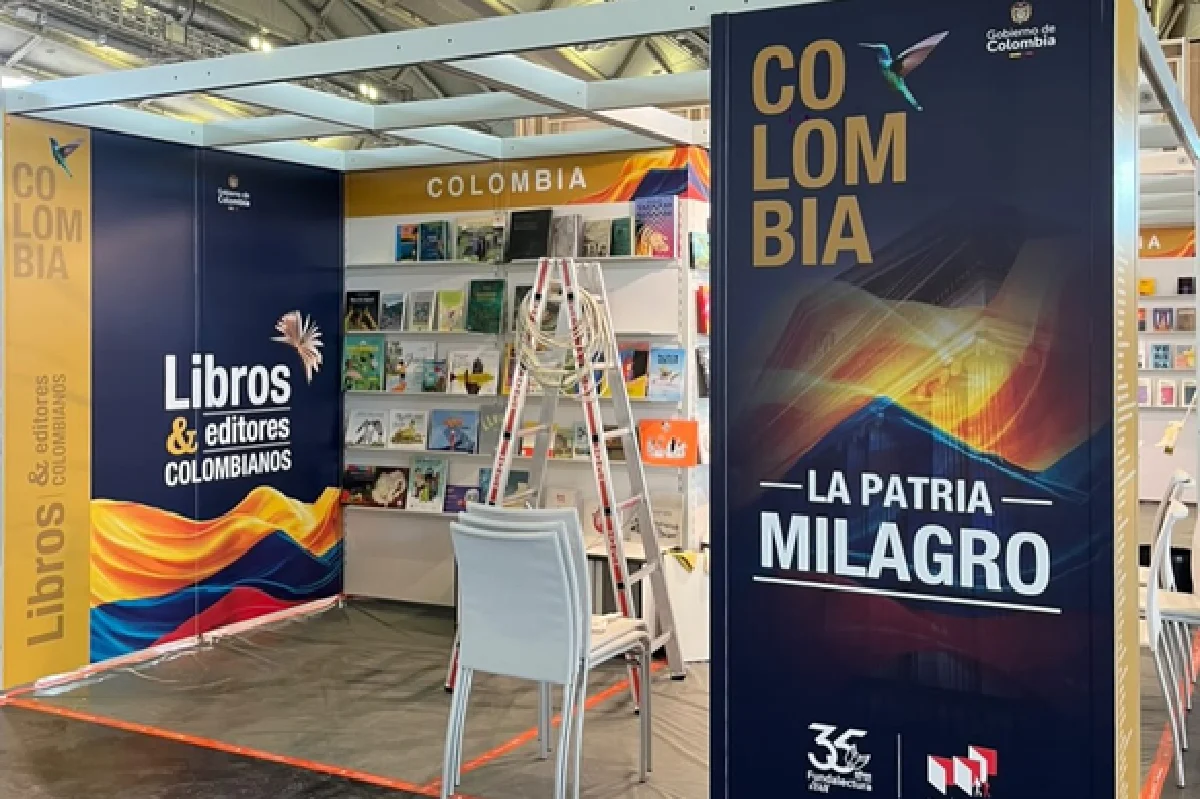
The outrage centers on a stand design described as stark and simplistic, featuring slogans such as "Kolumbien" and "Das Wundervaterland" (The Wonder Homeland/Fatherland) in large, uppercase letters against a dark blue background, accompanied by a Colombian flag. Critics argue this imagery directly mirrors de la Espriella’s presidential campaign, effectively transforming a platform for literary exchange into a political billboard. The controversy extends beyond mere aesthetics, raising serious concerns about the government’s approach to culture, freedom of expression, and the international image of a nation celebrated for its rich literary and cultural diversity.
The Provocative Display: A Visual and Ideological Statement
Upon first glance, the Colombian stand might appear unassuming: a minimalist design dominated by dark blue hues and bold white text. However, for many Colombians and international observers, the imagery immediately resonated with the political discourse of the current administration. The phrases "Kolumbien" and "Das Wundervaterland," particularly the latter, are not neutral descriptors but rather direct echoes of President Abelardo de la Espriella’s ultra-right-wing campaign rhetoric. Another panel reads "Kolumbianische Bücher und Verleger" (Colombian Books and Publishers), but even this more benign statement is overshadowed by the politicized context.
This deliberate choice stands in stark contrast to previous Colombian representations at the Frankfurt Book Fair, which historically leveraged sophisticated designs that celebrated the nation’s immense biodiversity, its vibrant indigenous cultures, or iconic literary works like José Eustasio Rivera’s jungle epic, "La Vorágine." Publishers and authors have long strived to present a multi-faceted and inclusive image of Colombian literature, reflecting its diverse ecosystems and the voices of its 65 indigenous languages. This year’s stand, however, has been derided by Laguna Libros, a prominent Colombian publishing house, as an "homage to mediocrity," suggesting it might even have been "created with artificial intelligence" given its generic appearance, with the government’s slogan placed squarely at its center. The fact that these key slogans are not even translated into German further underscores a perceived lack of genuine engagement with the international audience, prioritizing domestic political messaging over cross-cultural communication.

Chronology of Discontent and Policy Shifts
The first wave of public outcry erupted swiftly after images of the stand circulated on social media, particularly following a critical post by Laguna Libros on Instagram. The publisher, while expressing gratitude for the opportunity to participate in Frankfurt, voiced profound "shame" over the image of Colombia presented by the official stand. This sentiment was quickly echoed by a deluge of commentators, highlighting a widespread disappointment within the Colombian literary community.
The roots of this controversy, however, run deeper than just the stand’s design. A significant shift in responsibility for the national representation has occurred. Traditionally, the esteemed National Library of Colombia, with its deep expertise in literature and cultural promotion, was tasked with curating the country’s presence at international book fairs. This year, however, the mandate was controversially transferred to the Communication Department of the Presidency. This move immediately raised red flags, suggesting a political agenda would supersede artistic and literary considerations.
Further fueling concerns are recent policy changes and appointments within Colombia’s cultural sector under the de la Espriella administration. Within just two months of the government’s tenure, several decisions have signaled a challenging environment for culture, which the Colombian constitution mandates the state to promote. Most notably, the Ministry of Culture, for the first time in 27 years, canceled the awards and prizes of the National Promotion Program, citing unspecified "budget problems." Critics, however, view this as a strategic move to defund and deprioritize cultural initiatives that do not align with the government’s ideology.
Key appointments have further solidified these fears. The state research institute Caro y Cuervo, named after renowned humanists and philologists, now has a director who openly advocates for "sweeping away cultural Marxism" and speaks of a "culture war" aimed at ending the "woke agenda." This rhetoric, often associated with far-right movements globally, suggests a deliberate attempt to reshape the intellectual and artistic landscape according to a specific political doctrine.

Perhaps most contentious is the recent appointment of Julia Cristina Daza as the new head of the National Library. Daza, who actively campaigned for Abelardo de la Espriella from Miami, possesses no discernible experience in the book and library sector, nor in promoting reading, historical memory, or cultural heritage. Her public statements upon assuming office further alarmed cultural practitioners. She declared it an honor to contribute to the "Wonder Homeland" project and vowed to place the institution, which dates back to 1777, "in God’s hands." Such pronouncements from the head of a secular national cultural institution are seen as deeply troubling, signaling a potential for ideological and religious bias to influence its mandate.
Supporting Data: The Slogans, the Law, and the Voices of Opposition
The core of the controversy lies in the deliberate use of political slogans. "Das Wundervaterland" (The Wonder Homeland/Fatherland) is more than just a catchy phrase; it’s a loaded term that, according to Felipe González, founder of Laguna Libros, "invokes a sectarian religious conviction." González, who founded his experimental publishing house nearly two decades ago and has participated in the Frankfurt Book Fair multiple times, expressed profound "surprise and indignation" at the government’s approach. He passionately articulated how this singular, ideologically charged slogan attempts to homogenize and "erase" the staggering cultural diversity of Colombia – a megadiverse nation boasting unique ecosystems and 65 indigenous languages, each representing a distinct worldview and literary tradition. "This diversity is being erased," González lamented, observing that "everything now receives the PR stamp of the presidency, all the same aesthetic."
Beyond the ideological implications, the design of the stand may also be in violation of Colombian law. As highlighted by Laguna Libros, the "Anti-Brand Law of 2023" explicitly prohibits the state from adopting the image or branding of a transient government. This legislation was enacted to safeguard national institutions from being co-opted for partisan political messaging, ensuring that symbols and public spaces represent the enduring character of the nation rather than the fleeting agenda of a particular administration. If the stand’s design is indeed deemed a direct appropriation of de la Espriella’s campaign branding, it would represent a flagrant disregard for this important legal framework, further exacerbating concerns about the rule of law and democratic norms under the current government.
The critique extends to the very essence of the government’s engagement with culture. Juan David Correa, who served as the longest-tenured Minister of Culture under the preceding left-wing government of Gustavo Petro, did not mince words. A seasoned cultural journalist, writer, editor, and organizer of the Bogotá Book Fair, Correa has personal experience in orchestrating Colombia’s presence at Frankfurt. Speaking to the taz, he branded the current Colombian presentation as "maximally tasteless fascist propaganda," drawing parallels to the style of Donald Trump. "This has nothing to do with the world of books," Correa asserted, adding, with a tone of weary resignation, that it was "not surprising from a government of non-readers." His statement points to a deeper disconnect, suggesting that the current administration fundamentally misunderstands or actively disdains the very cultural sector it is charged with representing.

Official Responses and Their Omissions
While direct official responses defending the stand’s design have been sparse, the government’s actions speak volumes. The decision to hand over the organization of the stand to the Presidential Communication Department, rather than the National Library, is itself an implicit statement of intent. The appointment of individuals like Julia Cristina Daza to lead the National Library, despite her lack of relevant experience and open alignment with the "Wonder Homeland" project, serves as a de facto endorsement of the government’s cultural direction. Daza’s public vow to place the 246-year-old institution "in God’s hands" further illustrates an approach that prioritizes a specific ideological framework over established cultural and academic principles.
The cancellation of the National Promotion Program awards, ostensibly due to "budget problems," can also be interpreted as a form of official response – a deliberate withdrawal of state support for cultural initiatives that may not align with the government’s narrative. This lack of transparency regarding the "budget problems" and the absence of clear alternative support mechanisms leave many cultural practitioners feeling unsupported and marginalized. The rhetoric emanating from the newly appointed head of the Caro y Cuervo Institute, speaking of "cultural Marxism" and "culture war," represents an aggressive official stance, signaling a confrontational approach to cultural policy rather than one of fostering diversity and open dialogue. In essence, the government’s "response" is not a defense of the stand in isolation, but rather a pattern of actions that collectively indicate a profound ideological shift in its cultural agenda.
Broader Implications for Colombian Culture and International Standing
The fallout from the Frankfurt Book Fair controversy is multi-layered, threatening to undermine years of efforts to foster and internationalize Colombian literature.
Erosion of Cultural Autonomy: The most immediate and profound implication is the perceived erosion of cultural autonomy. By injecting overt political messaging and a singular, divisive narrative into a global cultural event, the government risks stifling independent artistic expression. When state representation becomes a vehicle for partisan propaganda, it sends a chilling message to authors, publishers, and artists that their work must conform to a prescribed ideological line, or risk marginalization and lack of support. This politicization jeopardizes the very notion of art as a space for critical thought, diverse perspectives, and open dialogue. Felipe González’s concern that "everything now receives the PR stamp of the presidency, all the same aesthetic" highlights this homogenizing effect, which can be particularly damaging to a nation rich in regional and linguistic differences.

Damage to International Image: Colombia has long enjoyed a revered status in the global literary landscape, largely thanks to giants like Gabriel García Márquez and a vibrant contemporary scene. The controversial stand risks tarnishing this reputation. International publishers, literary agents, and readers attending the Frankfurt Book Fair expect a celebration of literary achievement and cultural exchange, not political campaigning. The "maximally tasteless fascist propaganda" described by Juan David Correa is unlikely to foster genuine interest in Colombian literature and could instead project an image of a nation grappling with authoritarian tendencies and a disregard for artistic freedom. This could have long-term repercussions for the international visibility and marketability of Colombian authors and their works.
The Future of Cultural Promotion: The shift in responsibility for the Book Fair stand from the National Library to the Presidential Communication Department, coupled with the cancellation of cultural awards and the appointment of politically aligned, inexperienced figures to key cultural institutions, paints a grim picture for the future of cultural promotion in Colombia. These actions suggest a systematic dismantling of established frameworks designed to nurture and disseminate literature and arts based on merit and cultural value. Publishers like Laguna Libros, which operate as "experimental laboratories" for diverse literary forms, may find it increasingly difficult to secure state support or even a platform for their work if they do not align with the government’s "Wonder Homeland" narrative. The emphasis on a "culture war" and "anti-woke agenda" by figures in charge of research institutions further indicates a hostile environment for progressive, critical, or diverse cultural initiatives.
Freedom of Expression: Ultimately, the controversy raises fundamental questions about freedom of expression. When state-sponsored cultural representation becomes overtly political and ideologically driven, it implicitly discourages dissenting voices. The fear of reprisal, whether through defunding, marginalization, or outright censorship, can lead to self-censorship among artists and intellectuals. This is particularly concerning in a country with a complex history, where literature has often served as a vital space for memory, critique, and social commentary. The notion that the head of the National Library would declare the institution "in God’s hands" in a diverse, secular nation underscores a potential threat to the intellectual independence and pluralism essential for a thriving literary ecosystem.
The Frankfurt Book Fair stand, therefore, is not an isolated incident but a visible symptom of a broader cultural strategy being implemented by President de la Espriella’s government. It signals a move away from an inclusive, diverse, and internationally oriented cultural policy towards one that prioritizes nationalistic and ideologically driven messaging, with potentially profound and damaging consequences for Colombia’s rich cultural heritage and its place in the global literary community. The challenge for Colombian artists and intellectuals will be to navigate this shifting landscape while continuing to champion the myriad voices and stories that truly define their "Wonder Homeland."