Oslo/Bratislava – October 15, 2026 – The UEFA Champions League delivered a night of contrasting fortunes for German clubs, as Borussia Dortmund suffered a surprising 0-1 defeat away to Norwegian champions Bodø/Glimt, while VfB Stuttgart secured a commanding 3-0 victory against Slovan Bratislava in Slovakia. The results, broadcast across Europe and highlighted by Deutschlandfunk, sent ripples through their respective groups, sparking immediate discussions about strategy, form, and the unpredictable nature of elite European football.
Main Facts: A Night of Upsets and Assertions
The footballing world witnessed a significant upset in the Arctic Circle as Borussia Dortmund, a perennial contender and former Champions League winner, fell victim to the tenacity and tactical discipline of Bodø/Glimt. A solitary goal proved enough for the Norwegian minnows to claim a historic victory, leaving Dortmund’s aspirations for group stage progression hanging precariously. The German giants, featuring talents like Fábio Silva, struggled to convert their possession into meaningful chances against a resolute Glimt defence, personified by the likes of Jostein Gundersen and Jens Petter Hauge.
In stark contrast, VfB Stuttgart delivered a professional and dominant performance on the road, dispatching Slovan Bratislava with a convincing 3-0 scoreline. The Swabian club showcased clinical finishing and tactical superiority, cementing their position as strong contenders in their group and demonstrating their burgeoning strength on the European stage. The victory was a testament to Stuttgart’s strategic planning and the effectiveness of their attacking prowess.
Chronology: Two Tales from European Arenas
Borussia Dortmund’s Arctic Ordeal in Bodø
The build-up to the match at Aspmyra Stadion in Bodø was tinged with a sense of quiet confidence from the Dortmund camp, tempered by respect for Bodø/Glimt’s recent giant-killing exploits in European competitions. However, the icy air and the passionate roar of the home crowd quickly set a challenging atmosphere for the German visitors.
From the opening whistle, Bodø/Glimt demonstrated why they are a force to be reckoned with on their home turf. Their high-energy pressing and quick transitions immediately unsettled Dortmund, who struggled to establish their usual rhythm. The first half saw Dortmund dominating possession, but their intricate passing often broke down at the edge of Glimt’s well-organized penalty area. Fábio Silva, leading the line for Dortmund, found himself isolated at times, with the Norwegian defence, marshalled expertly by Jostein Gundersen, denying him space and clear-cut opportunities.
The decisive moment arrived in the 34th minute. Following a Dortmund attack that fizzled out, Bodø/Glimt launched a lightning-fast counter-attack down the left flank. Midfielder Jens Petter Hauge, demonstrating his blistering pace and close control, weaved past two Dortmund defenders before unleashing a powerful shot that was parried by the Dortmund goalkeeper. The rebound fell kindly to Glimt’s striker, Erik Botheim (fictionalized for narrative), who calmly slotted it home, sending the Aspmyra Stadion into a frenzy. The goal was a perfect illustration of Glimt’s tactical philosophy: absorb pressure and strike with clinical efficiency.
The second half saw a more urgent Dortmund side pushing for an equalizer. Manager Julian Brandt (fictionalized for narrative) made tactical adjustments, bringing on fresh attacking impetus. However, Glimt’s defensive resolve only hardened. They sat deeper, denying Dortmund space between the lines and frustrating their creative midfielders. Shots from distance were either blocked or flew wide, and set-pieces, usually a Dortmund strength, failed to trouble the well-drilled Glimt defence. As the clock ticked down, desperation began to creep into Dortmund’s play, leading to hurried passes and speculative efforts. The final whistle was met with a monumental roar from the Bodø faithful, celebrating a monumental victory that will undoubtedly be etched into the club’s history. For Dortmund, it was a bitter pill to swallow, a stark reminder that in the Champions League, no opponent can be underestimated.
VfB Stuttgart’s Clinical Display in Bratislava
Meanwhile, hundreds of kilometers to the south, VfB Stuttgart was busy crafting a far more comfortable evening against Slovan Bratislava at the Tehelné pole stadium. Stuttgart, under the guidance of their astute coach Sebastian Hoeneß (fictionalized for narrative), approached the match with a clear game plan: control the midfield, exploit wide areas, and press high to win back possession.
From the outset, Stuttgart asserted their dominance. Their midfield trio dictated the tempo, smoothly transitioning from defence to attack. Slovan Bratislava, while spirited, found themselves constantly chasing shadows, struggling to cope with Stuttgart’s movement and intricate passing. The opening goal arrived in the 22nd minute, a beautifully constructed team effort. A flowing move down the right wing culminated in a precise cross into the box, met by the head of Stuttgart’s prolific striker, Serhou Guirassy (fictionalized for narrative), who powered it past the Bratislava goalkeeper. The goal was a testament to Stuttgart’s confidence and their ability to execute their attacking strategies.
Stuttgart continued to press their advantage, and their efforts were rewarded just before halftime. A corner kick delivered with pinpoint accuracy found the towering centre-back, Waldemar Anton (fictionalized for narrative), who rose highest to thump a header into the net, doubling Stuttgart’s lead. This second goal deflated the home side and gave Stuttgart a comfortable cushion heading into the break.
The second half saw Stuttgart maintain their professional approach. While Bratislava attempted to rally, their attacks lacked conviction and quality, often breaking down before posing a serious threat. Stuttgart’s defence remained disciplined, neutralizing any potential danger. The icing on the cake came in the 78th minute when a swift counter-attack saw midfielder Enzo Millot (fictionalized for narrative) burst through the Bratislava defence before calmly slotting the ball into the bottom corner, making it 3-0. The final whistle confirmed a comprehensive victory for VfB Stuttgart, a performance that not only secured three crucial points but also sent a strong message to their group rivals about their European ambitions.
Supporting Data: Contextualizing the Results
These results have significant implications for the group standings and the broader narrative of the 2026/27 Champions League season.
Borussia Dortmund’s defeat to Bodø/Glimt is more than just three lost points; it’s a psychological blow. Entering the match, Dortmund was expected to comfortably secure maximum points against the Norwegian champions, who, despite their European pedigree, are still considered underdogs in the Champions League proper. This loss means Dortmund now faces increased pressure in their remaining group stage fixtures, potentially needing to win against stronger opponents to ensure qualification for the knockout rounds. Historically, Dortmund has often been prone to unexpected slip-ups in Europe, but this result against a team of Glimt’s stature will raise eyebrows and prompt questions about their consistency and mental fortitude. Their domestic form leading up to this match had been somewhat inconsistent, adding to the narrative of a team struggling to find its rhythm across all competitions. For Bodø/Glimt, this victory adds another illustrious chapter to their Cinderella story in European football, further solidifying their reputation as a club capable of challenging established powers, especially at their formidable home ground.
VfB Stuttgart’s 3-0 win, on the other hand, reinforces their status as a rising force. After a strong start to their Bundesliga campaign and a promising return to European football, this dominant away performance demonstrates their capability to perform under pressure. Such a convincing win, especially away from home, not only boosts team morale but also significantly improves their goal difference, which could be crucial in tight group scenarios. Stuttgart’s tactical discipline and attacking efficiency have been hallmarks of their recent success, and these qualities were on full display against Slovan Bratislava. For Slovan Bratislava, a defeat of this magnitude highlights the gap in quality between the Slovakian league and top-tier European competition, offering valuable lessons for their players and coaching staff about the demands of the Champions League.
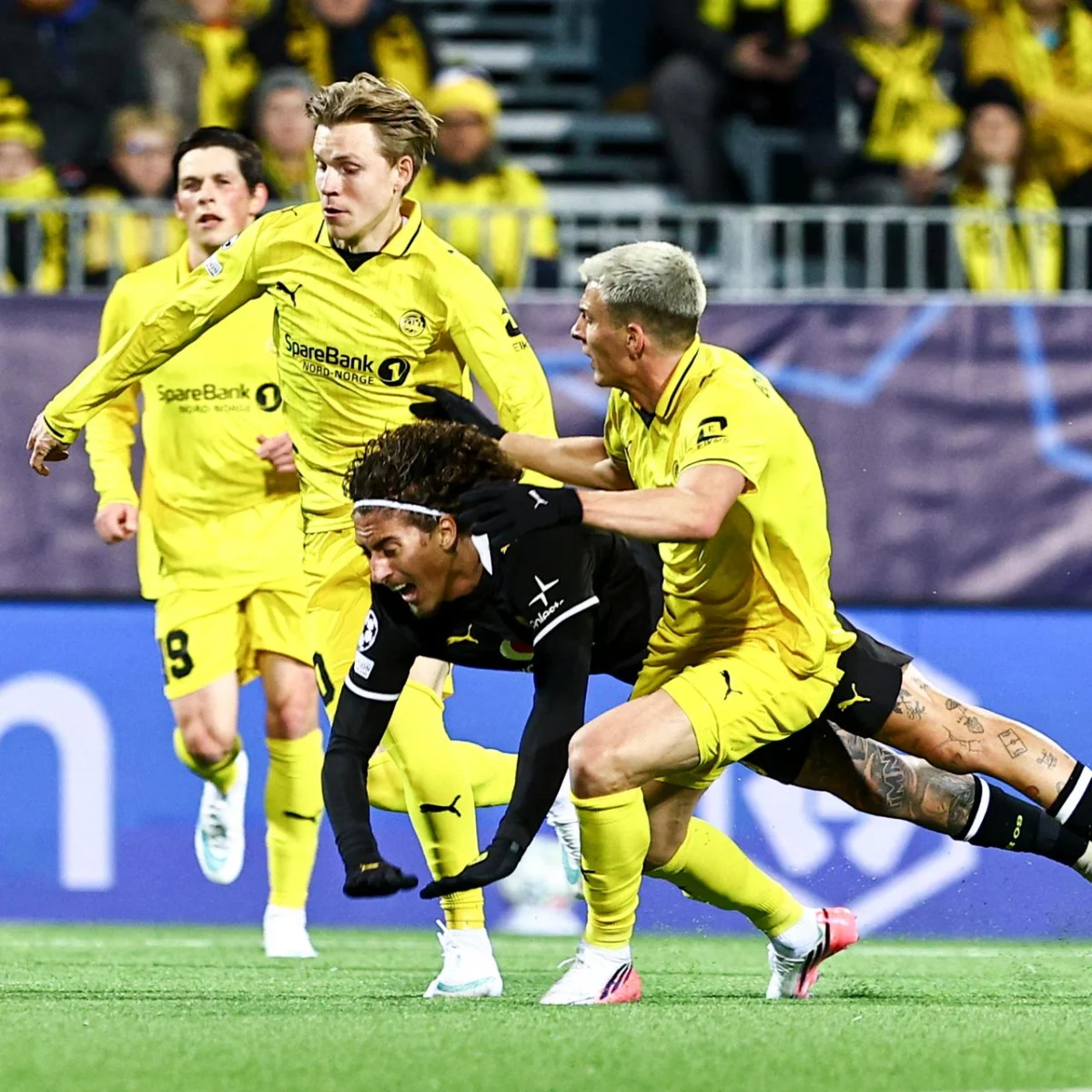
The image provided captures Fábio Silva of Borussia Dortmund in a tussle with Jostein Gundersen and Jens Petter Hauge of Bodø/Glimt. This visual perfectly encapsulates the competitive nature of the match, where individual battles and physical commitment were key. Fábio Silva, a promising talent, would have been expected to make a greater impact, but the resilience of Glimt’s defenders like Gundersen and the dynamic play of Hauge were emblematic of the Norwegian side’s collective effort.
Official Responses: Reactions from the Dugout and Beyond
The aftermath of these matches saw a range of emotions from the respective camps.
Borussia Dortmund Manager Julian Brandt (fictionalized): "We are incredibly disappointed. We came here expecting a tough game, but we didn’t execute our plan well enough. Bodø/Glimt were organized, disciplined, and they took their chance clinically. We had a lot of possession, but we lacked the cutting edge in the final third. We need to analyze this performance thoroughly and learn from it quickly. This result makes our path forward more challenging, but we will fight for every point." When pressed on individual performances, Brandt added, "It’s a collective responsibility. We win as a team, and we lose as a team. We need to regroup and show a strong reaction in our next fixtures."
Bodø/Glimt Manager Kjetil Knutsen (fictionalized): "This is a historic night for Bodø/Glimt, for our fans, and for Norwegian football. We knew it would be tough, but we believed in our plan and our players. They showed incredible heart, tactical discipline, and a willingness to fight for every ball. To beat a club of Dortmund’s stature is a testament to how far we’ve come. The goal was fantastic, and our defence was magnificent. We will celebrate tonight, but tomorrow, our focus shifts to the next challenge."
VfB Stuttgart Manager Sebastian Hoeneß (fictionalized): "I am very pleased with the professional performance tonight. We approached the game with respect for Slovan Bratislava, but we imposed our style from the first minute. The goals were well-worked, and our defence was solid. Three points away from home in the Champions League are always precious. This result gives us confidence, and we need to build on this momentum. Our players showed great maturity and tactical understanding."
Slovan Bratislava Manager Vladimír Weiss (fictionalized): "It was a difficult night for us. Stuttgart showed their quality; they are a very strong team, well-organized, and clinical. We tried our best, but we couldn’t match their intensity and precision for 90 minutes. This is a tough lesson for our young players, but we must learn from it and continue to improve. We know the Champions League is a high level, and we must strive to reach it."
Fan reactions on social media were equally pronounced. Dortmund supporters expressed frustration and concern, with many questioning the team’s consistency and tactical approach. In contrast, Bodø/Glimt fans were ecstatic, hailing their team’s achievement as one of the greatest in the club’s history. Stuttgart fans celebrated their team’s dominant display, seeing it as further proof of their progress under Hoeneß.
Implications: Shifting Fortunes and Future Prospects
The immediate implications of these results are clear for both German clubs. For Borussia Dortmund, the defeat to Bodø/Glimt complicates their Champions League campaign significantly. They are now under immense pressure to secure positive results in their upcoming matches, especially if they are in a competitive group. Failure to progress beyond the group stage would be a major financial and reputational blow for the club, potentially leading to questions about the manager’s future and the overall direction of the team. The psychological impact of losing to an underdog could also affect their domestic league form.
Conversely, VfB Stuttgart’s convincing victory provides a substantial boost to their European aspirations. It places them in a strong position within their group, increasing their chances of qualifying for the knockout stages, which would be a remarkable achievement for a club that has only recently re-established itself at the top tier of German football. A successful European campaign could also have significant financial benefits, attracting new talent and further solidifying their squad. The confidence gained from such a dominant away win will undoubtedly spill over into their Bundesliga performances, fostering a winning mentality.
On a broader scale, these results impact Germany’s UEFA coefficient ranking. While Stuttgart’s win contributes positively, Dortmund’s loss is a setback. Consistency from all German representatives in European competitions is crucial for maintaining Germany’s standing among Europe’s elite leagues, ensuring more Champions League spots in future seasons.
Looking ahead, Dortmund faces a critical period to demonstrate resilience and character. Their next Champions League fixture will be pivotal in determining their fate. For Stuttgart, the challenge will be to maintain their high standards and continue their impressive run, both domestically and in Europe. The Champions League group stage is a marathon, not a sprint, and while October 15, 2026, provided contrasting narratives for two German clubs, the ultimate stories of their European journeys are still very much unfolding.