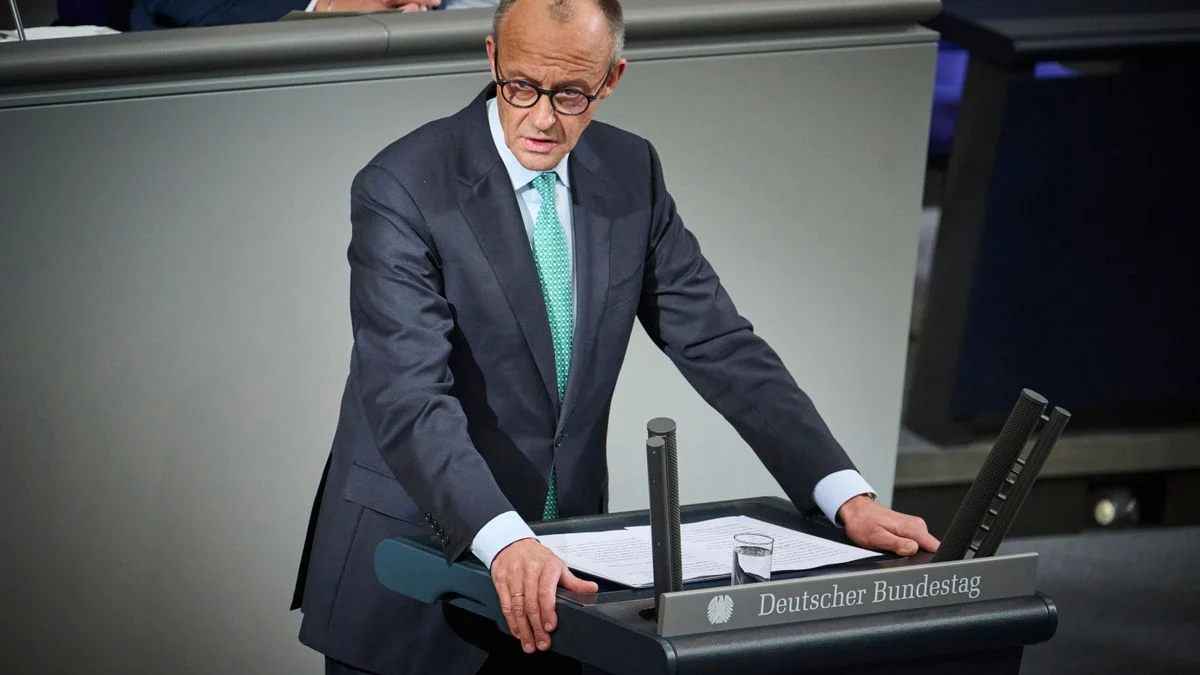
Berlin, Germany – In a political landscape increasingly defined by volatility and public discontent, Friedrich Merz, leader of Germany’s opposition Christian Democratic Union (CDU), has launched a pointed critique at Chancellor Olaf Scholz. According to a recent analysis, Merz contends that the Chancellor is desperately searching for a "new narrative for his black-red coalition" – a striking assertion given that Scholz leads a "traffic light" coalition of the Social Democrats (SPD), Greens, and Free Democrats (FDP). This rhetorical maneuver by Merz is not merely an observational comment but a sharp indictment, suggesting that Scholz’s current government lacks a coherent vision and is failing to articulate a compelling story for Germany’s future, perhaps even yearning for the perceived stability of a bygone era of grand coalitions.
Merz’s remarks underscore a growing perception within political circles and among the electorate that the current three-party government, often dubbed the "Ampelkoalition" (traffic light coalition), is struggling to find its footing amidst a confluence of domestic challenges and international crises. The CDU leader’s framing of Scholz’s quest for a "black-red" (CDU/CSU and SPD) narrative serves as a powerful metaphor for the alleged ideological fissures and leadership vacuum within the current ruling alliance. It implies that Scholz, a Social Democrat who previously served as Vice-Chancellor in a grand coalition under Angela Merkel, is either out of sync with his current partners or nostalgic for a more predictable political arrangement, while simultaneously failing to define the identity and direction of the government he actually leads.
The underlying premise of Merz’s critique is that effective governance requires more than policy pronouncements; it demands a unifying narrative that inspires confidence, explains difficult decisions, and rallies public support. In Merz’s view, the Chancellor and his diverse coalition partners have thus far failed to craft such a story, leaving Germany feeling rudderless at a critical juncture in its history. This perceived narrative deficit has become a focal point for the opposition, enabling them to portray the government as reactive rather than proactive, fragmented rather than unified, and ultimately, unprepared to steer the nation through turbulent times.
Unpacking the Chancellor’s Narrative Vacuum
Merz’s Incisive Critique
Friedrich Merz’s recent public statements have been characterized by an escalating tone of impatience and concern regarding the state of German governance. His assertion that Chancellor Olaf Scholz is "searching for a new narrative for his black-red coalition" is a meticulously crafted barb designed to hit multiple targets simultaneously. Firstly, it highlights the perceived ideological disunity within the actual "traffic light" coalition, which brings together the traditionally left-leaning SPD and Greens with the economically liberal FDP. These parties often find themselves at odds on fundamental policy questions, from fiscal discipline and industrial strategy to social welfare and environmental regulations. Merz implies that Scholz, instead of forging a new, cohesive identity for his unique three-party alliance, is metaphorically reaching for a blueprint from a different, perhaps simpler, political constellation.
Secondly, the "black-red" reference harks back to the era of grand coalitions, specifically the Merkel years when the CDU/CSU and SPD governed together. While these coalitions were often criticized for blurring ideological lines and stifling robust parliamentary debate, they were also perceived, at times, to offer a degree of stability and broad political consensus, particularly during crises. By invoking this image, Merz suggests that Scholz either implicitly longs for such stability, or more critically, is incapable of manufacturing a similar level of unity and shared purpose with his current, ideologically diverse partners. The critique is that Scholz is trying to force a "grand coalition" narrative onto a "traffic light" reality, a square peg in a round hole, demonstrating a fundamental leadership deficiency.
Merz articulated this perspective forcefully in a recent party gathering, stating, "The Chancellor appears to be a man without a clear compass, leading a government that speaks with three different voices on almost every major issue. Where is the grand vision? Where is the unifying story that explains to the German people why difficult decisions are being made and where we are headed? It seems Herr Scholz is still mentally governing a ‘black-red’ coalition, failing to grasp the realities and demands of his current partners." Such statements resonate with a segment of the public that feels the government is indecisive and lacking a clear direction, particularly in crucial policy areas like economic recovery, energy transition, and migration.
A Coalition Adrift? The Search for a Guiding Story
The Ghost of Grand Coalitions Past
The "Ampelkoalition" assumed power in December 2021 with ambitious plans for modernizing Germany, accelerating climate protection, and fostering social cohesion. However, its tenure has been marred by a series of unforeseen crises and persistent internal disagreements, which have made the task of forging a coherent narrative exceedingly difficult.
Chronology of Challenges:
- February 2022: The Ukraine War Erupts: Just weeks into its term, the coalition was confronted with Russia’s full-scale invasion of Ukraine. This necessitated a dramatic pivot in German foreign and defense policy, including the "Zeitenwende" (turning point) speech by Chancellor Scholz and a €100 billion special fund for the Bundeswehr. While initially unifying, the ongoing war has placed immense strain on energy policy, economic stability, and public finances, exposing fault lines within the coalition regarding the pace and scope of support for Ukraine and Germany’s own rearmament.
- Energy Crisis and Inflation (2022-2023): The cessation of Russian gas supplies plunged Germany into an unprecedented energy crisis. The government responded with massive relief packages and an accelerated transition away from fossil fuels, but the high cost of living and energy prices fueled public anxiety and highlighted policy divergences. While the Greens pushed for faster renewables expansion, the FDP emphasized market mechanisms and the SPD sought social safeguards.
- The Budget Crisis (Late 2023): A landmark ruling by the Federal Constitutional Court in November 2023 declared the government’s reallocation of €60 billion, originally earmarked for pandemic relief, to climate projects as unconstitutional. This decision blew a significant hole in the budget, forcing the coalition into weeks of intense, often acrimonious, negotiations to find cuts and new funding. The budget crisis laid bare deep ideological differences between the FDP’s commitment to fiscal discipline and the SPD and Greens’ desire for investment and social spending. It epitomized the coalition’s struggle to present a united front and a clear economic narrative.
- Migration Debate (Ongoing): Germany has seen a significant increase in asylum applications, leading to renewed public debate and pressure on local authorities. The coalition has struggled to find a unified approach, with the Greens emphasizing humanitarian concerns and integration, while the FDP and parts of the SPD call for stricter border controls and faster deportations. This issue consistently highlights the government’s inability to speak with one voice, further eroding public trust in its capacity to manage complex challenges.
- Internal Squabbles and Public Perception: Beyond major crises, the coalition has been plagued by recurrent public disagreements between ministers, particularly between the FDP (e.g., Finance Minister Christian Lindner) and the Greens (e.g., Economy Minister Robert Habeck). These public spats, often concerning the budget, industrial policy, or social programs, have contributed to an image of disarray and a lack of collective leadership. Each party seems to prioritize its own agenda, making it difficult for the Chancellor to weave these disparate threads into a coherent governmental narrative.
This chronology illustrates a government constantly reacting to external shocks and internal friction rather than proactively shaping its agenda and communicating a clear vision. The absence of a strong, consistent narrative from the Chancellor has allowed these individual policy debates to be perceived as symptoms of a deeper disunity, rather than necessary compromises within a functioning coalition.
Economic Headwinds and Geopolitical Pressures
Domestic Discontent and International Scrutiny
The "Ampelkoalition"’s struggles are not merely a matter of political communication; they are deeply intertwined with challenging economic realities and a complex geopolitical environment. Germany, traditionally Europe’s economic powerhouse, has faced significant headwinds, contributing to a palpable sense of unease among its citizens and drawing scrutiny from international partners.
Supporting Data:
- Economic Stagnation: After a period of robust growth, Germany’s economy has been teetering on the brink of recession. In 2023, the country registered a slight contraction in GDP, making it one of the weakest performers in the Eurozone. Forecasts for 2024 remain subdued, with many economists pointing to high energy costs, bureaucratic hurdles, and a lack of significant structural reforms as contributing factors. This economic stagnation directly impacts public sentiment, making people less tolerant of political infighting and more demanding of decisive leadership.
- Inflation and Cost of Living: While inflation has cooled from its peak, the cumulative effect of rising prices for energy, food, and housing continues to burden households. Public surveys consistently show "cost of living" as a top concern for Germans. The government’s various relief packages, while substantial, have not fully alleviated these pressures, and the perception remains that the state is struggling to control economic forces impacting daily lives.
- Public Opinion Polls: Trust in the government has steadily declined. Recent polls consistently place the SPD, Greens, and FDP significantly below their 2021 election results. The FDP, in particular, has struggled to maintain support, often polling near or below the 5% threshold required for parliamentary representation. The CDU/CSU, led by Merz, has consistently polled as the strongest political force, often by a significant margin, underscoring the public’s desire for a change in leadership and direction. A recent DeutschlandTrend survey indicated that only around 20-25% of Germans are satisfied with the government’s work, a stark contrast to previous administrations.
- Business Confidence: German business sentiment, as measured by indices like the Ifo Business Climate Index, has shown volatility, often reflecting pessimism about current conditions and future prospects. Businesses frequently cite excessive bureaucracy, high energy prices, skilled labor shortages, and a lack of clear government strategy as impediments to investment and growth. This directly challenges the government’s narrative of modernizing Germany and making it fit for the future.
- Geopolitical Pressures: Beyond Ukraine, Germany faces increasing pressure to redefine its role in a multipolar world. The challenges posed by China’s economic might, the instability in the Middle East, and the future of transatlantic relations demand a clear foreign policy doctrine. Critics argue that the Ampel coalition, despite the "Zeitenwende," has struggled to articulate a consistent and robust foreign policy, often appearing hesitant or internally conflicted, particularly on defense spending and relations with authoritarian regimes.
The confluence of these factors creates a fertile ground for Merz’s critique. The lack of a unifying narrative from the Chancellor is not just a communication problem; it reflects a deeper struggle to effectively address these multifaceted challenges. The public, grappling with economic uncertainty and a sense of geopolitical vulnerability, yearns for strong, decisive leadership and a compelling vision for how Germany will navigate these storms. When such a narrative is absent, or appears fragmented, the vacuum is quickly filled by opposition voices offering alternative interpretations and solutions.
Official Responses and Counter-Narratives
Scholz’s Defense and Coalition Partners’ Stances
Faced with a barrage of criticism from the opposition, Chancellor Olaf Scholz and his coalition partners have consistently sought to present a united front and defend their governmental achievements. Their counter-narrative emphasizes stability, crisis management, and the necessity of navigating complex global shifts with a responsible and forward-looking approach.
Chancellor Scholz, known for his calm demeanor and pragmatic style, has often responded to critiques by highlighting the unprecedented challenges his government has faced since taking office. In recent public addresses, he has stressed the coalition’s success in averting an energy collapse, supporting Ukraine, and implementing key reforms, such as the citizen’s income (Bürgergeld). "We are steering Germany safely through an era of profound change," Scholz stated in a recent interview, "and we are doing so with foresight and determination. Those who claim we lack a narrative simply refuse to acknowledge the tangible progress we are making in securing our energy supply, strengthening our social fabric, and modernizing our economy for the future." He often frames the government’s work as a continuous process of adaptation and problem-solving, rather than a single, static narrative.
Members of the SPD, Scholz’s party, echo this sentiment, often pointing to legislative successes in social policy and the shift towards renewable energies. "It is easy for the opposition to criticize from the sidelines," said SPD co-leader Lars Klingbeil, "but this government has demonstrated its capacity to act swiftly and decisively in times of crisis. Our narrative is one of responsibility, resilience, and a just transition for all Germans." They contend that the "traffic light" coalition is delivering on its promises despite difficult circumstances, and that internal debates are a natural, democratic feature of a multi-party government, not a sign of weakness.
The Green Party, a key partner in the coalition, often emphasizes the transformational aspects of the government’s agenda, particularly regarding climate action and environmental protection. Economy Minister Robert Habeck frequently points to accelerated renewable energy expansion and new industrial policies designed to decarbonize Germany’s economy. "Our narrative is one of ecological modernization," Habeck stated, "ensuring Germany remains competitive while meeting its climate targets. This requires bold decisions and, yes, sometimes difficult compromises, but we are committed to building a sustainable future." Greens also argue that the coalition is successfully balancing ecological imperatives with social justice, a narrative they believe resonates with a significant portion of the electorate.
The Free Democratic Party (FDP), despite its frequent disagreements with the SPD and Greens, also defends the coalition’s overall direction. Finance Minister Christian Lindner, while advocating for fiscal discipline, emphasizes the FDP’s role in preventing excessive state spending and promoting economic freedom. "Our contribution to this coalition’s narrative is a commitment to sound finances and unleashing the potential of our innovative economy," Lindner remarked. "We are ensuring that Germany remains a country of opportunity, not just a recipient of state subsidies." The FDP argues that its presence in the coalition prevents a leftward drift and maintains a balance necessary for economic prosperity.
These official responses aim to counter the opposition’s narrative of disunity and aimlessness. They attempt to stitch together the disparate policy achievements into a broader story of a responsible government navigating unprecedented challenges while simultaneously laying the groundwork for a modern, sustainable Germany.
The CDU’s Alternative Vision
In contrast to the government’s defensive stance, Friedrich Merz and the CDU have been actively positioning themselves as the stable alternative, ready to take the reins. Their counter-narrative focuses on what they perceive as the government’s failures and proposes a return to what they term "common sense politics," emphasizing economic competence, security, and a strong, decisive state.
Merz’s vision for Germany, and implicitly the CDU’s "narrative," is built on several pillars:
- Economic Revival: The CDU advocates for significant deregulation, tax cuts for businesses, and a reduction in bureaucracy to stimulate economic growth and attract investment. They argue that the current government’s policies are stifling innovation and driving companies out of Germany. "We need to unleash the entrepreneurial spirit of this country," Merz proclaimed, "not shackle it with endless regulations and ever-increasing burdens."
- Fiscal Responsibility: Following the budget crisis, the CDU has intensified its calls for strict adherence to the debt brake and a return to balanced budgets. They criticize the "Ampelkoalition" for what they see as profligate spending and a lack of long-term financial planning.
- Robust Security and Migration Management: The CDU consistently pushes for stronger border controls, faster deportation of rejected asylum seekers, and a more robust defense policy. They argue that the government has failed to adequately address the challenges of migration and ensure internal security. Merz frequently states, "Order and security are the foundations of a functioning society. The current government has lost control in crucial areas."
- Clear Leadership and Unity: Perhaps most importantly, the CDU positions itself as the party of stable, unified leadership, contrasting itself with the perceived infighting of the "traffic light" coalition. Merz aims to project an image of a party that speaks with one voice and has a clear plan for Germany’s future, appealing to voters tired of political squabbling.
The CDU’s strategy is to highlight the government’s perceived weaknesses – its internal divisions, its handling of the economy, and its struggles with migration – and present itself as the credible, experienced alternative. By pointing out the Chancellor’s alleged search for a "black-red narrative," Merz is not only criticizing Scholz but also subtly hinting at the CDU’s own readiness to lead, perhaps even in a future grand coalition, should the current government falter beyond repair. The CDU’s narrative is one of restoration: restoring economic strength, national security, and political stability to Germany.
Implications for Germany’s Political Future
The Path to 2025 and Beyond
The ongoing debate over the Chancellor’s narrative and the "Ampelkoalition"’s cohesion carries profound implications for Germany’s political future, particularly as the next federal election in 2025 looms closer. Friedrich Merz’s critique is more than just opposition rhetoric; it is a strategic move designed to shape public perception and lay the groundwork for a potential change in government.
Short-Term Implications (Leading up to 2025):
- Increased Political Volatility: The "Ampelkoalition" is likely to face continued pressure, both from within and from the opposition. The perceived lack of a clear narrative will make it harder for the government to push through difficult reforms or secure public buy-in for controversial policies. This could lead to further internal disputes, potentially paralyzing the government or even leading to its premature collapse, though this remains a low probability given the political costs for all involved.
- Rising Support for Opposition: The CDU/CSU, benefiting from the government’s struggles, is likely to consolidate its position as the leading political force. Merz’s sharp critiques, if they resonate with public discontent, could further boost his party’s standing. However, the rise of the far-right AfD also complicates the political landscape, siphoning off protest votes and making coalition formation more challenging for mainstream parties.
- Focus on Leadership and Cohesion: The discourse will increasingly revolve around who can offer stable, unified leadership. Chancellor Scholz will be under immense pressure to demonstrate stronger leadership and forge greater cohesion within his coalition, potentially requiring him to make difficult choices to placate dissenting partners or impose a clearer party line.
Long-Term Implications (Beyond 2025):
- The Grand Coalition Question: Merz’s reference to a "black-red coalition" subtly reintroduces the possibility of a future Grand Coalition (CDU/CSU + SPD). While often viewed as a last resort due to its tendency to weaken the opposition and blur political lines, persistent governmental instability could make a Grand Coalition appear as a safer, more stable option to voters. If the Ampel coalition continues to struggle, the CDU, as the likely largest party, might find itself in a position to lead such an alliance.
- Merz’s Leadership Test: For Friedrich Merz, effectively articulating the CDU’s alternative narrative and maintaining party unity will be crucial. His ability to capitalize on the government’s perceived weaknesses while presenting a credible, forward-looking vision will determine his success in the next election. He must demonstrate that the CDU offers not just criticism, but concrete solutions and a capacity for effective governance.
- Redefining Germany’s Political Center: The struggles of the "Ampelkoalition" also reflect a broader challenge in defining Germany’s political center in a post-Merkel era. The traditional "Volksparteien" (catch-all parties) like the CDU and SPD have seen their support erode. The ability of any future government to unite disparate ideological strands under a compelling narrative will be key to re-establishing a stable political center capable of addressing Germany’s complex challenges.
- Impact on German Foreign Policy: A government perceived as internally divided or lacking a clear narrative could also diminish Germany’s standing on the international stage. In an era of global crises, allies and partners look to Germany for decisive leadership. A strong, coherent domestic narrative is often a prerequisite for projecting strength and reliability internationally.
In conclusion, Friedrich Merz’s strategic critique of Chancellor Scholz’s "search for a new narrative for his black-red coalition" is a powerful political statement. It effectively encapsulates the current anxieties about governmental cohesion, economic direction, and national leadership. As Germany navigates an increasingly complex world, the ability of its political leaders to articulate a unifying, inspiring vision will be paramount, not only for electoral success but for the nation’s continued stability and prosperity. The coming months will test whether the current government can find its voice, or if the opposition will successfully convince the electorate that a new narrative, and indeed a new leadership, is desperately needed.