Paris, France – As France grapples with recurrent waves of social unrest, marked by both widespread peaceful demonstrations and destructive riots, the discourse surrounding the perpetrators often simplifies a deeply complex issue. While hundreds of thousands take to the streets to voice legitimate grievances, parallel acts of vandalism and looting ignite fierce condemnation. Amidst this polarized debate, acclaimed French writer Édouard Louis challenges the prevailing narrative, arguing that to view the rioters merely as criminals is to dangerously overlook the profound societal causes fueling their actions. "We must look closer," Louis insists, advocating for a sociological lens that moves beyond moral judgments to understand the raw, often inarticulate, anger shaking the foundations of the Republic.
His intervention comes at a critical juncture, as the nation struggles to reconcile its republican ideals with the stark realities of social inequality, economic precarity, and systemic marginalization that disproportionately affect certain communities. The events of recent weeks, particularly a significant day of nationwide mobilization, have laid bare the fault lines within French society, compelling a re-evaluation of how violence is understood, condemned, and ultimately addressed.
I. Unrest in France: A Dual Reality Unfolds
The past months in France have been defined by a striking dichotomy: a vibrant, largely peaceful expression of democratic dissent juxtaposed with explosive, destructive outbursts. This dual reality was starkly evident, for instance, during the widespread demonstrations that swept across the country on October 17th, serving as a powerful illustration of the nation’s current state of tension.
A. Widespread Mobilization for Change
On this particular day, and indeed throughout broader periods of protest, hundreds of thousands of citizens across France converged in major cities like Paris, Marseille, Lyon, and Limoges. Their purpose was clear: to articulate their discontent, to protest against government policies, and to collectively demand radical political change. These mobilizations were fueled by a range of grievances, including the controversial pension reforms, the spiraling cost of living, and a pervasive sense of social injustice. Participants chanted slogans, sang protest songs, and marched with banners calling for greater equality and a more equitable redistribution of wealth. These were the visible, organized expressions of a populace yearning for a fairer society, a movement rooted in the democratic right to assembly and free speech.
The scale of these demonstrations underscored the depth of popular frustration with the current political and economic climate. Unions, student groups, and civil society organizations played a crucial role in orchestrating these events, aiming to channel collective anger into constructive political pressure. Their actions were largely peaceful, embodying the spirit of civic engagement and the pursuit of change through democratic means.
B. The Surge of Violent Outbursts
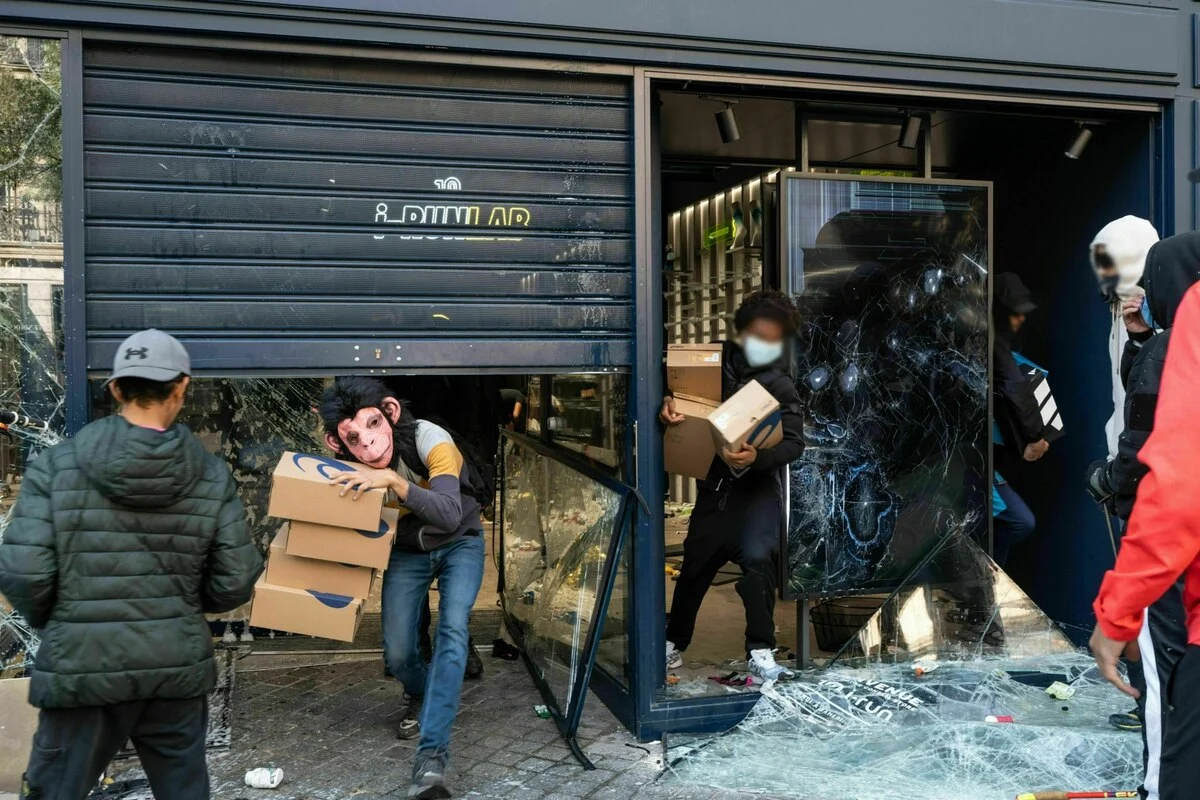
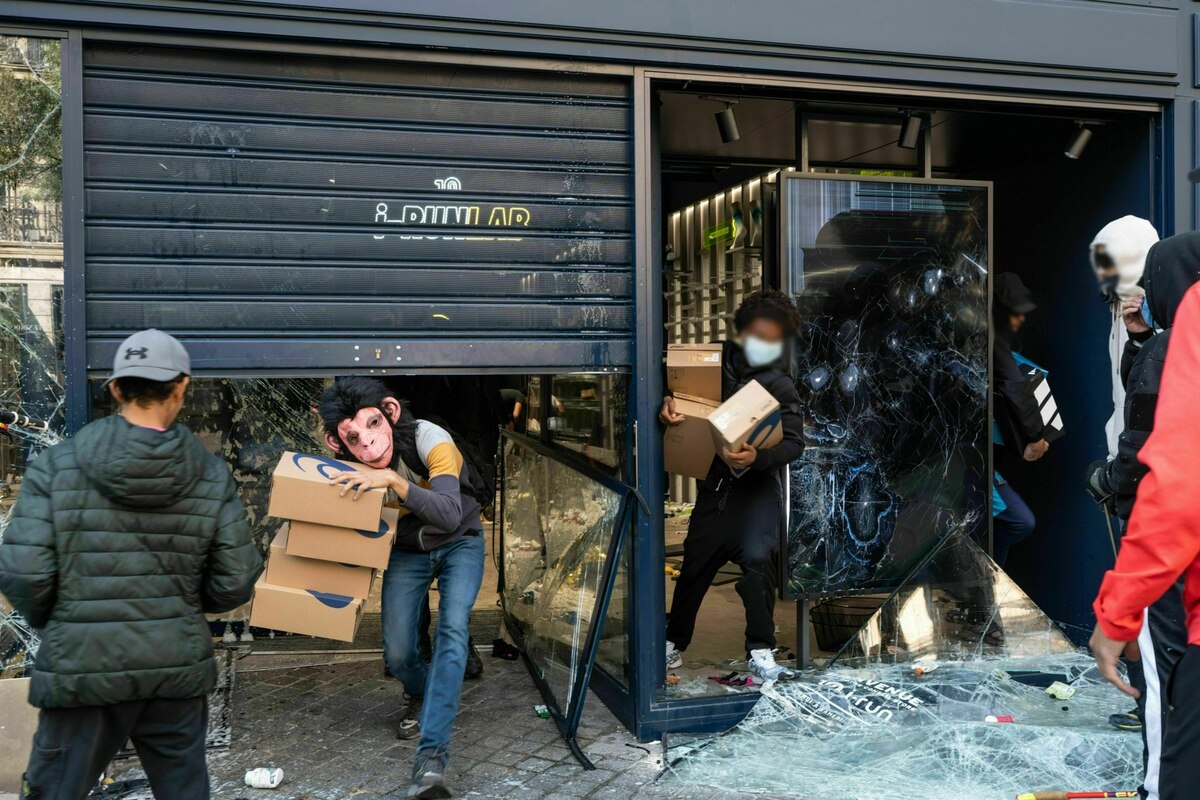
Simultaneously, however, a darker, more destructive current manifested. In the very same cities—Paris, Lyon, Marseille, and Limoges—several thousand individuals deviated from the peaceful demonstrations, transforming parts of the day into a wave of violent riots. The impact was immediate and devastating: businesses were vandalized and looted, storefronts shattered, and kiosks and vehicles set ablaze. Iconic public spaces suffered significant damage; the Place de la République in Paris, a symbolic heart of French democracy, was ravaged, and the Boulevard de Magenta disfigured. In Limoges, the town hall was set on fire, while in Lyon, the local tourist information office also succumbed to flames.
The immediate aftermath was captured in a torrent of videos circulating on social media, depicting scenes of despair. Heartbroken shopkeepers, some visibly weeping, stood before the ruins of their livelihoods, their businesses reduced to rubble and ash. The sheer scale and indiscriminate nature of the destruction sparked immediate outrage and widespread condemnation from across the political spectrum, laying the groundwork for a heated national debate about accountability and the future of public order.
II. The Contested Narratives of Chaos
In the wake of such widespread destruction, two dominant and often clashing narratives quickly emerged, each attempting to frame and explain the violence. These perspectives, Édouard Louis argues, ultimately converge in their failure to truly grasp the underlying social dynamics at play.
A. The "Law and Order" Discourse
The first, and arguably most prevalent, reaction was a resounding condemnation of the perpetrators, swiftly labeled as "chaots" or "hooligans." From the political right and far-right, extending even to segments of the Socialist Party anxious to appear "respectable" and align with governmental rhetoric, the call was for severe penalties and a firm restoration of order. This discourse framed the violence as an unprovoked assault on the Republic itself, a deliberate act to plunge France "into chaos."
Figures on the right and far-right, including Marine Le Pen and Éric Zemmour, were quick to exploit the imagery of burning cars and looted shops, using it to bolster their calls for increased police powers, stricter sentencing, and a zero-tolerance approach to public disorder. They argued that these "anarchic" elements were not merely disrupting public peace but actively undermining the very fabric of French society and its institutions. Even mainstream politicians, under pressure to demonstrate resolve, often echoed these sentiments, prioritizing the immediate restoration of order over any deeper inquiry into the causes of the unrest. The focus was squarely on individual culpability and the need for decisive state action.
B. The Left’s Dilemma: Distancing and Damage Control
A different, yet equally problematic, narrative emerged from parts of the political left. While condemning the violence, this perspective sought to meticulously distance the destructive acts from the legitimate social movement. Proponents argued that the "chaots" had "nothing to do" with the peaceful demonstrations, that their actions actively harmed the cause of social justice, and that they played directly into the hands of the extreme right, who would inevitably use the events to demand further repression – a prediction that quickly materialized.
This narrative, while well-intentioned in its desire to protect the integrity of the protest movement, implicitly maintained a similar binary to the right-wing discourse: "authentic" peaceful protestors on one side, and a separate, destructive element on the other. It struggled to acknowledge any organic connection between the broader anger and the specific forms of violence, preferring to view the latter as an external aberration. The concern here was less about the perpetrators’ motivations and more about the strategic implications for the wider political struggle, fearing that the violence would discredit the legitimate demands for change and provide ammunition for authoritarian responses.
III. Édouard Louis’s Sociological Interrogation
Édouard Louis, however, challenges both these prevailing narratives, arguing that they share a fundamental flaw: they treat the "chaots" as a monolithic, decontextualized group, disconnected from any discernible social reality. For Louis, this intellectual shortcut prevents any meaningful understanding of the violence and its deeper implications.
A. Deconstructing the "Chaotic" Label
Louis’s critique is sharp: both the right’s condemnation and a segment of the left’s distancing strategy operate under the false premise that the group of "chaots" is a real, distinct entity. They construct an artificial division, implying a clear line between "authentic" demonstrators—driven by legitimate political and social outrage, choosing peaceful protest—and those who, "completely detached from the context," simply decide to be violent. This latter group is portrayed as an assembly of isolated individuals, supposedly motivated solely by a "lust for destruction" and a desire to cause trouble.
This framing, Louis contends, conveniently strips the perpetrators of their social context, their history, and their grievances. It reduces complex human behavior to a mere individual whim or an innate predisposition towards malice, effectively shutting down any possibility of sociological analysis. By denying the rioters any connection to broader societal forces, these narratives absolve society itself of any responsibility in producing such anger.
B. The Unmistakable Social Signature of the Rioters
Louis urges a closer look, one that observes the striking similarities among those who engaged in rioting and looting. He asks: how can one overlook the fact that these individuals "resemble one another"? He points to their shared characteristics:
- Social Background: They largely appear to hail from the lower social strata, identifiable by their clothing (caps, sneakers) and the accents and expressions common to those milieus. This isn’t a random cross-section of society; it’s a specific demographic.
- Racialized Identity: Crucially, Louis emphasizes that a significant portion of these individuals are "racialized men"—Black and Arab individuals. This observation immediately injects a critical dimension of race and systemic discrimination into the discussion, challenging any attempt to universalize or depoliticize the violence.
- Life Conditions: Louis connects these demographics to their lived experiences, painting a stark picture of decades of systemic marginalization:
- Housing: Confined to dilapidated housing estates (banlieues) on the outskirts of major cities.
- Poverty: Held in conditions of persistent poverty, with limited economic opportunities.
- Education: Assigned to "decayed secondary schools infested with rats or cockroaches," highlighting profound educational inequality.
- Police Harassment: Unable to move through cities "without being controlled and humiliated by the police," exposing a pervasive experience of racial profiling and state-sanctioned indignity.
For Louis, these shared characteristics are not coincidental. They underscore his core thesis: that this violence is not merely about individual choice, but about profound social conditioning and systemic marginalization. It is a specific milieu, shaped by specific living conditions, that "produces certain behaviors." The decision to smash a window or loot a store is not an isolated, spontaneous act of individual will, but rather a manifestation of a social imprint that compels individuals to act in particular ways.
C. Empathy vs. Understanding: A Call for Deeper Inquiry
Louis openly admits his own emotional response to the images of distraught shopkeepers. "I say it quite openly: it makes me sad too, and I feel for the weeping shopkeepers when I see them in front of their stores." This admission is vital, as it preempts accusations of condoning violence. However, he immediately qualifies this empathy: "But empathy must not distract from questioning more deeply what this violence means."
For Louis, understanding why certain people riot does not equate to denying the suffering of those affected by the destruction. Instead, it is a refusal to use that suffering as an excuse to cease critical thought. It is a rejection of the false dilemma that the pain of one group must inevitably blind us to the pain of another. This distinction is crucial for Louis: it allows for compassion for the victims of destruction while simultaneously demanding an unflinching examination of the societal conditions that produce the perpetrators. It is about holding two truths simultaneously: that violence is harmful, and that it is often a symptom of deeper systemic failures.
IV. Unpacking the Root Causes of Violence
Louis’s framework compels an uncomfortable but necessary shift in focus: from merely condemning the symptoms to rigorously examining the underlying diseases plaguing French society. He posits that the violence witnessed is not random but deeply rooted in a confluence of socio-economic degradation and cultural factors.
A. Socio-Economic Degradation
At the heart of Louis’s argument is the devastating impact of chronic socio-economic neglect. He directly links the propensity for violence to a series of systemic failures:
- Impoverishment of the French Population: A general decline in living standards for many, eroding purchasing power and increasing financial insecurity.
- Decline in Social Welfare: The systematic reduction of social assistance programs, which serve as crucial safety nets, leaving vulnerable populations even more exposed.
- Destruction of Public Services: The dismantling or degradation of essential public services – education, healthcare, transport – particularly in marginalized areas, exacerbates inequality and limits opportunities.
- Neglect of Lower Social Strata: A consistent pattern of indifference and underinvestment by successive governments, including Macron’s and his predecessors’, towards working-class communities and the banlieues.
Louis provocatively asks: "To what extent do suffering and social violence drive some people to the point where violence is their only language?" And further: "To what extent have the impoverishment of the French population, the decline in social aid, the destruction of public services, as well as the neglect of the lower social strata by the governments of Macron and his predecessors, contributed to destruction and looting becoming the only possible way for some?" These are not rhetorical questions but a direct challenge to the political establishment to acknowledge its role in creating the conditions for unrest. For Louis, these actions are not senseless; they are a desperate, albeit destructive, form of communication when all other channels have failed or been ignored.
B. Contributing Factors and Their Context
While emphasizing socio-economic roots, Louis also acknowledges other contributing factors, but always contextualizes them within his broader framework.
- Masculinity: He notes that while both men and women participate in looting, destructive acts are "almost exclusively carried out by men." This observation opens up questions about toxic masculinity, the pressures on young men in marginalized communities, and how violence can become a performative assertion of power or identity in environments where other forms of agency are denied.
- Culture and Social Media: Louis points to the "glorification of violence in social media" and a "fascination for money and consumption." These elements are undoubtedly present in contemporary youth culture. However, Louis immediately pivots to his central query: "But the questions remain the same: Why do these representations, these behaviors resonate more strongly in certain social milieus than in others?" And critically: "Why does violence take precisely this form, among precisely these people, at precisely this moment?"
This nuanced approach prevents an easy scapegoating of social media or cultural trends. Instead, it forces an examination of why these external influences find fertile ground in specific communities. It suggests that while these factors may shape the form of violence, the underlying propensity for it stems from deeper, structural issues.

C. Challenging Individual Responsibility
Louis fundamentally rejects the notion that violence is merely an individual choice. "A person never decides an act, an action, alone," he asserts. "A violent act is never an individual, not even a group of individuals, who wakes up in the morning and decides: ‘Hey, I’m going to do something violent today.’" Even if such a thought occurred, he argues, "the reason for their action would lie beyond themselves." One would still need to explain why they possess such a destructive urge, and why this particular mode of action seems accessible or appealing to them.
He illustrates this with a provocative thought experiment: "The day we see children from affluent neighborhoods and students from elite universities in white shirts and polished shoes smashing shop windows and looting supermarkets—on that day, perhaps, we can begin to believe in theories of responsibility and individual action." But until then, he argues, as long as "the same behaviors almost always occur among the same population groups, in the same areas, and among the same groups of men, one must admit that something in the organization of our society makes these behaviors more likely than others."
Louis criticizes the selective application of sociological analysis. When students from privileged backgrounds demonstrate or block their schools, society readily attributes their actions to context and situation. However, when young men or women from working-class neighborhoods protest by burning buildings, smashing windows, and looting, this nuanced argumentation suddenly ceases. They are no longer seen as products of a history, a social class, a neighborhood, an upbringing, or a relationship with the police, money, and consumption. Instead, they are reduced to individuals "without motives, without a past, without social conditioning," ascribed a "pure will, an almost natural viciousness." This "de-sociologizing" perspective, Louis concludes, is not only intellectually lazy but dangerously misleading.
V. Broader Implications and Future Outlook
Édouard Louis’s incisive analysis carries significant implications for France’s societal health, political stability, and the very nature of its republican ideals. By demanding a sociological rather than merely a moralistic reading of the unrest, he pushes for a profound re-evaluation of how the nation confronts its deepest inequalities.
A. The Political Dimension of Violence
Louis insists that the question of violence is not a moral one—not about whether the acts are "good or bad"—but fundamentally political. "Why do they do that and what does their action tell us about the state of France and the current social violence?" he asks. The acts of rioting, even when seemingly irrational or self-defeating, are for Louis a potent, albeit often unintended, form of communication. They speak volumes "about the neglect of certain segments of the population, about lives reduced to exclusion and violence."
This perspective reclaims the agency of the marginalized, even in their destructive acts. It frames the riots as a distorted mirror reflecting back the failures of the state and society to provide dignity, opportunity, and a voice to all its citizens. The violence becomes a raw, unfiltered message from those who feel unheard and unseen, a desperate cry from the margins that polite society often prefers to ignore.
B. Societal Divides and the Republic’s Challenge
Louis’s argument highlights the deepening polarization within French society. The facile division between "good" protestors and "bad" rioters masks a more fundamental cleavage between those who feel represented and those who feel utterly abandoned by the Republic. The insistence on individual culpability for violence, without acknowledging its systemic roots, exacerbates these divides, fueling resentment and further alienating marginalized communities.
The challenge for the French Republic is immense: how to uphold its foundational ideals of liberté, égalité, fraternité when a significant portion of its population experiences neither freedom from humiliation, nor equality of opportunity, nor fraternity from the state. The riots expose a profound crisis of integration and social cohesion, questioning the very efficacy of the French model of universalism when faced with racial and socio-economic realities.
C. Policy Responses and the Path Forward
Louis’s analysis implicitly calls for a radical shift in policy. Rather than relying solely on increased policing, arrests, and punitive measures—which only address symptoms—there is an urgent need for comprehensive social and economic policies. These must tackle the root causes of inequality:
- Investment in Banlieues: Genuine, long-term investment in housing, education, public services, and cultural infrastructure in marginalized neighborhoods.
- Combating Poverty and Unemployment: Robust measures to reduce poverty, create employment opportunities, and ensure fair wages.
- Addressing Systemic Discrimination: Concrete actions to combat racial profiling, police brutality, and other forms of systemic discrimination faced by racialized communities.
- Rebuilding Social Welfare: Reinvesting in social aid programs and public services to create a stronger safety net and foster social mobility.
The current debates often oscillate between calls for repression and expressions of empathy without action. Louis argues for a third way: a rigorous, sociological understanding that can inform policies aimed at genuine inclusion and justice. This means re-evaluating policing strategies, fostering community relations built on trust rather than suspicion, and, crucially, listening to the voices, however distorted, of those who resort to violence.
Conclusion
The events that have unfolded in France are, as Édouard Louis acknowledges, "of immense complexity." He does not claim to fully understand or solve them, but he passionately believes that society "must not close our eyes to certain questions of crucial importance" if it is to truly grasp "the very justified anger that has been shaking the country for several weeks."
Louis’s intervention is a powerful plea for intellectual courage and moral honesty. It demands that France move beyond simplistic condemnations and politically convenient narratives to confront the uncomfortable truths about its own internal workings. The violence on the streets is not just a breakdown of order; it is a profound sociological statement, a desperate communication from those pushed to the brink. To ignore its roots, to simply label it "criminal," is to perpetuate the very neglect that fuels it. Only by looking closer, by daring to understand the origins of this anger, can France hope to heal its divisions and forge a more equitable and peaceful future for all its citizens.