By Dinah Riese
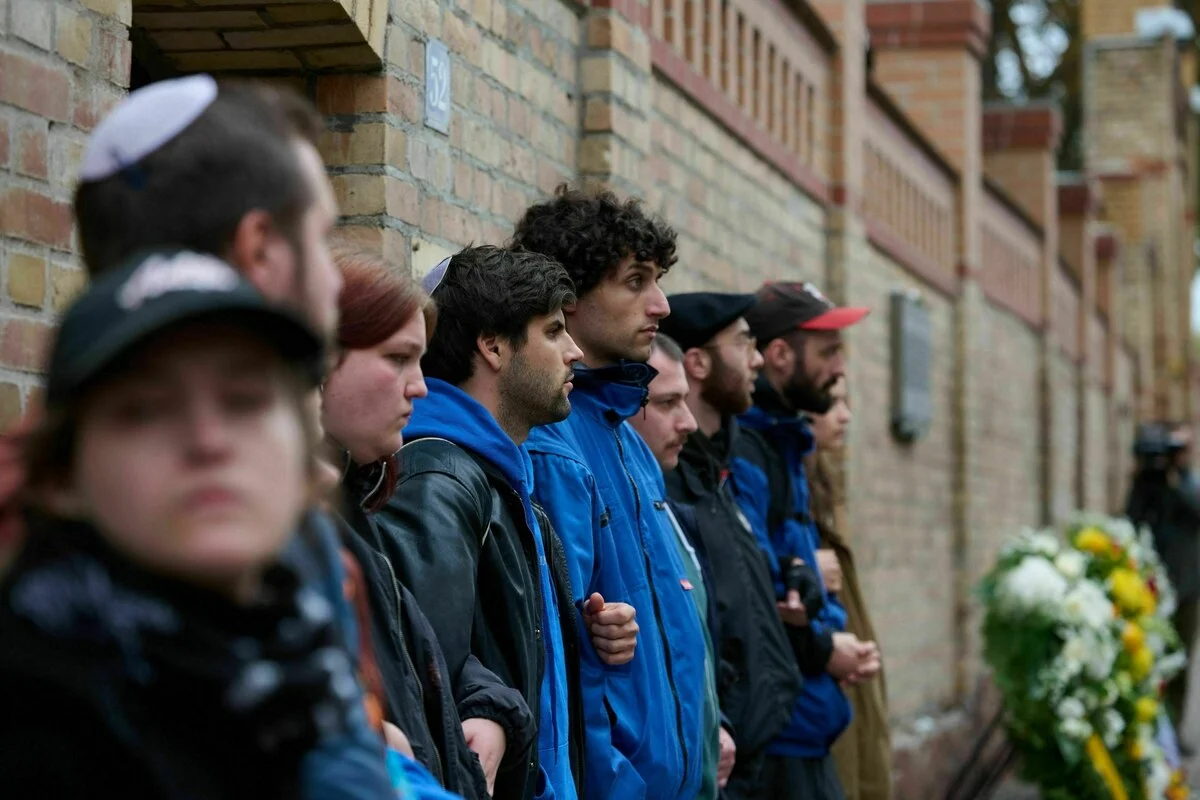
The seventh anniversary of the antisemitic terrorist attack in Halle, Germany, was marked this year not just by somber reflection, but by an act of resolute civil disobedience. As survivors, families, and community members gathered to commemorate the lives lost on October 9, 2019, a group of young activists took a stand that rippled through the national political discourse. The Jewish Student Union of Germany (JSUD), led by its president, Ron Dekel, formed a human chain at the entrance of the Halle synagogue, physically barring the newly elected AfD deputy speaker of the state parliament, Hans-Thomas Tillschneider, from entering the memorial service.
This confrontation, caught on camera and widely reported, serves as a stark metaphor for the current state of German democracy: a society increasingly forced to decide where the boundaries of political legitimacy lie in the face of a surging far-right movement.
The Chronology of the Confrontation
The day began with an atmosphere of solemnity. The Halle attack, in which a lone perpetrator failed to break into the synagogue but murdered two people in the vicinity, remains a traumatic open wound for the Jewish community in Germany.
As guests arrived at the synagogue, a clear protocol had been established: survivors and the bereaved were to enter first. However, the arrival of Hans-Thomas Tillschneider, a polarizing figure within the Alternative for Germany (AfD) party, disrupted the order. Members of the JSUD, standing as a blockade, made it clear that Tillschneider’s presence was unwelcome.
"We were not going to allow our memorial to be hijacked," Ron Dekel explained in an interview following the incident. "We have seen time and again how politicians from the far-right attempt to use our tragedies for their own political theatre—to secure a ‘kosher stamp’ of approval. We refused to grant them that."

According to witnesses, Tillschneider attempted to force his way into the service, claiming his right as a representative of the state parliament to attend. When confronted by the students, he reportedly adopted a posture of indignation, positioning himself as the victim of the situation. The stand-off lasted until it became clear that the students would not yield, and the ceremony proceeded with the focus remaining on the survivors, rather than the political controversy.
Supporting Data: The Rising Tide of Antisemitism
The protest in Halle did not occur in a vacuum. It is the result of years of escalating tension. Since the 2019 attack, the Jewish community in Germany has faced a series of existential threats, ranging from the rise of extremist political rhetoric to the surge in antisemitic incidents following the October 7, 2023, Hamas massacre in Israel.
Data from the Federal Association of Departments for Research and Information on Antisemitism (RIAS) suggests a dramatic uptick in anti-Jewish hate crimes. In the months following October 2023, the number of incidents recorded across Germany reached unprecedented levels. These include:

- Physical assaults and property damage: Synagogues across the country have faced increased security requirements and, in some cases, attempted arson.
- Normalization of rhetoric: The political discourse in state legislatures has shifted. When politicians who have historically downplayed the severity of the Halle attack—or characterized it as an "amok run" rather than a premeditated antisemitic act—are elected to positions of power, it signals a systemic shift in the political landscape.
- Diminishing public attention: As the JSUD points out, the media and the general public have shown signs of "memorial fatigue." Attendance at commemorative events has fluctuated, and the urgency that followed the 2019 attack has, in the eyes of many survivors, been replaced by a dangerous complacency.
Official Responses and Political Implications
The election of two AfD politicians to the roles of parliament president and deputy president in a German federal state marks a historic shift. For the JSUD, this is not merely a change in personnel; it is an indicator that a party with deep ties to extremist ideologies is entering the heart of the democratic institution.
"It means that a far-right party is again holding the highest political office in a German federal state," Dekel noted. "This creates a palpable wave of insecurity for Jews in this country."
The AfD’s response to the incident in Halle was predictable, with the party’s leadership framing the protest as an attack on democratic norms and the freedom of assembly. However, the JSUD argues that the "democratic norm" is precisely what the AfD seeks to erode. By attempting to attend a memorial for the victims of an antisemitic attack—while simultaneously supporting policies and ideologies that the community views as the root cause of such violence—the party engages in a form of political gaslighting.

"Hans-Thomas Tillschneider knew he was unwanted," Dekel said. "He chose to disregard the feelings of the survivors to claim a space that was not his to take. He prioritizes his political image over the sanctity of our grief."
The Implications for Civil Society
The actions of the JSUD in Halle carry profound implications for German civil society. The blockade represents a transition from passive commemoration to active, defensive civil society. It is a declaration that the protection of Jewish life in Germany is no longer something that can be left solely to the state, especially when the state itself is becoming a site of contestation for far-right actors.
The Erosion of "Never Again"
The motto "Never Again" has been a cornerstone of German post-war identity. Yet, the events in Halle suggest that the meaning of this phrase is being hollowed out. If the representatives of a party that has been monitored by the Office for the Protection of the Constitution for suspected extremist tendencies are allowed to stand at the forefront of commemorations, the integrity of the memory is compromised.

The Role of the Youth
The fact that the protest was led by young Jewish students is significant. It reflects a generation that is unwilling to inherit the trauma of the past while remaining silent about the threats of the future. "We will not let our memorial days be taken from us," said Dekel. "We will not let this country be taken from us. Not again."
A Call to Action
The incident at the Halle synagogue serves as a warning to the broader German public. The JSUD argues that antisemitism is the "canary in the coal mine"—a signal of deeper, more systemic failures in the democratic order.
The strategy of the students—a physical, non-violent blockade—highlights a growing frustration with the institutional response to the far-right. When official channels fail to address the concerns of the most vulnerable, civil society often finds itself forced to take direct action to maintain the boundaries of decency and memory.

As Germany moves forward, the question remains: will the political establishment continue to try to normalize these extremist forces, or will it recognize, as the students in Halle have, that some lines cannot be crossed? The Jewish community in Germany has made its position clear. They are no longer waiting for permission to protect their spaces or their history. They are drawing a line, and in doing so, they are challenging every citizen to decide which side of the wall they stand on.
The memory of the Halle attack is a reminder of the fragility of democracy. The events of this past week are a reminder that, while the threat may be growing, the resolve to resist it is also hardening. The struggle for the soul of the country is being fought not just in the halls of parliament, but on the steps of the places where memory is preserved and protected.