Main Facts: A Unique Challenge in the Heart of Germany
Dresden, Germany – In a nation of over 83 million people, six-year-old Caroline stands as a singular figure, the only known individual in Germany diagnosed with the ultra-rare PUS3 syndrome. This genetic condition, characterized by a mutation in the Pseudouridine Synthase 3 gene, has plunged her parents, Constanze Rethberg and André Arnold, into a world of profound uncertainty and relentless advocacy. While the path ahead offers little in the way of conventional hope, their unwavering love has ignited a fierce determination to forge a new future, not just for Caroline, but for the handful of others worldwide who share her unique diagnosis.
Caroline’s daily life is a testament to both her spirited resilience and the formidable challenges posed by PUS3 syndrome. Despite her age, her developmental trajectory mirrors that of a toddler, requiring constant care and vigilance. She navigates her world with a joyful, if sometimes unpredictable, energy, finding particular delight in simple pleasures like the hum of an elevator or the interactive sounds of her custom-made learning tools. Yet, beneath these moments of childhood innocence lies a complex medical reality: severe sleep disturbances, delayed motor and cognitive development, and a susceptibility to serious health complications like epileptic seizures and kidney issues.
For Constanze, an assistant physician, and André, an engineer, Caroline’s diagnosis has transformed their lives into a perpetual balancing act of medical appointments, intensive caregiving, and a tireless quest for answers. With only a dozen or so documented cases globally, PUS3 syndrome remains largely unknown to the broader medical community, leaving families like Caroline’s adrift in a sea of limited information and even fewer therapeutic options. This stark reality has compelled Rethberg and Arnold to become pioneers in their own right, co-founding the "kleine Gene, große Hoffnung" (Small Genes, Great Hope) association. Their ambitious goal: to galvanize research and accelerate the development of a gene-based therapy for PUS3 syndrome, a beacon of hope against staggering odds.
Chronology: Navigating the Diagnostic Odyssey and Embracing Small Victories
The journey to Caroline’s diagnosis was a protracted and emotionally taxing odyssey, a common experience for families grappling with rare diseases. Constanze Rethberg vividly recalls the first disquieting signs that something was amiss. "We were sitting in the kitchen, Caroline was nine months old, and something had fallen off the table," she recounts. "But Caroline didn’t react at all when I picked it up; she didn’t even look at me." This seemingly minor incident marked the beginning of a years-long search for answers, a period characterized by a whirlwind of medical consultations, tests, and agonizing uncertainty.

For parents, the initial developmental delays can be bewildering, often dismissed or misattributed by early medical assessments. Caroline’s parents navigated this "diagnostic odyssey" for years, a period fraught with anxiety and a growing sense of isolation. The pivotal moment arrived only after Caroline suffered a severe epileptic seizure, a harrowing event that underscored the urgency of her condition and provided a critical clue for specialists. Epilepsy, as her parents would later learn, is one of the more prevalent symptoms associated with PUS3 syndrome.
The eventual diagnosis, while providing a name for Caroline’s condition, offered little in the way of a clear prognosis. "There are only four or five papers on PUS3 syndrome, and hardly any doctors who know about it," Constanze Rethberg explains, highlighting the profound knowledge gap that plagues ultra-rare diseases. Parents were left without answers regarding Caroline’s future development, whether her newfound abilities would endure, or if the syndrome would shorten her life. This lack of information is perhaps one of the most crushing burdens for families, leaving them to navigate a future shrouded in ambiguity.
Despite these profound uncertainties, Caroline’s journey has been punctuated by moments of immense joy and unexpected progress. Each developmental milestone, often taken for granted in typically developing children, becomes a cause for celebration in the Arnold-Rethberg household. At 17 months, Caroline began to crawl, a significant achievement that brought immense relief and excitement. Two years ago, she took her first independent steps, a monumental leap forward in her physical autonomy. More recently, with the aid of support wheels, she has even mastered riding a balance bike, circling confidently in their fenced garden. These "small victories" are not merely developmental benchmarks; they are powerful affirmations of Caroline’s potential and a testament to the tireless dedication of her parents, who have learned to cherish every flicker of progress.
Caroline’s daily life is a mosaic of intensive therapies, structured routines, and moments of pure, unadulterated joy. Upon returning from school, she eagerly presses the elevator buttons, a simple act that brings her immense pleasure. "She loves riding the elevator," says her father, André Arnold, observing her energetic movements even after a full day. Indoors, she races from room to room, communicating her desires through gestures and pointing. Music is a constant source of delight, whether through her interactive Tiptoi books or the custom-built "Busy Board" crafted by her engineer father. This sensory learning game, a wooden board with various knobs and switches, plays different songs depending on the selection, a clear indication of Caroline’s profound connection to auditory stimuli. "Music is her thing," Arnold affirms, finding solace in her engagement.

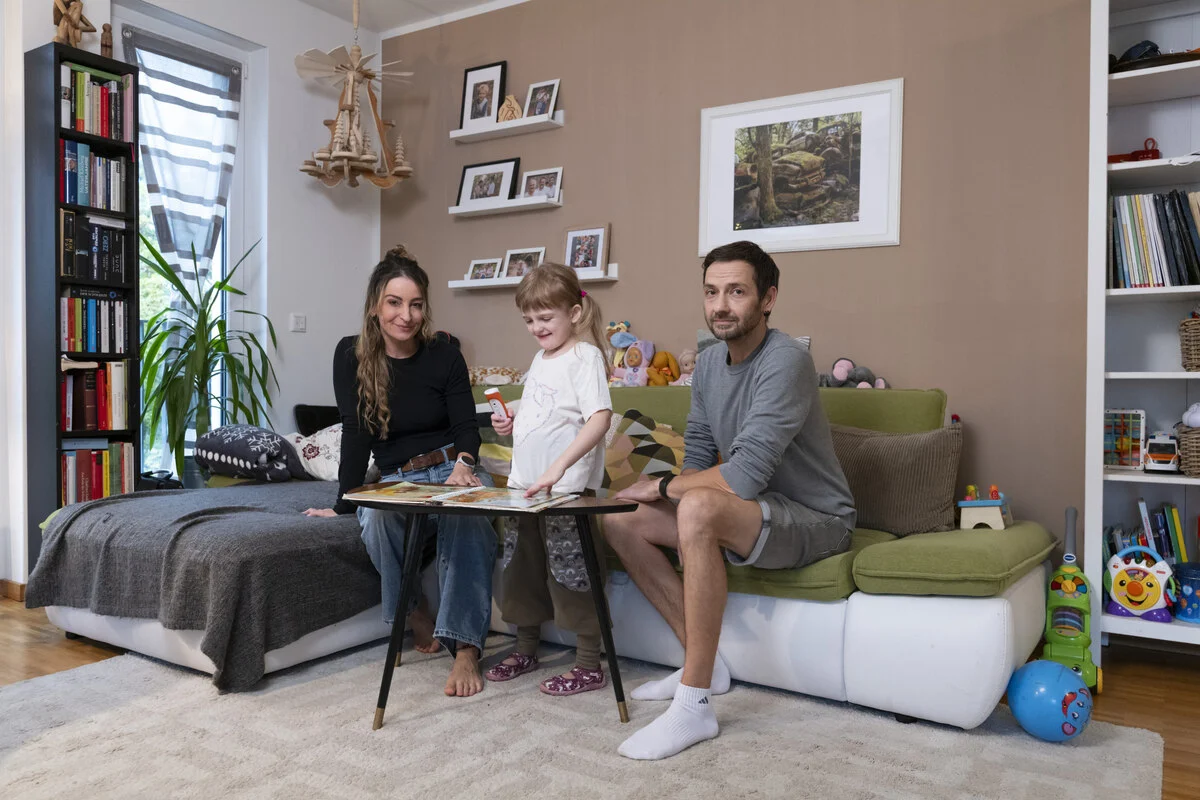
However, the constant care required by Caroline’s condition exacts a heavy toll. Constanze Rethberg’s sleep tracker reveals the stark reality of their nights: 6.38 hours of sleep recorded, despite spending over ten hours in bed with Caroline. "That was one of the worse nights," she admits. Caroline suffers from a severe sleep disorder, necessitating that one parent always sleeps beside her to provide comfort and reassurance when she wakes. This chronic sleep deprivation is particularly challenging for Constanze, who works demanding hospital shifts as an assistant physician. André Arnold acknowledges the relentless nature of their lives: "A situation like now, where we sit on the sofa for a photo and watch Caroline play, doesn’t exist in our daily lives." Their routine is a meticulously choreographed dance of responsibilities, reliant on both parents being physically and mentally "fit" to manage Caroline’s needs and those of their ten-year-old son, Caspar, who also deserves their attention for school and homework. Caroline’s inability to assess danger means her parents are in a perpetual state of alert, a constant vigilance that defines their every waking hour.
Supporting Data: The Orphan Disease Dilemma and the Promise of Gene Therapy
PUS3 syndrome is an exemplar of an "orphan disease"—a term used for rare conditions that affect a small percentage of the population, often rendering them commercially unattractive for pharmaceutical companies to research and develop treatments. With only about a dozen diagnosed cases worldwide known to the PUS3-Foundation, Caroline’s condition is not just rare, but ultra-rare. This scarcity of patients directly correlates with a scarcity of scientific literature, clinical expertise, and crucially, funding for therapeutic development.
The syndrome itself is triggered by a specific gene mutation in the Pseudouridine Synthase 3 gene. Genes carry the instructions for making proteins, which are the building blocks and functional machinery of our cells. A mutation in this gene can disrupt the normal production or function of the PUS3 enzyme, leading to a cascade of cellular dysfunctions that manifest in the diverse range of symptoms seen in affected individuals. These symptoms can include developmental delays, intellectual disability, epilepsy, and various physical anomalies, such as the kidney malformation Caroline experiences, which predisposes her to urinary tract infections.
The "orphan drug" concept was introduced to incentivize pharmaceutical companies to develop treatments for these neglected diseases, often through tax breaks, market exclusivity, and research grants. However, for ultra-rare conditions like PUS3 syndrome, the patient pool remains so small that even these incentives are often insufficient to justify the enormous costs associated with drug discovery and clinical trials. This economic reality leaves families like the Arnolds and Rethbergs in a dire situation, dependent on the goodwill of academic researchers, philanthropic organizations, and their own grassroots efforts.

Globally, the landscape for rare diseases is improving, albeit slowly. Organizations like the PUS3-Foundation in Poland, where the majority of known cases are located, serve as vital hubs for patient advocacy, information sharing, and research coordination. The collaboration between these smaller patient groups and specialized research foundations, such as the Gene2Cure-Foundation in the USA, represents a promising model for advancing treatments for conditions that might otherwise be ignored. Gene2Cure, as its name suggests, focuses specifically on developing therapies for extremely rare genetic disorders, understanding that traditional pharmaceutical pipelines are ill-equipped to address these unique challenges.
The potential for gene therapy offers a glimmer of hope. Gene therapy aims to correct genetic defects at their source by introducing a healthy copy of a gene, editing faulty genes, or regulating gene expression. For conditions caused by a single gene mutation, like PUS3 syndrome, gene therapy holds significant promise, as it directly targets the underlying cause of the disease rather than just managing its symptoms. However, developing such therapies is a complex and expensive endeavor, requiring sophisticated scientific expertise, rigorous safety testing, and substantial financial investment. The path from laboratory discovery to a clinically approved treatment is long and arduous, typically spanning many years and hundreds of millions of dollars. For ultra-rare diseases, this journey is even more challenging due to the limited number of patients available for clinical trials, making statistical validation difficult.
Official Responses: Caregiving, Policy, and the Fight for Recognition
Caroline’s complex needs necessitate a comprehensive support system. She relies on a range of assistive devices and medical interventions, including special leg splints to prevent ankle instability due to weaker muscles, corrective eyeglasses, and multiple daily medications. To aid her communication, a speech computer is essential, alongside emergency medications for seizures, diapers, a baby monitor for constant supervision, and urine test strips to monitor her kidney health.
André Arnold acknowledges that many of these expenses are currently covered, thanks to Germany’s system of long-term care insurance and the associated "Pflegegrade" (care grades) which determine the level of support an individual receives based on their needs. This system is designed to alleviate some of the financial burden on families caring for individuals with significant disabilities. However, this relief comes with a looming sense of precariousness. "But we don’t know how long the political system will continue to support this," Arnold states, expressing a deep-seated anxiety shared by many families reliant on public provisions.

His concerns are not unfounded, touching upon a broader political climate in Germany where the sustainability and scope of social welfare programs are frequently debated. Arnold points to the rise of populist parties like the AfD, whose rhetoric often includes a critical stance towards social spending and disability rights, as well as mainstream parties like the CDU, whose Chancellor has reportedly questioned the necessity of one-to-one care for children with disabilities. Such political discourse directly impacts families like his, who depend on these services for their daily survival and Caroline’s well-being.
Constanze Rethberg extends this critique to the often-overlooked plight of the caregivers themselves. "People with disabilities have the right to compensation for disadvantages, but what about those who stand behind them?" she asks, highlighting a critical gap in policy. She argues that parents and primary caregivers of individuals with profound disabilities, who often function as full-time nurses, therapists, and advocates, should be afforded the right to work fewer hours with adequate compensation. This would acknowledge the immense, unpaid labor they perform and mitigate the professional and financial sacrifices they are forced to make. As an assistant physician working shifts, Rethberg personally experiences the pressure to explain why she cannot take on additional hours or shifts, a constant reminder of the societal expectation that often fails to recognize the unique demands of their caregiving roles. This advocacy for caregivers’ rights underscores a vital aspect of disability policy: supporting the support system.
In response to the systemic neglect of ultra-rare diseases by the pharmaceutical industry, Constanze and André took decisive action. In the spring, they established the association "kleine Gene, große Hoffnung" (Small Genes, Great Hope). This grassroots organization serves a dual purpose: to raise awareness for those affected by PUS3 syndrome and, more crucially, to actively drive the development of a therapeutic solution. They have strategically partnered with the PUS3-Foundation in Poland, leveraging the larger concentration of diagnosed cases there to build a more robust research cohort and collective voice. This collaboration extends across continents, involving the Gene2Cure-Foundation in the United States, an organization specifically dedicated to pioneering therapies for extremely rare conditions.
Their ambitious plan is to develop a therapy that directly addresses the genetic root cause of PUS3 syndrome. Such a gene-based intervention could potentially alter the course of the disease, offering hope for significant improvement in Caroline’s and other affected children’s lives. André Arnold proudly states that the initiative is fully funded until the end of 2026, a testament to their initial success in securing crucial resources. However, the continuation of this groundbreaking research beyond that point is entirely dependent on sustained donations. This underscores the precarious financial model for rare disease research, often relying on the generosity of individuals and philanthropic organizations rather than the substantial budgets of large pharmaceutical corporations.

Implications: A Future Forged by Hope and Unconditional Love
The vision for a gene-based therapy is ambitious, with an optimistic timeline projecting the first human trials potentially commencing in 2029. This prospect, while distant, represents a tangible goal that fuels the parents’ relentless efforts. Yet, they approach this future with a measured realism, tempered by years of navigating medical uncertainties. "We don’t have too much hope," André Arnold admits, reflecting the emotional fatigue that comes with chronic illness. However, this realism is immediately followed by an assertion of profound agency: "But to say we just sit back and do nothing was not an option for us." This sentiment encapsulates the essence of their journey: a refusal to surrender to fate, an active embrace of hope even in its most fragile form.
The implications of their endeavor extend far beyond Caroline. Their association, "kleine Gene, große Hoffnung," is a beacon for other families worldwide affected by PUS3 syndrome. By pooling resources, sharing knowledge, and actively commissioning research, they are setting a precedent for how patient advocacy groups can drive scientific progress for diseases that would otherwise remain in the shadows. Their work highlights the critical role of patient-led initiatives in the rare disease landscape, often filling the void left by larger, profit-driven entities.
Ultimately, Caroline’s story is a profound exploration of resilience, the extraordinary power of parental love, and the quiet joy found amidst immense challenges. As Caroline, headphones donned, sways gently to the music, her parents watch with a mixture of tenderness and unwavering devotion. "Life with Caroline is like being with a clumsy one-year-old who is just discovering the world," André Arnold observes, a smile gracing his lips. "That’s why we laugh a lot with her." Constanze Rethberg, in a statement that beautifully encapsulates their philosophy, summarizes their life: "We may have a different life, but we are no less happy."
This perspective offers a powerful counter-narrative to the often-pitying gaze directed at families facing such profound medical challenges. It underscores that happiness is not contingent on conventional pathways but can be forged anew through acceptance, adaptation, and an unwavering commitment to love. Caroline’s existence, while defined by a rare genetic mutation, is equally defined by the rich tapestry of experiences, the small triumphs, and the boundless affection that surrounds her. Her story, and that of her parents, is a potent reminder of the human spirit’s capacity to find light and meaning even in the most challenging corners of existence, and to fight relentlessly for a future where no rare disease goes unheard or unaddressed.