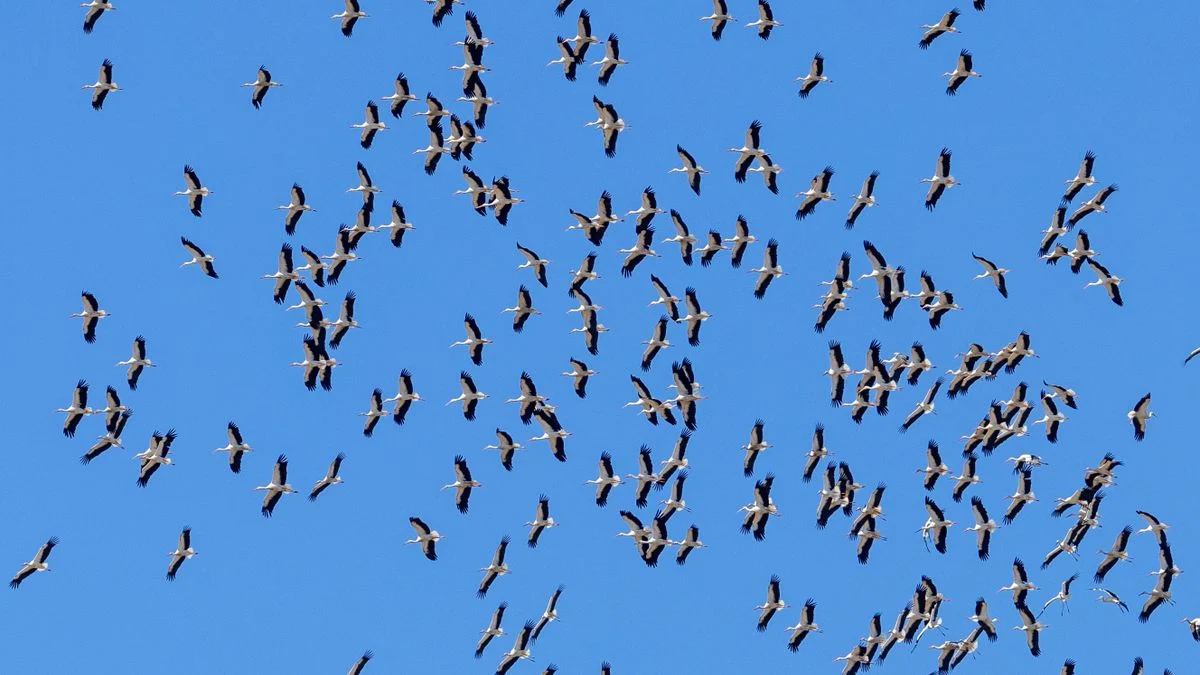
If you happen to hear a rhythmic, metallic clattering echoing from a rooftop or a nesting platform in your neighborhood this spring, you are likely witnessing one of Europe’s most successful conservation stories. Across Germany, the iconic white stork (Ciconia ciconia) is experiencing a population boom of historic proportions. According to the latest data from the Nature and Biodiversity Conservation Union (NABU), the country is bracing for a record-breaking nesting season, with estimates suggesting that up to 15,000 breeding pairs will settle across the nation—a figure unparalleled since modern record-keeping began.
The Magnitude of the Recovery: Breaking Records
The resurgence of the white stork is not merely a statistical anomaly; it is a monumental shift in the ecological landscape. For decades, the sight of a stork was becoming an increasingly rare luxury in many German regions. Today, that narrative has been rewritten.
"Even a century ago, we did not see as many storks as we are seeing today," says Bernd Petri, a leading expert from the NABU Federal Working Group for White Storks. Petri notes that the current population density represents a "good state of conservation," a stark contrast to the grim outlook that defined the late 20th century. While the species was once on the brink of regional extinction, it has now reclaimed its place as a cornerstone of the German countryside.
Chronology of a Crisis and Comeback
To understand the significance of today’s numbers, one must look back at the precipitous decline that nearly erased the species from the German map.
The Dark Days of the 1980s
In the 1980s, the white stork population in Germany had plummeted to fewer than 3,000 breeding pairs across both the East and the West. In vast swathes of the country, the familiar silhouettes of storks were completely absent. This decline was driven by a "perfect storm" of environmental pressures:
- Agricultural Intensification: The rapid modernization of farming practices led to the widespread use of pesticides and the removal of hedgerows, severely depleting the stork’s primary food sources, such as insects and small rodents.
- Habitat Loss: The systemic drainage of wetlands and moors destroyed the foraging grounds essential for raising healthy broods.
- Migration Hazards: Storks faced unprecedented dangers along their traditional migration routes, including illegal hunting and environmental hazards in their wintering grounds.
The Turning Point
Beginning in the 1990s and accelerating into the 21st century, concerted conservation efforts—ranging from wetland restoration to the protection of migration corridors—began to bear fruit. However, experts like Petri emphasize that the storks themselves played an active role in their own salvation through behavioral adaptation.
Changing Routes: The Evolution of Migration
Perhaps the most fascinating aspect of the stork’s recovery is its shift in migratory behavior, which has fundamentally altered the demographic map of the species within Europe.
The "Migration Divide"
Germany serves as a natural "migration divide" (Zugscheide). Historically, the vast majority of German storks were "Eastern migrants," traversing the Balkans and the Middle East to reach their wintering grounds in sub-Saharan Africa. This journey was notoriously perilous, fraught with extreme weather and anthropogenic threats.
Today, however, the migration patterns have shifted significantly. "Thirty years ago, three-quarters of our storks were Eastern migrants," Petri explains. "Today, the ratio has reversed: three-quarters now migrate to the West."
The Spanish Connection
Instead of the arduous trek to Africa, the majority of Western-migrating storks now stop in Spain. This shorter route has drastically increased survival rates. In Spain, these birds have discovered a veritable "land of plenty." They have adapted to feed on the expansive rice fields and, notably, on large-scale municipal waste management sites. While reliance on human-provided food sources is a complex ecological issue, it has undoubtedly served as a safety net that has fueled the current population explosion.
As a result, the geographic center of the stork population in Germany has shifted, moving from the Elbe River region toward the Rhine.
Data and Distribution: Where the Storks Reside
White storks are currently breeding in all of Germany’s federal states, though some regions serve as clear hotspots.
- State-Level Leaders: In the most recent survey year, Lower Saxony recorded 2,737 breeding pairs, closely followed by Baden-Württemberg with 2,602.
- Density Hotspots: A healthy ecological density is generally defined as six to seven pairs per 100 square kilometers. However, some regions far exceed this. The district of Groß-Gerau in Hesse, for instance, boasts an incredible 90 pairs per 100 square kilometers. Other significant clusters are found in the regions of Middle Franconia and Upper Swabia.
Implications for Conservation and Society
The return of the white stork serves as a barometer for the health of Germany’s wetlands and meadows. However, the success also brings new questions regarding the management of these birds and the habitats they occupy.
The Anthropogenic Influence
The fact that storks are thriving in areas with high human activity—such as landfills or near intensified agricultural zones—suggests that they are highly resilient generalists. However, scientists caution that this is not a permanent solution. Relying on human-generated food waste could create future ecological traps if waste management practices change or if the nutritional quality of that food is insufficient for long-term health.
Lessons for Biodiversity
The "stork miracle" provides a vital lesson for other species conservation projects. It demonstrates that when landscape-scale restoration—such as re-wetting moors—is combined with the protection of migration paths, animal populations can recover with surprising speed. It also highlights the importance of "behavioral plasticity," where species adapt their migration or feeding habits to a rapidly changing, human-dominated world.
Conclusion: A Future for the "White Knight"
As we move through this decade, the white stork stands as a symbol of hope. It is a testament to the fact that, with the right combination of environmental policy, private conservation efforts, and natural adaptability, human-induced biodiversity loss can be reversed.
The clattering of storks on the rooftops of Germany is more than just a sound; it is a signal of a landscape that is healing. As the 15,000 pairs settle in to raise their young, they remind us that the natural world is not necessarily a fragile entity destined for decline, but a dynamic, resilient force—provided it is given the space and the resources to thrive. For now, Germany can celebrate a historic victory, as its most famous migratory visitor makes a home in its skies once again.