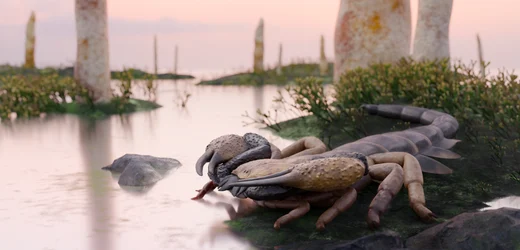
For hundreds of millions of years, the landscape of what is now England and Wales was defined not by the gentle rolling hills of the modern countryside, but by a primordial wilderness. Beneath the surface of these ancient environments lurked a predator of terrifying proportions—a creature so large it would dwarf a modern Labrador retriever. Recent scientific breakthroughs have finally settled a century-long debate, confirming that the fossilized remains of Praearcturus gigas belong to one of the largest scorpions ever to roam the Earth.
Published in the journal Palaeontology, a new study led by researcher Richard J. Howard has provided definitive evidence that this ancient arthropod was not merely a curiosity of the fossil record, but a dominant apex predator of the Silurian period, some 415 million years ago.
Main Facts: A Predator of Mythic Proportions
The physical statistics of Praearcturus gigas are nothing short of staggering. Analysis of the fossil fragments reveals that this creature reached a total body length of approximately one meter. Its most formidable feature, however, was its weaponry: massive, 16-centimeter-long pincers designed to crush the exoskeletons of its prey.
At a time when life on land was still in its infancy, Praearcturus stood as a titan. While the modern imagination often associates giant prehistoric arthropods with the gargantuan dragonflies or centipedes of the later Carboniferous period, Praearcturus predates these creatures by at least 55 million years. This places the scorpion in an era where terrestrial ecosystems were just beginning to take shape. Before the ancestors of reptiles, mammals, and birds had even begun to colonize the land, this scorpion reigned supreme, effectively filling an ecological niche that had no other significant competition.
Its diet was as opportunistic as its size was imposing. While it fed primarily on smaller arthropods, researchers believe that Praearcturus was versatile enough to hunt primitive fish and other large organisms that crossed its path. In a world with few predators, this giant was essentially the master of its domain.
A Century of Confusion: The "Giant Woodlouse" Mystery
The journey to identifying Praearcturus as a scorpion is a masterclass in the evolution of paleontological techniques. When the creature was first described in 1871 by the naturalist Henry Woodward, the scientific community was far from certain about its classification. Due to the fragmented nature of the remains, Woodward initially classified the animal as a giant, isopod-like crustacean—a classification that persists in its very name, as "Arcturus" refers to a group of living woodlice.
For over a century, the specimen languished in the annals of the Natural History Museum in London, misidentified and misunderstood. It wasn’t until the 1980s that a handful of daring paleontologists began to challenge the "giant isopod" narrative. They suspected that the anatomy of the fossils was more consistent with the Chelicerata subphylum, which includes modern scorpions and spiders.
However, proving this hypothesis proved remarkably difficult. The most diagnostic feature of a scorpion—the iconic, stinger-tipped tail—was conspicuously absent from the known fossil fragments. Without this "smoking gun," the classification remained a subject of fierce academic contention. It was not until 2015, when new, more complete fossil discoveries provided comparative data, that researchers were finally able to map the anatomy of Praearcturus onto the body plan of a scorpion, effectively ending 144 years of scientific uncertainty.
Chronology: From the Silurian to the Modern Laboratory
The timeline of Praearcturus provides a window into the rapid acceleration of life during the Silurian period.
- 415 Million Years Ago: The height of the Praearcturus era. At this point, life on land is sparse. There are no vertebrate predators of significant size, creating a "power vacuum" that the giant scorpion exploits to reach its maximum size.
- 1871: Henry Woodward formally names Praearcturus. The scientific consensus of the time classifies it as a crustacean.
- 1980s: The first academic murmurs emerge suggesting the creature might actually be an early scorpion, sparking decades of debate.
- 2015: A breakthrough. New fossils are discovered that share skeletal characteristics with the original Praearcturus fragments, providing the necessary morphological evidence to reclassify the animal.
- Present Day: Richard J. Howard’s team publishes the final word in Palaeontology, cementing the legacy of the beast as a giant scorpion rather than a misplaced isopod.
While the exact duration of the species’ survival remains a subject of ongoing investigation, fossil fragments suggest that the lineage may have persisted for roughly 40 million years. As terrestrial life became increasingly complex and competitive, the "easy" dominance enjoyed by Praearcturus eventually waned, likely giving way to more specialized predators.
Supporting Data: Why So Big?
The question of why Praearcturus reached such massive proportions is central to the research conducted by Howard and his team. In modern evolutionary biology, size is often a function of resource availability and the absence of predation.
"When people think of giant arthropods, they think of the Carboniferous—the era of giant dragonflies and millipedes," Howard noted in his assessment. "But those creatures lived when land ecosystems were already established. Praearcturus was different. It lived in a time when life on land was only just beginning. The ancestors of reptiles, mammals, and birds had not yet left the water. This suggests that the species grew so large simply because there were no other large predators to stop it."
The absence of vertebrate competitors allowed the scorpion to undergo what biologists call "ecological release." Without the need to compete with land-dwelling vertebrates for food or space, the scorpion was free to occupy the top of the food chain, growing as large as its physiological constraints would allow.
Official Responses and Scientific Implications
The staff at the Natural History Museum have hailed the reclassification as a triumph of modern analytical techniques. By leveraging comparative anatomy and new, higher-resolution imaging of the 19th-century specimens, researchers have been able to "see" the animal as it truly was.
The implications of this discovery are profound for the field of evolutionary biology. It forces a reassessment of how early terrestrial ecosystems functioned. If a one-meter-long predator was roaming the landscape 415 million years ago, the "struggle for existence" was far more intense in the early stages of colonization than previously theorized.
Furthermore, the case of Praearcturus serves as a poignant reminder of the limitations of the fossil record. For over a century, the scientific community operated under an incorrect assumption based on partial data. It was only through the patience of generations of researchers—and the willingness to discard outdated taxonomies—that the true identity of this prehistoric giant was revealed.
Conclusion: A Legacy Carved in Stone
The giant scorpion of England and Wales is more than just a footnote in a textbook; it is a testament to the strange, often brutal, and always fascinating history of life on Earth. Praearcturus gigas reminds us that the history of life is not a straight line, but a complex, often jagged path of adaptation and extinction.
As we continue to dig into the layers of the Earth, the story of this ancient predator suggests that we have only scratched the surface of what occurred during the dawn of terrestrial life. Whether as a misidentified woodlouse or a confirmed titan of the Silurian, Praearcturus remains a reminder that in the vast, deep time of our planet, the most terrifying monsters were once the reality of everyday life.