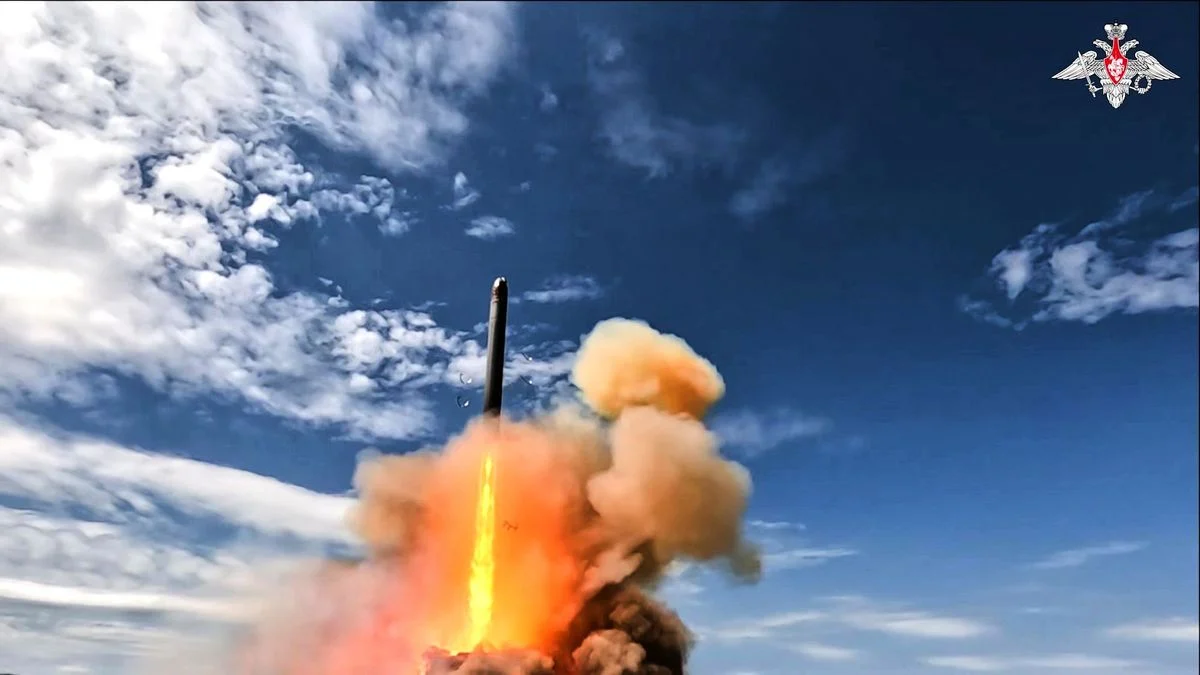
In a move that has sent tremors through the international security architecture, Russian President Vladimir Putin announced on Tuesday the successful test-firing of the RS-28 Sarmat, a heavy intercontinental ballistic missile (ICBM) that Moscow has spent years developing. Billed by the Kremlin as the "most powerful missile system in the world," the Sarmat represents a significant technological leap in Russia’s strategic nuclear arsenal, designed specifically to bypass modern missile defense shields and deliver a devastating payload across transcontinental distances.
The Announcement and Technical Specifications
Addressing his military leadership following the successful launch, President Putin struck a defiant tone, emphasizing the missile’s unprecedented capabilities. "This truly unique weapon will strengthen the combat potential of our armed forces, reliably ensure Russia’s security from external threats, and provide food for thought for those who, in the heat of aggressive rhetoric, try to threaten our country," Putin stated.
The technical specifications cited by the Russian Ministry of Defense are formidable. According to official Kremlin data, the Sarmat is capable of carrying a payload significantly heavier than any existing Western system, effectively allowing it to transport multiple independently targetable reentry vehicles (MIRVs) or hypersonic glide vehicles. Perhaps most alarming to Western analysts is the reported range. While standard ICBMs typically operate within a range of 10,000 to 12,000 kilometers, Russian officials claim the Sarmat boasts a range of 35,000 kilometers, theoretically allowing it to strike targets by flying over the South Pole, thereby circumventing the northern-facing early warning radars used by the United States and its NATO allies.
The President confirmed that the system is expected to be fully operational and integrated into the Russian Strategic Missile Forces "by the end of the year," signaling an accelerated timeline for deployment.
A Chronology of Development: From Concept to "Satan II"
The journey of the Sarmat has been long and marked by significant geopolitical shifts. The project, which Western intelligence agencies dubbed "Satan II," traces its origins back to the early 2010s, when Russia initiated a massive modernization program to replace its aging fleet of Soviet-era R-36M (NATO reporting name: SS-18 Satan) missiles.
- 2011–2014: Initial design contracts were awarded to the Makeyev Rocket Design Bureau. The goal was to create a "supersize" liquid-fueled ICBM capable of overcoming the advanced Missile Defense (MD) systems being deployed by the United States in Eastern Europe and Alaska.
- 2016: The first images of the Sarmat prototype were released to the public, showcasing its massive frame.
- 2018: During his annual address to the Federal Assembly, Vladimir Putin unveiled a series of "invincible" weapons, with the Sarmat taking center stage. He demonstrated the missile’s capability to reach any target globally, underscoring its role in Russia’s new nuclear deterrent doctrine.
- 2020–2021: A series of pop-up tests were conducted to evaluate the missile’s ejection mechanism from its silo.
- 2022: The successful full-scale flight test on Tuesday marks the culmination of these efforts, transitioning the program from the developmental phase to the production and deployment stage.
Supporting Data: Why "Supersize" Matters
The classification of the Sarmat as a "supersize" or "heavy" ICBM is a technical distinction with profound strategic implications. Unlike lighter, solid-fueled missiles like the American Minuteman III, the Sarmat uses liquid fuel, which allows it to carry a much heavier payload—up to 10 tons of nuclear warheads.
Technical Advantages
- MIRV Capability: The missile can carry up to 10–15 heavy warheads or a mix of warheads and decoys. This makes the task of interception mathematically improbable for any current defense system, as each individual warhead must be tracked and destroyed separately.
- Hypersonic Integration: The Sarmat is designed to be compatible with the Avangard hypersonic glide vehicle. These vehicles can travel at speeds exceeding Mach 20 and execute unpredictable maneuvers, rendering static ballistic missile interceptors ineffective.
- Shortened Boost Phase: By optimizing the propulsion system, Russian engineers have reduced the "boost phase"—the time it takes for the missile to clear the atmosphere and accelerate. This is the period when an ICBM is most vulnerable to infrared detection; a shorter boost phase makes it significantly harder for the US Space-Based Infrared System (SBIRS) to lock onto the missile.
Official Responses and Global Reaction
The international reaction to the Sarmat test has been characterized by caution and strategic concern. While the Kremlin presents the missile as a defensive necessity, the West views it as a provocative escalation.
The Pentagon, in its immediate response, downplayed the surprise element of the test. A spokesperson for the Department of Defense stated that the launch was "routine" and "not a threat to the United States or its allies." US intelligence officials have been tracking the Sarmat’s development for years and noted that the test was conducted in accordance with the New START treaty, which requires notification of major ballistic missile tests.
However, behind the scenes, analysts express deep concern. The sentiment among European defense experts is that the Sarmat is not merely a replacement for old technology, but a tool for "nuclear signaling." By demonstrating the ability to strike any point on the globe, Russia is attempting to force the West to the negotiating table regarding security guarantees in Eastern Europe.
Implications for Global Security
The successful deployment of the Sarmat signals a transition in the global nuclear order. We are moving away from the post-Cold War era of nuclear arms reduction and into an era of "Renewed Deterrence."
The Erosion of Stability
The Sarmat’s ability to bypass traditional missile defenses undermines the logic of "Mutually Assured Destruction" (MAD). If one side believes it has developed a weapon that can neutralize the other’s retaliatory capability, the temptation to launch a preemptive strike or to act with greater aggression in conventional conflicts increases.
Impact on Arms Control
The introduction of the Sarmat complicates future arms control negotiations. With the United States currently looking to modernize its own nuclear triad and Russia prioritizing heavy, high-yield systems, the prospect of a new arms race is becoming increasingly tangible. The Sarmat test effectively serves as a bargaining chip for Moscow, placing pressure on Western governments to reconsider the deployment of missile defense systems in Europe, which Russia has long argued are directed at its own deterrent capability.
A Signal of Strategic Autonomy
For Russia, the Sarmat is a matter of national prestige. It proves that despite sanctions and economic isolation, the Russian military-industrial complex remains capable of producing world-class strategic weaponry. It reinforces Putin’s domestic narrative that Russia is a "besieged fortress" that must rely on its own military strength to survive in a hostile international environment.
Conclusion: The Shadow of "Satan II"
The RS-28 Sarmat is more than just a missile; it is a symbol of a shifting geopolitical landscape. As the world watches to see how this weapon will be integrated into Russia’s operational forces, one thing remains clear: the era of nuclear ambiguity has returned. The technical prowess displayed in this test serves as a stark reminder that the fundamental mechanisms of the Cold War—power projection, deterrence, and the constant threat of total destruction—remain the primary drivers of international statecraft in the 21st century.
As the "Satan II" moves toward full deployment, the diplomatic challenges facing the global community will only intensify. The coming year will be a critical test of whether the existing framework of international arms control can withstand the pressure of this new, more lethal, and more technologically sophisticated nuclear reality. Whether or not this missile will ultimately serve to prevent conflict or accelerate the slide toward a more volatile future remains the central question of modern security policy.