

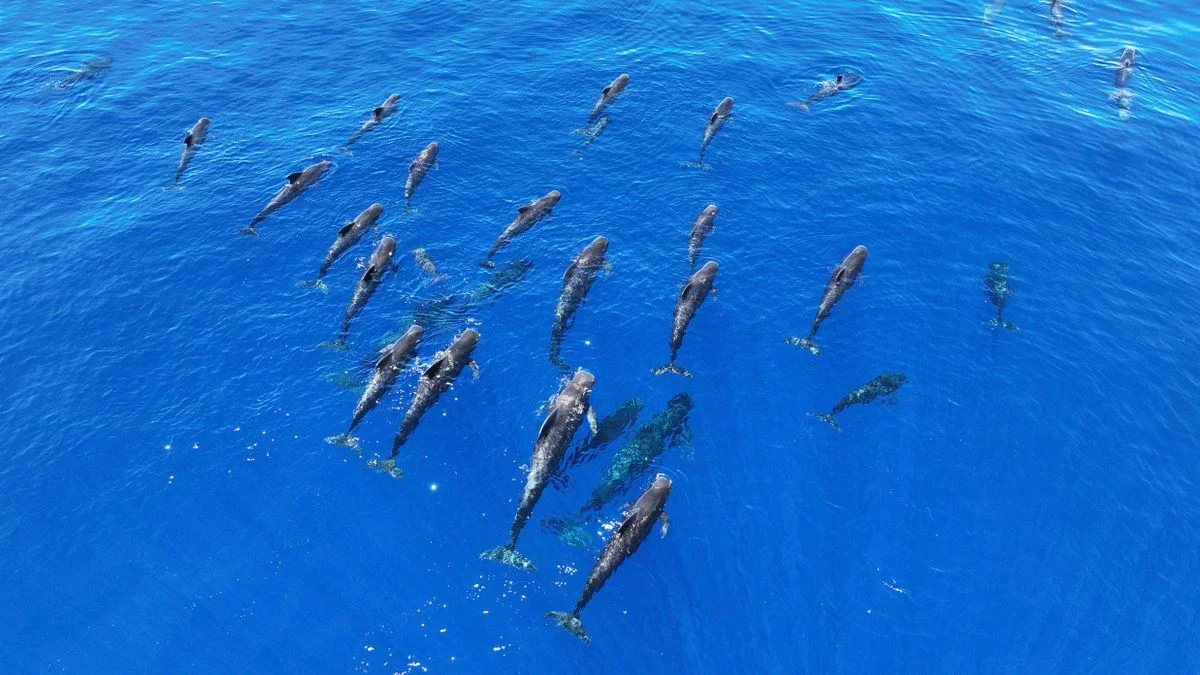
The Strait of Gibraltar, a narrow maritime artery separating the Iberian Peninsula from North Africa, serves as one of the most vital—and congested—shipping lanes on the planet. Every year, over 60,000 massive vessels traverse these waters, moving goods between the Atlantic and the Mediterranean. Yet, beneath the churning wakes of container ships and oil tankers, a silent, acoustic crisis is unfolding. A population of long-finned pilot whales (Globicephala melas)—numbering only 250 individuals—is struggling to maintain social cohesion, hunt, and nurture their young amidst a cacophony of man-made noise.
New research published in the Journal of Experimental Biology reveals that these highly social marine mammals are being forced to alter their vocal behavior to be heard above the roar of ship engines. In a fight for survival, the whales are attempting to "shout" over the industrial din, yet scientists warn that this biological compensation has critical limits.
The Chronology of an Acoustic Study
The data driving these findings stems from an ambitious international research project conducted between 2012 and 2015. Led by Milou Hegeman and Frants Jensen from Aarhus University in Denmark, the team sought to quantify the daily struggle of the Gibraltar pilot whale population.
The methodology required an intimate look at the whales’ lives. Over the three-year period, the researchers utilized specialized suction-cup acoustic recording tags (DTAGs) attached to the backs of 23 pilot whales. These high-tech devices acted as "black boxes" for the marine mammals, recording their vocalizations, the ambient noise level of the ocean, the depth at which the whales were swimming, and their precise physical movements.
After 24 hours of data collection, the tags were designed to release automatically and float to the surface for retrieval. This approach allowed the scientists to observe the animals in their natural habitat without the distorting influence of a research vessel trailing them too closely, providing a rare and unfiltered glimpse into the acoustic environment of the Strait.
Supporting Data: Living Inside a Vacuum Cleaner
Back in the laboratory, the research team faced the daunting task of processing 1,432 individual whale calls, cross-referencing them with the varying levels of background noise recorded by the tags. The results were startling. The ambient noise in the Strait fluctuated between 79 and 144 decibels.
To put this into perspective, the authors of the study compared the acoustic environment to a spectrum ranging from a bustling, noisy restaurant to the relentless, high-decibel roar of a household vacuum cleaner. For a creature that relies on sound for navigation and communication, the Strait of Gibraltar has become an acoustic minefield.
The analysis revealed that when the ambient noise spiked, the pilot whales responded by increasing the amplitude of their vocalizations. This "Lombard effect"—the involuntary tendency of animals to increase their vocal effort in loud environments—was most pronounced in high-frequency calls and short, pulsed signals. These specific sounds are generally used by the pods for short-range communication, such as keeping a mother and calf in contact during a dive. By slightly increasing their volume, the whales were able to maintain some level of auditory clarity within the immediate vicinity of their group.
The Limits of Vocal Adaptation
However, the study highlights a harrowing biological reality: the whales’ ability to adapt has a breaking point. While the animals could successfully "shout" to compensate for certain types of calls, they reached a physical ceiling for others.
Low-frequency calls and complex, multi-component vocalizations—which are crucial for long-distance coordination and reuniting separated members of the pod—showed no increase in amplitude. It appears that the pilot whales are already producing these sounds at the maximum power their biology allows.
"Increasing volume is not a universal solution," explains Frants Jensen. "When the whales reach their physiological limit, they simply cannot get any louder. In those instances, the ship noise effectively masks their signals entirely."
This failure to compensate for long-distance communication is particularly devastating for a species that relies on social cohesion. When a group of whales scatters during a hunting expedition, these low-frequency, long-range calls are the "acoustic glue" that allows them to find one another again. When that glue is drowned out by the constant hum of a 300-meter cargo ship, the social fabric of the pod begins to fray.
Implications for Marine Conservation
The implications for the 250-strong pilot whale population are severe. "Increasing noise levels reduce the effective communication range, making it significantly harder for widely dispersed animals to find each other," Jensen notes.
The consequences of this isolation go beyond mere social frustration. If individuals cannot locate their pod, they are more susceptible to predators, less efficient at collaborative hunting, and may experience heightened stress levels that impact reproductive success. In a population already limited to a few hundred individuals, the cumulative impact of this chronic acoustic interference could lead to a long-term decline in the group’s viability.
The researchers emphasize that the Strait of Gibraltar is not just a shipping lane; it is a critical habitat. The current level of noise pollution is not a temporary nuisance but a constant, pervasive environmental pressure. The study serves as a scientific wake-up call to regulators, shipping companies, and international maritime organizations.
The Call for Action: Quieting the Seas
The scientific community is now calling for a shift in maritime policy. Protecting the pilot whales of Gibraltar requires more than just local awareness; it demands global changes in ship design and traffic management.
Potential Mitigation Strategies:
- Speed Restrictions: Slower ships create significantly less cavitation noise from propellers. Implementing mandatory speed reduction zones (often called "Slow Steaming" areas) in critical whale habitats has been proven to lower ambient noise levels drastically.
- Technological Innovation: Investing in quieter hull and propeller designs for the next generation of commercial vessels could mitigate the problem at the source.
- Dynamic Traffic Management: Using real-time monitoring to detect whale presence and rerouting ship traffic accordingly could provide the animals with necessary "acoustic refuges."
The plight of the Gibraltar pilot whales is a microcosm of a broader issue affecting oceans worldwide. As global trade continues to expand, the acoustic footprint of humanity is spreading into the deepest corners of the sea. For the whales, the choice is clear: either the maritime industry must commit to a quieter future, or these highly intelligent, social creatures may find themselves silenced by the very machines that define our modern global economy.
In the final analysis, the researchers hope that by quantifying the "shout" of the pilot whale, they have provided the necessary evidence for policymakers to act. The ocean is not silent, but if we do not manage our noise, we risk turning it into a place where the most important messages—the calls that hold families together and ensure survival—can no longer be heard.






















Leave a Reply