


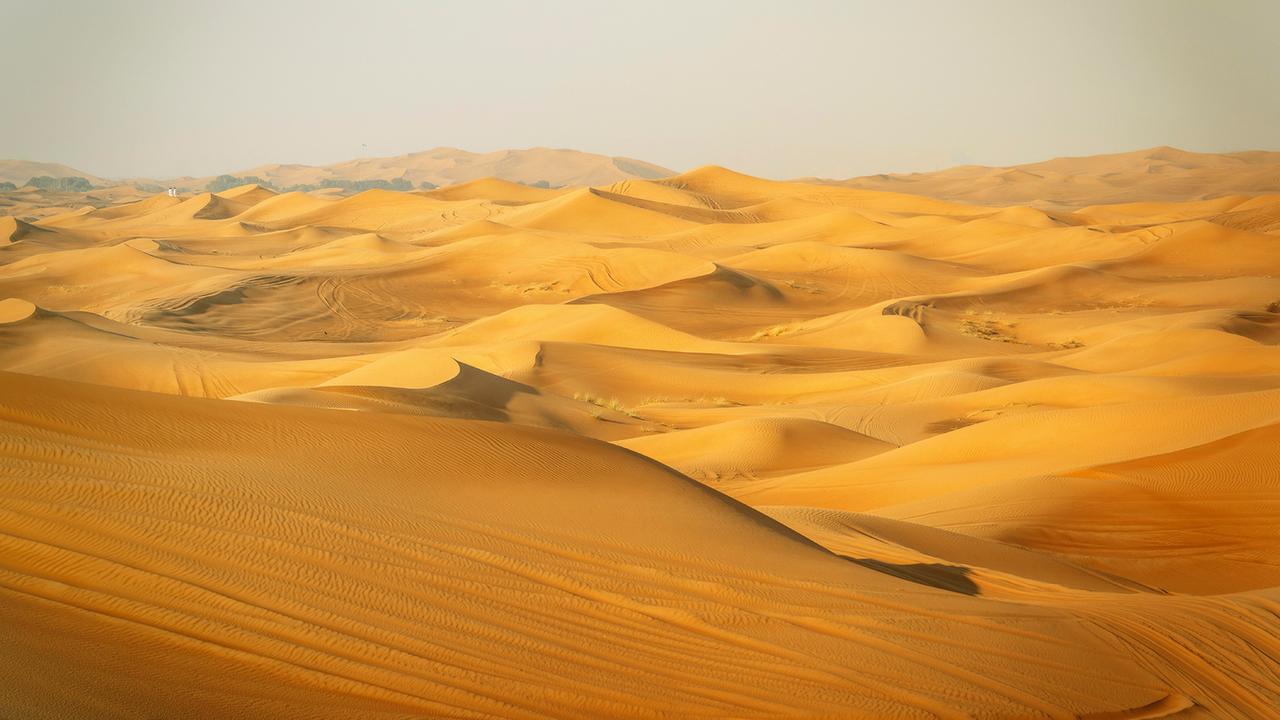
In a groundbreaking attempt to combat water scarcity, researchers from the University of Hohenheim are developing a radical strategy for the United Arab Emirates: transforming the desert landscape into a rain-generating engine using solar parks, artificial dunes, and strategic vegetation.
The United Arab Emirates (UAE) faces an existential challenge: the scarcity of fresh water. With annual rainfall hovering around a mere 100 liters per square meter in coastal regions—compared to 600 liters in Berlin or 1,000 liters in Munich—the nation has historically relied on energy-intensive seawater desalination plants to sustain its population. Now, however, a team of German meteorologists is proposing a paradigm shift that could fundamentally alter the region’s microclimate.
The Core Concept: Engineering a ‘Heat Bubble’
The project, spearheaded by meteorologist Oliver Branch of the University of Hohenheim, leverages the massive expansion of solar infrastructure already underway in the Gulf region. The core hypothesis is as much about meteorology as it is about energy production: by strategically increasing the size and density of solar parks, researchers believe they can manipulate local atmospheric conditions to trigger rainfall.
"We want to determine if doubling the size of these solar parks can generate significant precipitation," explains Branch. "The mechanism is based on the ‘heat bubble’ effect. By covering large swaths of the desert floor with solar panels, we alter the surface albedo—the reflectivity of the ground. This darkens the surface, causing it to absorb significantly more solar radiation, which in turn heats the air above it."
The Mechanics of Artificial Rainfall
This localized heating creates a thermal updraft. As the "heat bubble" rises, it carries air upward into higher, cooler layers of the atmosphere. If this rising air contains sufficient moisture—drawn in from the nearby sea—it reaches a saturation point, triggering condensation. This process, if successfully scaled, could lead to the formation of clouds and, ultimately, rainfall.
Because the process relies on the intake of maritime moisture, the research team is focusing its efforts on coastal zones. By creating a temperature gradient between the hot, dark solar surfaces and the cooler, moisture-laden sea breeze, the researchers hope to optimize the "conveyor belt" of air that brings clouds inland.
Chronology: From Theoretical Physics to Practical Implementation
The path to this ambitious project has been defined by years of incremental scientific discovery.
- 2015: Professor Volker Wulfmeyer, head of the Institute of Physics and Meteorology at the University of Hohenheim, begins initial studies into the feasibility of anthropogenic rainfall generation in the Arabian Peninsula.
- 2023-2024: The UAE increases its commitment to scientific research, offering prestigious grants and international collaborations through initiatives like the UAE Research Program for Rain Enhancement Science.
- May 2026: Oliver Branch and his team are awarded funding to launch a multi-year, large-scale investigation. The project is officially set on a trajectory to develop a working prototype by 2030.
- 2027-2029 (Projected): The research team plans to deploy advanced laser-based atmospheric sensing equipment to map moisture, temperature, and aerosol movement in real-time.
- 2030 (Goal): Completion of a pilot project that serves as a proof-of-concept for the integrated solar-dune-vegetation model.
Supporting Data and Integrated Strategies
The project is not relying solely on solar panels. The researchers have proposed a holistic "desert-greening" approach that combines solar infrastructure with biological and geological interventions.
The Role of Vegetation and Topography
Branch notes that solar parks are not the only surfaces capable of creating these thermal updrafts. "We have measured the surface temperature above Jojoba plantations in Israel and observed that they were four degrees warmer than the surrounding sand," he explains. By integrating green belts into the solar park design, the researchers aim to create a synergistic effect where plants contribute to the thermal uplift while simultaneously stabilizing the soil and reducing dust—which can often interfere with solar panel efficiency.
Furthermore, the team is investigating the use of artificial dunes. These landforms act as physical barriers that force air currents upward—a phenomenon known as "orographic lift." By sculpting the landscape, the researchers intend to force moist air to higher altitudes, increasing the probability of cloud formation in areas where the atmosphere might otherwise remain stagnant.
Technological Monitoring
To validate these models, the team will utilize state-of-the-art Light Detection and Ranging (LiDAR) technology. These laser systems can detect individual molecules in the air, allowing researchers to measure humidity and temperature profiles with unprecedented precision. This data will feed into a high-fidelity computer model, allowing the team to simulate thousands of scenarios—varying the size, placement, and composition of the solar-dune complexes—before a single cubic meter of sand is moved.
Official Responses and Independent Analysis
The project has garnered significant interest, yet it remains subject to rigorous scientific scrutiny. While the concept of "cloud seeding" or weather modification is not new, using passive infrastructure like solar panels to change regional climates is a frontier in meteorology.
Axel Seifert, a meteorologist at the German Weather Service (DWD) who is not involved in the project, acknowledges the ingenuity of the proposal but maintains a degree of caution. "It is an interesting conceptual approach," Seifert states. "However, the scalability is highly uncertain. Even if it works in one specific location in the Emirates, that does not mean the same physics can be applied to other arid regions like Namibia or Australia. Every site requires a unique, site-specific investigation."
Seifert emphasizes that the complexity of atmospheric systems means that changing the landscape in one area could have unforeseen, perhaps detrimental, effects on surrounding regions. Nevertheless, he advocates for the research, noting that the global trend toward massive solar farms is inevitable. "We will be building these massive solar parks anyway," he adds. "Understanding how they influence wind, temperature, and moisture is essential climate science, regardless of the ultimate success of the rain-generation goal."
Implications for Global Water Security
If the Hohenheim team succeeds, the implications would extend far beyond the UAE. Nations across the "Sun Belt"—the arid regions spanning North Africa, the Middle East, and parts of the Americas—are currently facing the dual threats of climate change-induced desertification and water stress.
A Model for Arid Nations
The UAE’s goal of having a working prototype by 2030 represents a significant commitment to "actionable science." Unlike many academic projects that remain theoretical, this study is designed for deployment. Should the team prove that solar arrays can act as a rain-generation catalyst, it would turn solar energy projects from simple power plants into multi-purpose infrastructure that addresses energy, water, and food security simultaneously.
The Risks of "Geo-Engineering"
The project also raises important ethical and environmental questions. Modifying the weather, even on a local scale, is a form of geo-engineering. Critics argue that interfering with atmospheric cycles could disrupt established rainfall patterns elsewhere. The researchers are keenly aware of these concerns, and their computer modeling phase is specifically designed to assess potential regional disruptions.
Conclusion: A Bold Step into the Future
The researchers remain optimistic, fueled by the tangible support of their hosts. "It is incredibly exciting that this isn’t just theory for an office," says Branch. "We are working toward a real-world demonstration."
Professor Wulfmeyer, who has been researching this field for over a decade, believes the technical threshold is within reach. "We are not far away from achieving the surface areas required to trigger precipitation," he asserts.
While the concept remains speculative and high-risk, it is a testament to the modern scientific spirit. As Axel Seifert concludes, "Research is allowed to be speculative, and it is allowed to be risky. That is how we advance." Whether the sands of the Emirates will one day be transformed by clouds born from solar panels remains to be seen, but the pursuit of this "sensation" may well hold the key to the next century of desert survival.









Leave a Reply