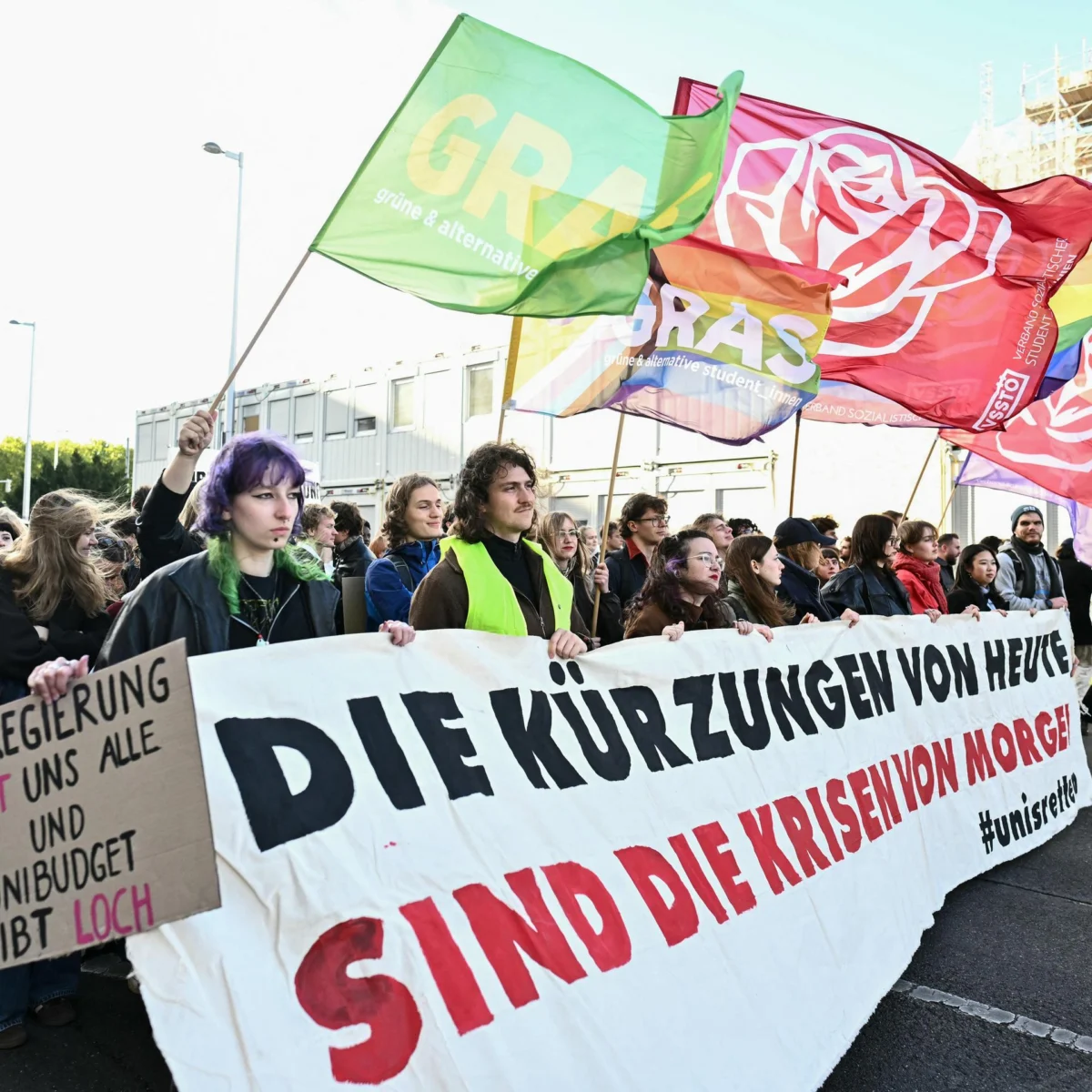
VIENNA, Austria – October 23, 2026 – Austria’s streets became a vibrant canvas of dissent today as tens of thousands of students, supported by university faculty and staff, staged nationwide protests against what they deem a critically insufficient funding proposal for the country’s higher education institutions. The demonstrations, spearheaded in the capital Vienna, signal a deepening crisis in the academic sector, with university rectors warning of impending job cuts, reduced academic offerings, and a severe blow to Austria’s long-term research and innovation capabilities.
The immediate catalyst for the widespread outrage was the government’s announcement over the past weekend of a financial framework allocating €16 billion to the nation’s 23 public universities for the fiscal years 2028 to 2030. This figure falls critically short of the €18 billion minimum that university rectors assert is necessary to merely offset projected inflation and rising operational costs, igniting fears that the proposed budget will cripple the quality and accessibility of higher education in the alpine republic.
In Vienna alone, organizers estimated that at least 40,000 individuals participated in the protest, a figure that police placed closer to 20,000. Regardless of the exact count, the sheer scale of mobilization underscored the profound concern permeating the academic community. Protesters carried banners articulating their anxieties, with one particularly poignant message reading: "Die Kürzungen von heute sind die Krisen von morgen" – "Today’s cuts are tomorrow’s crises" – encapsulating the sentiment that current austerity measures could have devastating and irreversible long-term consequences for Austria’s intellectual future.
The Spark of Discontent: A Chronology of Escalation
The current wave of protests did not emerge in a vacuum but rather represents the culmination of escalating tensions between the government and the higher education sector. For months, university rectors and student representatives have voiced growing concerns about the sustainability of Austria’s university system in the face of rising costs and what they perceive as chronic underfunding.
The Weekend’s Announcement: A Breaking Point
The decisive moment arrived over the past weekend with the government’s official unveiling of the proposed €16 billion budget for the 2028-2030 period. While presented by government officials as a significant investment in education, the figure was immediately met with dismay by university leadership. The gap between the allocated sum and the universities’ meticulously calculated needs of €18 billion was perceived not merely as a minor shortfall but as a deliberate and dangerous underestimation of the challenges facing the sector. This announcement, rather than offering reassurance, solidified fears that the government was not adequately prepared to address the structural financial issues plaguing higher education.
Rectors’ Early Warnings and Persistent Advocacy
Prior to the official budget announcement, the Austrian Rectors’ Conference had engaged in extensive consultations and public advocacy, repeatedly outlining the dire financial straits of universities. They highlighted the increasing strain of energy costs, the necessity for competitive salaries to retain top talent, and the urgent need for investment in modern research infrastructure and digital learning technologies. Their demand for €18 billion was not an arbitrary figure but one derived from detailed projections of inflation rates, salary adjustments, and essential operational expenditures over the three-year period. These warnings, however, appear to have gone unheeded in the final budget proposal, leading to a palpable sense of frustration and betrayal within university administrations.
Student Mobilization: A Rapid Response
The student community, long attuned to the financial struggles of their institutions, reacted swiftly to the budget news. Utilizing social media platforms, university mailing lists, and established student union networks, a broad coalition of student bodies, academic staff associations, and civil society groups rapidly mobilized. The call to action resonated deeply with students who fear that funding cuts will directly impact their educational experience, leading to overcrowded lectures, fewer specialized courses, and potentially longer study durations due to reduced resources. The speed and effectiveness of this mobilization underscored the deep-seated concern among those who stand to be most directly affected by the proposed cuts.
The Day of Protest: October 23, 2026
By the morning of October 23, 2026, the stage was set for a powerful display of collective discontent. In Vienna, thousands began to gather at key points, converging on major arteries and public squares. The atmosphere was charged with a mixture of anger, determination, and a hopeful sense of solidarity. Students carried homemade signs, chanted slogans emphasizing the value of education, and engaged in passionate discussions about the future of their universities.
The central march in Vienna saw a diverse crowd – from first-year undergraduates to seasoned professors – winding through the city’s historic streets. The air buzzed with the sound of megaphones amplifying speeches from student leaders and rectors, articulating the collective demand for a fully funded higher education system. While the police and organizers differed on the exact number of participants, the visual impact of the sprawling demonstration left no doubt about the widespread dissatisfaction. Similar, albeit smaller, protests and solidarity actions were reported in other university cities across Austria, demonstrating a unified national front against the proposed budget cuts. The image of the banner, "Today’s cuts are tomorrow’s crises," became a powerful emblem of the day’s protests, widely shared across social media and media outlets.
Deep Dive into the Numbers: Supporting Data and Economic Realities
The core of the dispute lies in the substantial €2 billion difference between the government’s proposed €16 billion and the universities’ requested €18 billion. This gap, seemingly a mere percentage point, represents a chasm in financial planning and a fundamental disagreement over the true cost of maintaining a high-quality university system.
The €16 Billion vs. €18 Billion Divide: A Matter of Survival
The university rectors’ demand for €18 billion for 2028-2030 is not an arbitrary negotiation tactic but a meticulously calculated figure based on several critical factors. Firstly, inflation is a major driver. With projected cumulative inflation for the period 2028-2030 estimated to be in the range of 6-8%, the purchasing power of the €16 billion would be significantly eroded. This means that even a seemingly stable budget would, in real terms, represent a substantial cut.
Secondly, rising energy costs continue to exert immense pressure on university budgets. Operating large campuses with numerous buildings, laboratories, and research facilities demands significant energy consumption, and these costs have seen volatile increases in recent years. Thirdly, staff salaries constitute a major portion of university expenditures. To attract and retain world-class academics, researchers, and administrative staff, competitive remuneration packages are essential. Without adequate funding, universities risk losing top talent to better-funded institutions abroad or to the private sector. Finally, maintenance and modernization of infrastructure are non-negotiable. Research equipment, IT systems, and physical campus facilities require continuous investment to remain functional and competitive. The €2 billion shortfall, therefore, is seen as the absolute minimum required to prevent a severe degradation of services and academic standards.
Predicted Consequences: A Looming Crisis
The rectors have painted a stark picture of the consequences if the €16 billion budget is implemented. Their most alarming prediction is the elimination of approximately one in ten jobs across the 23 public universities. This would encompass a wide range of positions, from administrative support staff crucial for day-to-day operations, to research assistants vital for cutting-edge projects, and even teaching faculty. Such a reduction would not only lead to significant unemployment within the academic sector but also drastically increase the workload for remaining staff, potentially leading to burnout and a decline in quality.
Furthermore, the rectors warn of a significant reduction in academic offerings. This could manifest in several ways:
- Larger class sizes: Leading to less individualized attention for students and reduced opportunities for in-depth discussion.
- Fewer specialized courses: Particularly in niche or emerging fields, which are often critical for advanced research and industry collaboration.
- Reduced elective options: Limiting students’ ability to tailor their education to their specific interests and career goals.
- Cuts to support services: Including counseling, career guidance, and libraries, all of which are essential for student success and well-being.
Such measures would inevitably diminish the quality of education, making Austrian universities less attractive to both domestic and international students.
International Comparisons: Austria at a Crossroads
When placed in an international context, Austria’s proposed university funding appears increasingly precarious. Many other developed nations, particularly within the European Union, are actively increasing their investment in higher education, recognizing its pivotal role in fostering innovation, economic growth, and societal progress. Countries like Germany, Switzerland, and the Netherlands consistently allocate a higher percentage of their GDP to tertiary education, resulting in robust research ecosystems and highly competitive academic institutions. If Austria’s universities are forced to operate with a real-terms budget cut, they risk falling behind their international counterparts, impacting their ability to participate in global research networks and attract international talent.
The Economic Value of Higher Education: A Long-Term Investment
Beyond the immediate academic implications, the protests underscore a fundamental debate about the long-term economic value of higher education. Universities are not merely institutions for teaching; they are engines of innovation, critical research hubs, and key drivers of a skilled workforce. Underfunding them is not simply an accounting decision; it is an investment choice with profound economic ramifications. A vibrant university sector fuels technological advancements, creates new industries, and enhances a nation’s global competitiveness. Conversely, a weakened higher education system can lead to a decline in research output, a shortage of highly skilled professionals, and ultimately, a less dynamic and prosperous economy. The students and rectors argue that the proposed cuts are short-sighted, sacrificing future prosperity for immediate fiscal savings.
Official Responses and Political Standoff
The widespread protests have put the Austrian government under immense pressure, forcing officials to defend their budgetary decisions amidst a chorus of criticism.
Government’s Stance: Fiscal Prudence and Efficiency
The government has largely defended its €16 billion proposal by emphasizing the need for fiscal responsibility and prudent management of public funds. Spokespersons have argued that the budget reflects a balanced approach, considering competing priorities such as healthcare, social welfare, and infrastructure development. They suggest that universities must also explore avenues for greater efficiency and optimization within their existing structures, implying that some of the demands could be met through internal reforms rather than solely through increased external funding. There have also been suggestions that universities could diversify their funding sources, for instance, by increasing third-party research grants or fostering stronger partnerships with industry.
University Rectors’ Counter-Arguments: Irreversible Damage
The rectors have vehemently rejected the government’s assertions of potential efficiency gains, arguing that years of tight budgets have already forced them to streamline operations to their absolute limit. They contend that further "optimization" would inevitably translate into a tangible reduction in quality and services. Professor Maria Schmidt, spokesperson for the Austrian Rectors’ Conference (a plausible, generic name), stated in a press briefing following the protests, "We are not asking for luxuries; we are asking for what is fundamentally necessary to maintain international standards. These cuts are not an efficiency measure; they are an act of self-harm for Austria’s future." They emphasize that the damage caused by significant job losses and reduced academic offerings would be difficult, if not impossible, to reverse, leading to a long-term decline in Austria’s academic standing.
Student Demands Beyond Funding
While funding is the central issue, student representatives have also used the platform of the protests to highlight broader concerns. They advocate for greater student involvement in university governance, improved student welfare services, and ensuring equitable access to higher education regardless of socioeconomic background. They argue that underfunding disproportionately affects students from disadvantaged backgrounds, who may rely more heavily on university resources and support systems. The protests, therefore, represent not just a financial demand but a call for a more inclusive and robust vision for higher education in Austria.
Political Fallout and Future Negotiations
The current standoff is poised to become a significant political challenge for the government. With a national election on the horizon (a plausible future scenario), alienating a large segment of the youth and academic community could have considerable electoral consequences. Political analysts are predicting intense negotiations in the coming weeks and months. The government may face pressure to revise its proposal, potentially offering a compromise that bridges some of the €2 billion gap. However, any concession would require delicate political maneuvering, as it could set a precedent for other sectors demanding increased funding. The possibility of further, even larger, protests remains high if a satisfactory resolution is not found.
Wider Implications: A Glimpse into Austria’s Future
The current funding dispute extends far beyond the immediate concerns of students and university staff; it touches upon fundamental questions about Austria’s identity, its place in the global economy, and the future trajectory of its society.
Impact on Austria’s Competitiveness: A Slipping Edge
Austria has long prided itself on its robust higher education system and its contributions to research and innovation. However, a sustained period of underinvestment could severely undermine this competitive edge. In an increasingly globalized and knowledge-driven economy, a nation’s prosperity is directly linked to its capacity for research and development. If Austrian universities are unable to attract top researchers, invest in state-of-the-art facilities, or offer cutting-edge programs, the country risks falling behind in critical sectors like technology, medicine, and environmental science. This could deter foreign direct investment and make it harder for Austrian businesses to compete on the international stage.
Brain Drain Concerns: Losing the Brightest
One of the most significant long-term threats posed by underfunded universities is the phenomenon of "brain drain." If academic positions are cut, research opportunities diminish, and the overall quality of education declines, Austria’s most talented students and promising researchers may seek opportunities abroad. This outflow of intellectual capital would be a severe blow, depriving the country of the very individuals who are crucial for its future innovation and development. Attracting them back once they have established careers elsewhere can be exceedingly difficult, leading to a permanent loss of expertise.
Societal Consequences: Diminished Critical Thinking and Mobility
Universities play a vital role in fostering critical thinking, promoting social mobility, and cultivating an informed citizenry. A weakened university system could have profound societal consequences. Reduced access to higher education, particularly for students from lower-income backgrounds, could exacerbate social inequalities. A decline in the quality of education could also impact the overall intellectual capacity of the nation, potentially leading to a less engaged and critically aware populace. The long-term health of a democratic society is intimately linked to the strength of its educational institutions.
A Precedent for Future Protests?
The scale and intensity of the Austrian student protests could also set a precedent for similar movements in other sectors or even in other European countries grappling with austerity measures. As governments face economic pressures, public services are often targeted for cuts. The resolute stand taken by Austrian students and academics might inspire other groups to mobilize and demand adequate funding for essential public goods, signaling a broader societal pushback against perceived underinvestment in critical areas.
The Banner’s Prophecy: "Today’s cuts are tomorrow’s crises."
The ominous message on the protest banner – "Today’s cuts are tomorrow’s crises" – resonates deeply with the long-term implications of this funding dispute. The rectors and students are not merely arguing for more money; they are advocating for a future-oriented vision for Austria. They contend that immediate fiscal savings achieved by underfunding higher education will inevitably lead to more profound and costly crises down the line: economic stagnation, a less educated workforce, a decline in research prowess, and a diminished international standing. The protests of October 23, 2026, therefore, are not just about a budget; they are about defining Austria’s commitment to its own future.
Conclusion
The widespread student protests across Austria today mark a critical juncture for the nation’s higher education system. With tens of thousands demonstrating against a proposed €16 billion budget that falls €2 billion short of university demands, the academic community has sent an unequivocal message: the future of Austrian universities is at stake. Rectors warn of severe job losses and a degradation of academic quality, while students fear the direct impact on their education and future prospects.
As the political standoff continues, the stakes remain incredibly high. The decision on university funding will not only shape the immediate fortunes of Austria’s 23 public universities but will also have profound and lasting implications for the country’s economic competitiveness, its capacity for innovation, and the intellectual development of its society for decades to come. The coming weeks will determine whether the government heeds the warnings echoing from the streets and lecture halls, or if Austria’s academic future will indeed face the crises that today’s cuts threaten to unleash.