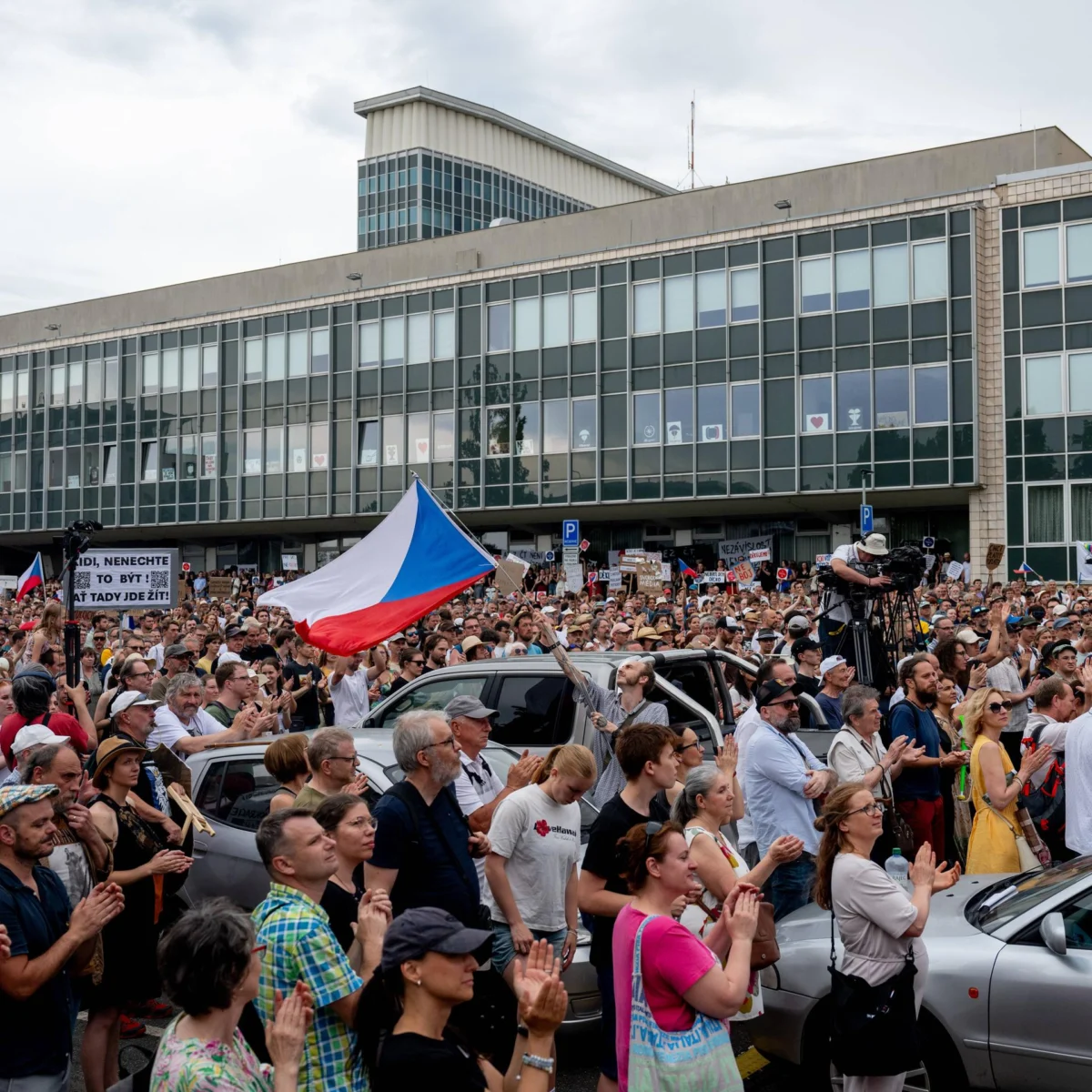
Prague, Czech Republic – June 22, 2026 – Thousands of Czech citizens converged on the streets of Prague today, staging a powerful demonstration against the government’s controversial proposal to abolish public broadcasting fees. The planned reform, spearheaded by Prime Minister Andrej Babis, seeks to transition the funding of public service media – including Czech Television (ČT) and Czech Radio (ČRo) – directly to the state budget, a move critics warn could irrevocably compromise their editorial independence and press freedom.
The widespread protest, held in front of the main offices of the nation’s leading broadcasters, saw participants waving Czech flags and holding banners decrying what they perceive as a direct assault on democratic principles. Speakers at the rally cautioned against the erosion of an impartial and independent news landscape, arguing that direct state financing, coupled with an anticipated 15% budget cut, would effectively transform public media into a government mouthpiece. The outcry intensified further with the announcement of a warning strike by employees of public radio and television stations scheduled for tomorrow, underscoring the gravity of the situation and the deep concern within the media sector.
This unfolding crisis highlights a critical juncture for media freedom in the Czech Republic, echoing broader European debates about the role and funding of public service broadcasting in an increasingly polarized political environment. The government maintains its proposal is aimed at modernizing media financing and reducing the burden on citizens, while opponents view it as a calculated political maneuver to silence critical voices ahead of upcoming electoral cycles.
A Looming Threat to Editorial Autonomy: Main Facts
The core of the dispute revolves around the proposed shift in the funding model for Czech public service media (PSM). Currently, ČT and ČRo are primarily financed through mandatory monthly fees paid by households and businesses. This system, common across many European democracies, is designed to insulate broadcasters from direct political influence, allowing them to report critically on government actions and provide diverse, unbiased content.
Prime Minister Andrej Babis and his administration advocate for the abolition of these fees, proposing instead that public broadcasters receive their funding directly from the state budget. While superficially presented as a measure to relieve the financial burden on the populace and streamline public administration, critics argue that this change would fundamentally alter the relationship between the government and the media. By making broadcasters financially dependent on the ruling party, the proposed model is seen as a potent tool for political leverage, potentially forcing editorial lines to align with government agendas or face financial penalties.
Adding to these concerns is the explicit plan to implement a 15% reduction in the overall financial resources allocated to public broadcasters. This double blow – shifting to direct state funding and simultaneously cutting budgets – is feared to cripple the operational capacity of ČT and ČRo, leading to potential job losses, diminished program quality, and a significant curtailment of investigative journalism and critical analysis. The cumulative effect, according to media watchdogs and opposition parties, would be a severe blow to the pluralism and independence of the Czech media landscape, undermining a cornerstone of democratic accountability.
The protests in Prague today represent a culmination of mounting anxieties within civil society, journalistic circles, and opposition political spectrums. The presence of thousands of citizens underscores a deep public attachment to the concept of independent media and a clear rejection of governmental attempts to exert greater control over information dissemination. The announced warning strike by public media employees further signals an internal resistance, demonstrating that the fight for media autonomy is being waged not only on the streets but also from within the institutions themselves.
Chronology of a Brewing Media Crisis
The current protests are not an isolated incident but rather the latest escalation in a series of developments concerning the future of public service media in the Czech Republic. The seeds of this crisis were sown months ago, even before today’s demonstration.
Early 2026: Initial Proposals and Justifications
The first hints of the government’s intentions emerged in late 2025 and early 2026, when Prime Minister Babis’s office began publicly discussing "modernizing" the funding of public media. Initial rhetoric centered on reducing the perceived "burden" of broadcasting fees on citizens, especially those with lower incomes, and improving the "efficiency" of public broadcasters. While details were initially vague, the idea of shifting to direct state funding quickly became central to the discourse. Government spokespersons argued that a state-funded model would be more transparent and accountable, subject to parliamentary oversight.
March-April 2026: Unveiling the Specifics and Initial Backlash
By March and April, the government’s plans began to solidify, with official drafts outlining the abolition of fees and the direct allocation of funds from the state budget. Crucially, these drafts also included provisions for a significant budget reduction, rumored initially to be around 10-15%. This specific detail ignited the first wave of strong criticism. Media experts, journalists’ unions, and opposition parties immediately condemned the proposal, drawing parallels to similar legislative changes in Hungary and Poland, where public broadcasters have seen their independence severely curtailed following shifts to state funding. Editorials across independent media outlets warned of a "slippery slope" towards state propaganda.
May 2026: Growing Opposition and Parliamentary Debates
Throughout May, the debate intensified. Public broadcasters themselves, through their general directors, issued formal statements expressing profound concern over the potential loss of independence and the devastating impact of budget cuts on their ability to fulfill their public service mandate. Parliamentary committees saw heated exchanges, with opposition MPs accusing the government of attempting to "muzzle" critical voices and undermine democratic checks and balances. Civil society organizations, including media watchdogs and human rights groups, began to organize public awareness campaigns, highlighting the importance of independent media for a healthy democracy.
Early June 2026: Call for Protests and Warning Strike
As the government signaled its intent to push the legislation forward, a coalition of media professionals, civil society groups, and opposition figures called for a major demonstration in Prague. Simultaneously, employees of Czech Television and Czech Radio, through their unions, announced a warning strike for June 23rd, citing the existential threat posed by the proposed reforms to their professional integrity and the future of public service broadcasting. This pre-emptive strike announcement served as a powerful signal of internal dissent and a commitment to defending their autonomy.
June 22, 2026: "Defend Our Media" Protest in Prague
Today’s demonstration in Prague marked a significant escalation of public resistance. Thousands gathered outside the headquarters of Czech Television and Czech Radio, near Kavčí hory, and later marched towards Wenceslas Square, a historic site for public gatherings. The atmosphere was charged with a mixture of defiance and concern. Banners read "Hands Off Public Media," "No to Babis’s Propaganda," and "Independent Media = Free Society."
Speakers included prominent journalists, former public broadcasters, media analysts like Dr. Jan Novák, and leaders of opposition parties. They articulated clear warnings about the potential for government control, the erosion of journalistic ethics, and the chilling effect on critical reporting. Many drew historical parallels, reminding attendees of the importance of free media during periods of political transition and authoritarian rule in Czech history. The sheer number of participants underscored a widespread public understanding of the critical role independent media plays in a functioning democracy. The protest served as a clear message to the government that its plans would not go unopposed.
Supporting Data: The Pillars of Public Service Broadcasting
The proposed overhaul of public media funding in the Czech Republic must be viewed within the broader context of the critical role public service media (PSM) plays in democratic societies and against the backdrop of international experiences.
The Rationale for Public Service Media:
Across Europe, PSM is widely recognized as a cornerstone of democratic infrastructure. Its mandate typically includes:
- Impartiality and Objectivity: Providing balanced, fact-based news and analysis, free from commercial or political bias.
- Diversity of Content: Offering a wide range of programs – cultural, educational, scientific, entertainment – that cater to all segments of society, including minorities and underserved communities.
- Critical Scrutiny: Holding power to account, conducting investigative journalism, and fostering public debate on important issues.
- Counter-Disinformation: Acting as a trusted source of information in an era of ‘fake news’ and foreign interference.
- Social Cohesion: Promoting shared values and understanding within a national community.
The current fee-based funding model for ČT and ČRo, while sometimes unpopular with segments of the public, is specifically designed to uphold these principles. By collecting funds directly from the populace, it creates a buffer between the broadcasters and the state, theoretically ensuring that editorial decisions are made based on journalistic merit rather than political expediency.
Economic Impact and Operational Concerns:
Czech Television and Czech Radio currently operate with substantial budgets, reflecting their extensive programming and reach across the country. A 15% budget cut, as proposed by the government, would translate into tens of millions of euros (or Czech korunas) in lost revenue. This reduction is not merely an inconvenience; it represents a significant operational challenge. Experts warn that such cuts would inevitably lead to:
- Job Losses: Affecting journalists, producers, technical staff, and administrative personnel, thereby diminishing the capacity for quality content creation.
- Program Reductions: Leading to fewer original productions, less in-depth reporting, and potentially a decline in specialized cultural and educational programming.
- Weakened Investigative Journalism: This often resource-intensive form of journalism is particularly vulnerable to budget cuts, as it requires time, staff, and legal support. Its decline would mean less scrutiny of corruption and mismanagement.
- Technological Stagnation: Impeding necessary investments in modern broadcasting equipment and digital platforms, thereby limiting the PSM’s ability to compete in the evolving media landscape.
International Precedents and Warnings:
The shift to direct state funding for public media has been observed in other Central and Eastern European countries, often with concerning outcomes.
- Hungary: Under Prime Minister Viktor Orbán, public media has been systematically brought under government control through changes in leadership, funding mechanisms, and editorial directives. Critics argue it now functions largely as a government mouthpiece, disseminating the ruling party’s narrative.
- Poland: Similar trends have been observed in Poland, where the ruling Law and Justice (PiS) party exerted significant influence over public broadcasters, leading to accusations of politicization and a lack of impartiality.
These examples serve as stark warnings for the Czech Republic, illustrating how seemingly administrative funding changes can rapidly lead to a profound erosion of media independence. Conversely, countries like Germany (with its Rundfunkbeitrag) and the UK (BBC’s license fee) largely maintain fee-based systems, recognizing their importance for autonomy.
Public Opinion and Media Trust:
While comprehensive recent polling on the specific funding reform might be limited, existing surveys consistently show that a significant portion of the Czech public values independent media and generally trusts public broadcasters more than politically aligned private outlets. A 2024 Eurobarometer survey, for instance, indicated that Czech citizens place a relatively high level of trust in traditional media, with public broadcasters often topping the list for reliability. Any move that threatens this trust is likely to face considerable public resistance, as evidenced by today’s protests.
Official Responses: A Clash of Narratives
The proposed media reform has elicited sharply contrasting responses from the government, the opposition, and the affected public broadcasters, highlighting a deep ideological divide.
The Government’s Stance (Prime Minister Babis and Allies):
Prime Minister Andrej Babis and his government have consistently defended the reform as a necessary and progressive step. Their official narrative centers on several key points:
- Modernization and Fairness: Babis argues that the current fee-based system is outdated and unfair, particularly to lower-income households and those who do not consume public media. Abolishing the fees is presented as a measure to relieve the financial burden on citizens.
- Efficiency and Accountability: Proponents claim that direct state funding would introduce greater transparency and accountability, as public broadcasters’ budgets would be subject to parliamentary scrutiny and annual budgetary cycles, similar to other state-funded institutions.
- Denial of Political Interference: The government vehemently denies any intention to exert political control over ČT or ČRo. Spokespersons have repeatedly stated that "safeguards will be put in place" to guarantee editorial independence, though the specifics of these safeguards remain vague and unconvincing to critics. "Our goal is not to control the media, but to ensure fair and modern financing for the 21st century," a government spokesperson reiterated recently. Babis himself has dismissed the protests as "politically motivated noise," suggesting they are orchestrated by opposition parties and vested interests within the media establishment resistant to change.
The Opposition’s Outcry:
Opposition parties across the political spectrum have united in strong condemnation of the government’s proposal, viewing it as a direct threat to democratic institutions.
- Accusations of Authoritarianism: Leaders from various opposition blocs have accused Prime Minister Babis of harboring authoritarian tendencies and attempting to silence critical voices ahead of future elections. "This is a naked attempt to turn public service media into a propaganda arm of the government," stated Petr Fiala, leader of the Civic Democratic Party (ODS), at a press conference.
- Defense of Media Freedom: Opposition MPs have vowed to fight the legislation in parliament, emphasizing the constitutional importance of a free and independent press. They argue that the proposed changes undermine the very foundation of journalistic integrity and the public’s right to unbiased information.
- Support for Protesters and Broadcasters: Opposition leaders have publicly expressed solidarity with the thousands of protesters and the striking public media employees, calling for the immediate withdrawal of the proposed legislation and urging the government to engage in genuine dialogue with all stakeholders.
Public Broadcasters’ Deep Concern:
The general directors of Czech Television and Czech Radio have voiced profound concern, bordering on alarm, over the proposed reforms.
- Threat to Independence: They argue that direct state funding, particularly with a significant budget cut, would fatally compromise their editorial autonomy. "Our independence is directly linked to our funding model," stated Petr Dvořák, General Director of Czech Television, in an official statement. "Moving to state budget financing would make us beholden to the political whims of the government in power, eroding public trust."
- Impact on Public Service Mandate: Both ČT and ČRo have highlighted their commitment to fulfilling their public service mandate, which includes providing comprehensive, impartial news, cultural programming, and educational content. They explain how the current funding model enables this mission without political interference.
- Justification for Warning Strike: The announced warning strike is framed as a last resort to draw attention to the critical nature of the situation and to defend the future of independent journalism. Employees express deep apprehension about their ability to continue delivering unbiased news if their funding is politicized. "We are not striking for higher wages, but for the very soul of public service broadcasting," commented a union representative.
Implications: A Crossroads for Czech Democracy and European Values
The outcome of this contentious media reform will have far-reaching implications, not only for the Czech media landscape but also for the broader democratic health of the nation and its standing within the European Union.
For the Czech Media Landscape:
The most immediate and profound implication is the potential transformation of ČT and ČRo from independent public service institutions into entities highly susceptible to government influence.
- Erosion of Trust: A shift towards state-controlled funding, coupled with budget cuts, would almost certainly lead to a decline in public trust in these broadcasters. If citizens perceive public media as biased or subservient to the ruling party, they will seek information elsewhere, potentially exacerbating the spread of disinformation from less credible sources.
- Decline in Critical Reporting: The chilling effect of financial dependence would likely stifle investigative journalism and critical reporting on government policies, corruption, and societal issues. This would diminish the media’s role as a vital watchdog, allowing power to operate with less scrutiny.
- Reduced Pluralism: With weakened public broadcasters, the overall media landscape would become less diverse. Private media outlets, often driven by commercial interests or political affiliations, may not adequately fill the void left by a compromised public service.
- Brain Drain: Talented journalists and media professionals, unwilling to compromise their integrity, might leave public broadcasters, leading to a significant loss of expertise and institutional memory.
For Czech Democracy:
The health of a nation’s democracy is intrinsically linked to the vibrancy and independence of its media.
- Weakened Checks and Balances: Independent media serves as a crucial check on government power. By undermining this check, the proposed reform risks concentrating more power in the executive branch, eroding the system of checks and balances essential for a robust democracy.
- Increased Polarization and Disinformation: A media environment lacking strong, impartial public broadcasters can become more polarized, with different outlets catering to specific political echo chambers. This can make it harder for citizens to form informed opinions and make rational decisions, potentially impacting electoral processes and social cohesion.
- Precedent for Future Reforms: Should this reform pass, it could set a dangerous precedent for future legislative actions that further curtail fundamental freedoms and democratic institutions in the Czech Republic.
For the European Union:
The Czech Republic’s actions will also resonate within the European Union, which increasingly emphasizes the protection of media freedom and pluralism as core values.
- Rule of Law Concerns: The EU has already expressed concerns about the erosion of media freedom in member states like Hungary and Poland. The Czech government’s move could draw similar scrutiny from Brussels, potentially leading to rule of law procedures or diplomatic pressure.
- Solidarity with Independent Media: The situation highlights a broader struggle across the continent to safeguard independent journalism against political interference and economic pressures. EU institutions and civil society groups may rally in support of Czech media professionals.
- Impact on EU Media Legislation: The ongoing debates and legislative efforts at the EU level, such as the European Media Freedom Act, aim to protect media independence. The Czech case could either underscore the urgent need for such regulations or test their effectiveness if they are already in force.
Long-Term Outlook:
The future of public service media in the Czech Republic hangs in the balance. The government’s determination to push through the reform clashes directly with a determined and growing public resistance. Further protests, parliamentary battles, and potential legal challenges are expected. The warning strike by broadcasters’ employees signifies a deep-seated commitment to fighting for their independence. The coming months will reveal whether the Czech Republic chooses a path that strengthens its democratic institutions through a free and robust media, or one that aligns it with countries where media freedom has been significantly compromised. The eyes of both the nation and the European Union will remain fixed on Prague as this critical debate unfolds.