

Introduction: A Historic Return to the German Capital
The world of long-distance running is bracing for another potential masterclass in human endurance. Sabastian Sawe, the Kenyan phenomenon who shattered the psychological and physical barrier of the two-hour marathon in London earlier this year, has officially confirmed his return to the BMW Berlin Marathon. On September 27, Sawe will step onto the asphalt of the German capital with a singular goal: to defend the title he captured under grueling conditions last year.
Sawe’s announcement, confirmed via RTL and n-tv, marks a significant moment for the Berlin Marathon. As the running world continues to process the seismic shift in marathon performance standards, the presence of the man who redefined what is possible—the first human to officially clock a sub-two-hour marathon in a competitive setting—elevates the Berlin event to a level of anticipation rarely seen in the history of road racing.
The Chronology of a Legend: From Berlin to London and Back
To understand the gravity of Sawe’s return, one must look at the trajectory of his recent performances.
The 2023 Berlin Triumph
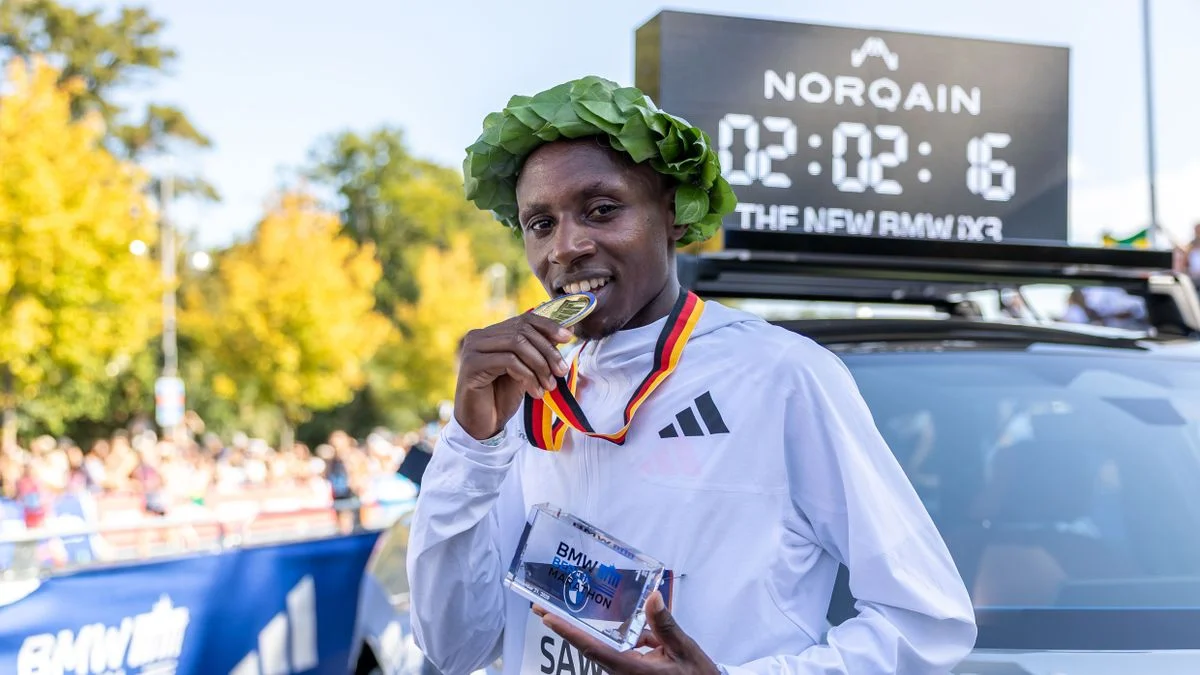
In September 2023, Sawe stood atop the podium in Berlin after a race that tested his resilience more than his speed. Clocking a time of 2:02:16, he navigated the course through 25-degree Celsius heat and stifling humidity. While the time was world-class, the conditions prevented him from chasing the absolute limits of his potential. Nonetheless, the victory cemented his status as the man to beat on the world stage.
The London Miracle: Breaking the Two-Hour Barrier
Everything changed in late April. In the streets of London, Sawe achieved the impossible. He crossed the finish line in 1:59:30, officially becoming the first human to break the two-hour barrier in a competitive 42.195-kilometer race. The race was a tactical and physical masterpiece, underscored by the fact that the runner-up, Ethiopia’s Yomif Kejelcha, also dipped under the historic mark with a time of 1:59:41.
This performance did more than just shave seconds off a record; it erased the "impossible" label that had followed the distance for decades. Now, as Sawe prepares to return to Berlin, the running community is left to wonder: if he could break two hours in London, what can he do on the famously flat and fast course of Berlin?
Supporting Data: Why Berlin Remains the Home of Records
The Berlin Marathon is not merely a race; it is a laboratory for speed. With a total elevation gain of just 70 meters, it is widely considered the fastest marathon course in the world.
The Statistical Edge
The historical data speaks for itself. Since its inception, the Berlin Marathon has been the site of 13 world records—a tally unmatched by any other marathon globally. While London is an exceptional race, its topography—featuring approximately 130 meters of elevation change and periodic undulations—makes the sub-two-hour performance there even more shocking to sports scientists and analysts.
For years, the "Fastest Marathon" title was a game of musical chairs between Berlin, Chicago, and London. However, Berlin’s consistency, combined with its wide, sweeping turns and iconic finish through the Brandenburg Gate, provides a rhythmic flow that suits Sawe’s stride perfectly. Athletes often describe Berlin as a course where the rhythm is never broken, allowing them to settle into a "cruising speed" that is difficult to maintain on more technical courses.
Official Responses and the Athlete’s Mindset
Despite his historic achievement, Sawe remains remarkably grounded. When asked about his expectations for September, he avoided the trap of hyperbole.
"Many people are asking what my goals are this time," Sawe remarked. "After my victory in London and my sub-two-hour performance, I can only say that I will prepare—as always—as well as possible. I want to run as fast as I can. What is possible, we will see on race day."
This quiet confidence is a hallmark of Sawe’s approach. He treats every race as a fresh start, refusing to be defined by the metrics of his previous successes.
The Director’s Perspective
Mark Milde, the race director of the Berlin Marathon, views Sawe’s return as a validation of the event’s prestige. "Having a world-record holder of this caliber return to defend his title is a great honor for our traditional event," Milde stated. "It underscores the quality of our course and the trust top-tier athletes place in Berlin to deliver their best performances."
Implications: The Geopolitics of Elite Racing
The commitment of Sabastian Sawe to Berlin carries significant weight beyond the stopwatch. In the world of elite road racing, competition for the world’s best athletes is fierce. Races like the Chicago Marathon, backed by substantial budgets and corporate sponsorships, are constantly vying for the top talent.
A Statement of Intent
By choosing to return to Berlin, Sawe has effectively sent a signal to other organizers. He is prioritizing the course that offers him the best opportunity to push his physical limits over the highest-paying contract. This is a massive win for Berlin, which has long prided itself on being the "Mecca of Marathoning." It reinforces the idea that, in the minds of the world’s greatest athletes, history and course profile still outweigh pure financial incentives.
The Scientific Interest
Sawe’s performance has also sparked a massive interest in the sports science community. Researchers are currently analyzing the biomechanics of his "London performance." Experts, including sports scientist Billy Sperlich, have noted that Sawe’s efficiency in oxygen uptake and his ability to maintain a consistent cadence under extreme fatigue are the variables that have allowed him to bridge the gap between 2:01 and 1:59.
The lessons from these "wunder-runs" are not just for elite athletes. Coaches and amateurs alike are scrutinizing the training loads, recovery protocols, and nutritional strategies that underpinned Sawe’s success. The interest in these methods is at an all-time high, with the running community eager to translate the "secrets" of the sub-two-hour marathon into actionable advice for the broader population.
Conclusion: The Horizon
As the date for the Berlin Marathon approaches, the narrative is clear: we are living in the golden age of marathon running. With Sabastian Sawe at the forefront, the race in Berlin is no longer just about winning; it is about the evolution of human capability.
Will the cooler, autumnal air of late September in Berlin provide the perfect conditions for Sawe to lower his own record? Or will the pressure of defending a title in the wake of such global scrutiny prove to be a different kind of challenge?
Whatever the outcome on September 27, the world will be watching. The barrier has been broken, the mystery has been solved, and now, the chase for the ultimate limit continues. For Sabastian Sawe, the road to Berlin is paved with the potential for history to repeat itself—or perhaps, to be rewritten once more.










Leave a Reply